If you have postponed a crown because of the cost, the difference between two major cities might surprise you. Dental crowns in Istanbul vs New York rarely cost anywhere near the same, and that difference shapes real decisions for patients who travel. In New York, a single crown can cost thousands before insurance, driven by rent, lab fees, and specialist rates. In Istanbul, the same procedure often costs a fraction of that, sometimes less than a month’s rent in Manhattan. But price alone doesn’t tell the full story. Materials, lab quality, chair time, and follow-up care all affect the final cost. We explain what drives these costs, where the savings come from, and what to watch for before booking a flight or local appointment.
What a Dental Crown Costs in Istanbul and New York
When you start comparing what a crown actually costs in each city, the gap is dramatic enough to shape your entire decision. In Istanbul, a standard metal-ceramic crown typically runs between $100 and $250 per tooth at a reputable private clinic. A higher-grade zirconia crown, which offers better aesthetics and strength, usually falls in the $150 to $350 range. Even premium brands and full-porcelain options rarely push past $400 at most established practices.
New York tells a very different story. The same metal-ceramic crown averages $1,200 to $1,800, while zirconia and all-ceramic restorations commonly land between $1,500 and $2,500. In Manhattan, fees at top-tier practices can climb past $3,000 per unit before any lab upgrades. That means a single crown in New York can cost more than a full set of ten in Istanbul.
Insurance changes the picture, but not as much as people hope. Many US dental plans cover only 50% of crown costs after a deductible, and annual maximums of $1,500 to $2,000 mean a single molar crown can exhaust your entire yearly benefit. Turkish clinics operate almost entirely on out-of-pocket payment, which is precisely why their listed prices stay low and transparent.
The raw numbers matter, but they only tell part of the story. What you pay reflects local labor, rent, regulatory overhead, and material sourcing, not necessarily a difference in clinical skill. Understanding that distinction is what separates a smart comparison from a misleading one.
Why Crown Prices Differ Between These Two Cities
Two crowns can look identical in a photograph and still carry price tags that differ by several hundred dollars, and the reasons rarely come down to one factor. Istanbul and New York sit in completely different economic environments, and every cost layer — labor, real estate, regulation, and currency — pushes the final number in a different direction.
The single biggest driver is labor cost structure. A dentist in Manhattan carries overhead that includes some of the highest commercial rents in the world, plus insurance, staffing, and licensing costs that a clinic in Istanbul simply does not face at the same scale. Local wage levels for dental assistants, technicians, and front-desk staff diverge just as sharply, and those salaries are baked into every appointment.
Beyond wages, several structural forces shape what a patient actually pays:
- Operating expenses: Rent per square meter in central New York can run many times higher than in comparable Istanbul districts, and that gap flows directly into treatment pricing.
- Currency and purchasing power: The Turkish lira’s exchange rate against the dollar makes Istanbul services cheaper for foreign patients even when local costs are proportionally similar.
- Insurance and payment models: U.S. practices negotiate with insurers and manage billing systems that add administrative cost; many Istanbul clinics operate on direct payment, which trims that layer.
- Competition density: Istanbul has a dense cluster of dental clinics competing partly on price, while New York practices compete more on convenience, reputation, and location.
- Regulatory and tax burden: Differing licensing requirements, equipment import duties, and tax structures change what a clinic must recover per procedure.
None of these factors works alone. A New York crown is expensive because rent, wages, insurance administration, and regulatory compliance stack on top of each other, while an Istanbul crown benefits from lower baseline costs and a weaker currency. Understanding this layering matters, because it explains why the gap persists even when the materials and techniques used are broadly comparable.
Material Choices and Their Impact on Total Price
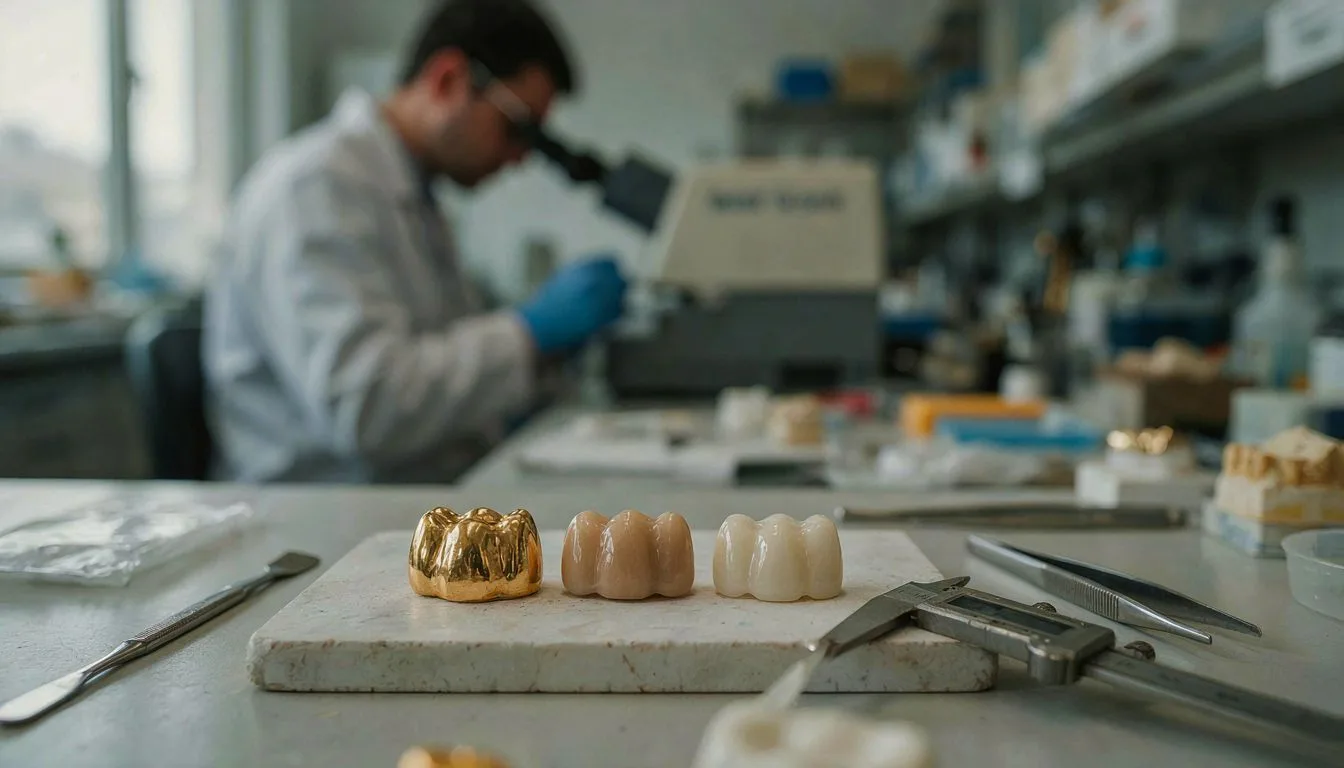
What sits on your tooth is only part of what you pay for. The material spec you choose — and the lab that fabricates it — often moves the final bill more than the chair time itself. In both cities, the same three tiers dominate: full metal, metal-ceramic (porcelain fused to metal), and all-ceramic or zirconia. Metal remains the cheapest option, typically landing at the bottom of the local range. Metal-ceramic sits in the middle and is still the workhorse in New York practices. All-ceramic and zirconia push toward the top, sometimes doubling the entry price of a metal crown.
Here is where the two markets diverge. In Istanbul, the material gap between a base metal crown and a zirconia crown is usually modest — often a few tens of dollars — because laboratory fabrication costs are already low across the board. In New York, that same jump can add several hundred dollars, since the lab fee, the technician’s time, and the material itself are all priced in a higher-cost environment. A crown that costs $250 in Istanbul might rise to $350 for zirconia, while a $1,200 New York crown can climb past $1,800 for the same upgrade.
Material choice also shapes the total price indirectly. Zirconia and high-grade ceramics demand more precise digital scanning, milling, and finishing, which some clinics bundle into the quoted fee and others bill separately. Metal crowns are faster to produce and rarely trigger extra charges. If your priority is durability on a back molar, metal or metal-ceramic keeps the total predictable. If you need a front tooth to match surrounding enamel, expect the premium — and ask whether the quote already includes it.
Laboratory Fees and Turnaround Time Compared

The price a clinic quotes you covers more than the dentist’s chair time. A meaningful slice of every crown invoice is the laboratory fee — the charge for a technician to actually build the restoration — and that line item behaves very differently on each side of the Atlantic.
In New York, most practices work with domestic labs that bill roughly $150 to $400 per unit for a standard porcelain-fused-to-metal or zirconia crown, with premium aesthetic work climbing higher. Istanbul clinics typically partner with high-volume local labs where the same category of crown might cost the practice the equivalent of $30 to $80. That gap is not a trick; it reflects technician wages, overhead, and the sheer scale of Turkey’s dental laboratory sector, which serves a large domestic market plus a steady stream of international patients.
Turnaround time tells a similar story. A New York patient can usually expect a crown in two to three weeks across two or three visits, though rush cases occasionally compress that to a few days at extra cost. Istanbul clinics, especially those built around medical tourism, routinely deliver a finished crown in three to five days, often within a single trip. Some use in-house milling machines to shave that down further.
The practical takeaway is that Istanbul compresses both the laboratory bill and the calendar, while New York spreads the cost across a longer timeline. Neither approach is automatically better — chair time, shipping, and revision policies all factor into what you ultimately pay.
Hidden and Additional Costs Patients Often Overlook
The price a clinic advertises rarely matches the amount you eventually pay, and this gap is one of the most common sources of frustration for patients traveling abroad for treatment. In Istanbul, many quotes are built around a package model, which sounds reassuring until you learn that certain steps are billed separately. Understanding which items tend to appear later on the invoice helps you compare offers honestly and avoid unpleasant surprises at the chair.
Before committing to any provider, ask for a written breakdown that separates the crown itself from every service wrapped around it. The categories below cover the charges patients most frequently discover only after treatment has begun.
- Diagnostic and imaging fees: X-rays, panoramic scans, or 3D imaging may be quoted as a separate line rather than included in the crown price, especially when a clinic needs detailed planning before preparation.
- Root canal therapy or core build-ups: A crown cannot simply sit on a compromised tooth. If decay or prior damage requires endodontic work or a post and core, that cost adds to the total and is rarely part of the original estimate.
- Temporary crowns: Some clinics include a provisional restoration, while others charge for it. In New York, temporary crowns are usually bundled, but in Istanbul they may appear as an add-on.
- Impressions, try-ins, and adjustments: Additional visits for fitting, bite correction, or re-cementation can carry per-visit fees, particularly if travel schedules force rushed appointments.
- Follow-up and repair costs: Once you return home, a local dentist handling a loose crown or a fracture will bill you at domestic rates, which can erase much of the initial saving.
The pattern is clear: the headline number covers the crown, not the journey to it. Patients who compare only the advertised figure miss the fact that out-of-pocket total cost includes diagnostics, preparatory work, and any post-treatment care. Requesting an itemized quote in writing, and confirming what happens if complications arise after you fly home, turns a vague estimate into a reliable budget figure.
Quality Standards and Longevity of Crowns in Both Markets
A crown’s price tag tells you nothing about how long it will actually last, and that gap between cost and durability is where the two markets diverge most. Both Istanbul and New York clinics operate under real quality frameworks, but the standards they answer to, the materials they favor at each price tier, and the follow-up culture around a finished crown differ in ways that affect your ten-year outcome.
In the United States, crowns are typically fabricated in certified dental laboratories that follow ANSI/ADA and ISO 6872 standards for ceramic materials, with documented shade matching, margin fit tolerances, and traceability for every unit. New York clinics also face state dental board oversight, mandatory continuing education, and malpractice exposure that pushes them toward conservative, well-documented treatment planning. The result is a crown with a well-documented material pedigree and a paper trail you can request.
Istanbul’s better clinics often match that technical standard, particularly those serving international patients who expect European-grade materials. Many work with ISO-certified labs, use the same branded zirconia and lithium disilicate blanks sold globally, and employ CAD/CAM workflows identical to those in New York. The difference is variance: Turkey’s regulatory environment is lighter, so quality depends far more on the specific clinic than on the system around it. A well-chosen Istanbul practice can deliver a crown indistinguishable from a New York one; a poorly chosen one can deliver a crown that fails within a few years.
Longevity data supports a nuanced view. Properly made zirconia and e.max crowns routinely last 10 to 15 years in both markets when the underlying tooth is healthy and the bite is managed. Failures usually trace back to preparation quality, cementation technique, and occlusion — not to where the crown was made. That means the deciding factor is rarely geography; it is the individual dentist’s skill and the lab they trust.
What you should ask for in either city: material brand and batch, lab certification, warranty terms, and a clear policy on remakes. A clinic confident in its work will answer without hesitation.
How to Decide Which City Fits Your Budget and Needs
Start with what the treatment actually requires, not with the sticker price. A single crown and a full-mouth reconstruction belong in completely different budget conversations, and the city that wins on one may lose on the other. Map your case first: how many units, which materials your dentist recommends, whether you need root canal therapy or core build-ups underneath, and how many visits you can realistically attend.
Then run the same case through both markets. Ask each clinic for a written, itemized estimate that includes diagnostics, impressions, the laboratory fee, temporary crowns, and follow-up adjustments. Compare the out-of-pocket totals rather than the headline numbers, because a low quote that excludes imaging or a temporary can end up costing more than a transparent higher one.
Factor in everything beyond the chair. Travel, accommodation, time away from work, and the cost of a return trip if a crown needs repair all belong on the ledger. For a single crown, those extras can erase the savings; for multiple crowns, they often shrink relative to the total. This is where the total cost of ownership matters more than any single price.
Weigh quality signals honestly. Both cities have skilled clinicians and certified dental laboratories, so the deciding question is not “which is better” but “which fits my case.” Ask about material brands, warranty terms, and who handles a repair if you are back home when something goes wrong.
Finally, match the decision to your constraints. If budget is tight and your schedule is flexible, Istanbul’s lower labor and operating costs usually translate into real savings. If you need quick turnaround, complex specialist work, or easy follow-up access, New York’s higher prices may buy convenience you actually value.
Write down your numbers, rank what matters most, and let the math and your priorities pick the city — not the marketing.
FAQs
How much do dental crowns typically cost in Istanbul compared to New York?
Dental crowns in Istanbul typically cost between $150 and $400 per tooth at private clinics, while the same procedure in New York often ranges from $1,200 to $2,500 or more before insurance. The gap reflects lower labor, overhead, and regulatory costs in Turkey rather than a difference in the crown materials themselves, since both cities offer comparable zirconia, porcelain, and metal options. Patients should factor in travel and accommodation, but even with those added, Istanbul treatment frequently remains less expensive overall.
Does insurance coverage affect the price difference for dental crowns between Istanbul and New York?
Insurance coverage does not change the underlying price difference for dental crowns between Istanbul and New York, since that gap reflects local labor, overhead, and market rates rather than reimbursement. What insurance affects is how much of each price the patient ultimately pays out of pocket. Most US dental plans cover a portion of crowns up to an annual maximum, while Istanbul clinics typically operate on a cash-pay basis, so coverage mainly shifts the patient's share rather than the list-price gap itself.
Are there quality or material differences reflected in dental crown prices in Istanbul versus New York?
Yes, dental crown prices in Istanbul and New York often reflect different material choices and quality tiers. Istanbul clinics commonly offer the same core materials, such as zirconia, e.max, and porcelain-fused-to-metal, at lower prices due to lower labor and overhead costs, though the range of quality varies more widely across providers. New York prices are higher largely because of licensing, rent, and laboratory fees, and they tend to cluster around premium materials and higher-end labs. The main practical difference is not that one city uses fundamentally better materials, but that Istanbul has a broader spread from budget to premium options, while New York is more consistently priced at the higher end.