Search for a dental crowns clinic in Turkey and you will find hundreds of results, most calling themselves the best. Very few make it easy to check that claim. Patients get stuck between confident marketing and verifiable facts, and this guide addresses that gap.
We will not tell you which clinic to pick. Instead, you will get a set of practical checks you can run yourself before you book anything, from the paperwork a clinic should hand over without hesitation to the questions that reveal how often they actually place crowns. The criteria follow a logical order: credentials first, then clinical routine, materials, hygiene, communication, pricing, and finally what happens after you fly home. By the end, you should be able to read a clinic’s offer the way an informed patient does, not the way a brochure wants you to.
Why Accreditation and Certification Matter for Turkish Dental Clinics
Accreditation in Turkish dental tourism works on three separate levels, and confusing them is where most patients lose their footing. A clinic itself may hold a health tourism authorization issued through the Ministry of Health, which is the baseline document that lets it legally treat international patients. Individual dentists carry their own credentials — a diploma recognized by the Turkish Dental Association, plus specialty certificates that should name the institution and the dates. Separately, the dental laboratory that actually fabricates your crown may hold its own certification, such as ISO 13485 or a CE marking on the materials it uses.
Each of these can be checked, but only if you know where to look. Ministry of Health authorizations can be verified through the official health tourism portal, where a clinic’s registration status is searchable. Dentist diplomas and specialty titles can be confirmed through the Turkish Dental Association’s registry. A valid certificate should carry an issuing body’s name, a registration or license number, an issue date, and an expiry date — a document missing any of these is decorative, not evidential.
Verifiable documentation is the only kind that should influence your decision. Treat unverifiable logos, expired certificates, and vague phrases like “internationally certified” as claims that still need proof, not as proof itself.
How to Verify a Clinic’s Experience with Dental Crowns
Accreditation tells you a clinic meets a baseline standard. It does not tell you whether crowns are central to their daily work. A clinic can be fully certified and still treat crowns as a sideline. So the next question is narrower and more practical: is crown work genuinely routine here, or something they handle occasionally between other procedures?
The fastest way to find out is to ask directly about case volume. How many crowns does the clinic place in a typical month? What proportion of their patients come specifically for crowns rather than implants, veneers, or general dentistry? A clinic that does crowns regularly will answer without hesitation and give you concrete numbers. Vague answers like “many” or “hundreds every year” are a signal to dig deeper.
Ask which indications they see most often. A clinic that mostly handles single molar crowns may be less prepared for a full-mouth reconstruction or a front-tooth case where shade matching matters. Then ask how complications are handled: what happens if a crown does not seat properly, or if the patient reports discomfort after returning home?
Before-and-after galleries deserve scrutiny. Do the cases shown match your own situation in tooth position, bite, and material? Are the photos consistent in lighting and angle, or do they look retouched? A gallery full of flawless smiles tells you less than a set of ordinary cases handled well. Finally, confirm who actually performs the work. Will the treating dentist handle your crown from preparation to cementation, or does a rotating team take over? Continuity of care matters, and you should know the answer before you commit.
Evaluating the Quality of Materials and Crown Types Offered
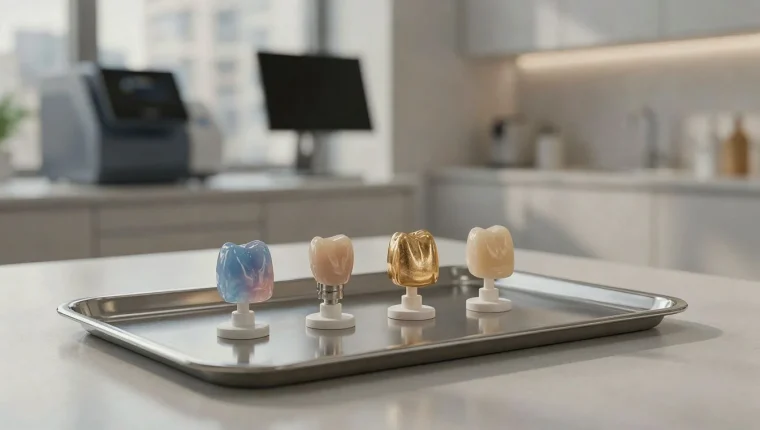
Material choice shapes how a crown fits, how long it lasts, and what it ultimately costs you. The main options fall into a few familiar categories. Full zirconia crowns offer high strength and are often chosen for back teeth where biting forces are heaviest. Layered zirconia or porcelain-fused-to-zirconia blends aesthetics with durability, making them common for visible front teeth. Porcelain-fused-to-metal remains a workhorse for many cases, while e.max lithium disilicate suits patients who want strong, natural-looking results in the smile zone. Each has trade-offs in wear, translucency, and preparation needs, so the right pick depends on the tooth, your bite, and your goals.
What many patients overlook is that the dental lab matters as much as the material brand. A clinic using premium zirconia blocks but an inconsistent lab can still deliver poorly fitting crowns. Ask which lab produces the restorations and whether it is in-house or outsourced. In-house labs give tighter quality control and faster turnaround; external labs can be excellent too, but you should know the name and reputation.
Then press on sourcing and traceability. Reputable clinics can tell you the manufacturer and batch of the material and provide a warranty card or certificate. Ask about expected lifespan under normal use, and how that changes with grinding or poor hygiene. These answers reveal whether a clinic treats materials as a genuine clinical decision or just a price point. How material choice feeds into your total quote belongs to the pricing discussion later.
What to Look for in Sterilization and Patient Safety Protocols

Sterilization is where a clinic’s real standards become visible, because hygiene is a practice you can partly observe rather than a promise you simply accept. For crown work, the critical chain runs from the handpiece and burs used to prepare the tooth, through impression trays and try-in crowns, to the final cementation appointment. Ask how instruments are processed between patients: cleaning, sealing in pouches, and autoclave sterilization with cycle logs that record date, temperature, and pressure. A clinic that tracks each instrument set to a specific patient is demonstrating accountability, not just routine.
Single-use items matter too. Needles, gloves, suction tips, and mixing tips should be opened in front of you. For reusable items, ask whether the clinic uses indicator strips or chemical indicators inside each pouch, since these confirm the sterilization cycle actually reached the required conditions. Waste handling is another quiet signal: sharps containers should be sealed and replaced when full, and clinical waste should never share a path with general rubbish.
If you are reviewing safety before you travel, raise your questions plainly rather than as an accusation. A simple “Can you walk me through how instruments are sterilized between patients?” is enough. Clinics confident in their protocols answer with specifics and often offer to show you the sterilization room during your visit. Vague answers or deflection are themselves useful information.
Assessing Communication, Language Support, and Online Consultations

Communication is where a clinic’s competence becomes visible before you ever sit in the chair. Start with the first reply to your inquiry: who wrote it, how quickly it arrived, and whether it answered your actual clinical questions. A fast response from a sales agent that dodges specifics about your case tells you less than a slower reply from someone who references your X-rays and crown history. Ask directly whether a dentist or treatment coordinator reviews your file, and notice if follow-up emails get forwarded to someone new each time.
Once you arrive, language support should extend well beyond the front desk. Confirm that an interpreter will be present during the consultation, the crown preparation itself, and the fit check — not just for the initial greeting. If your dentist explains shade selection or bite adjustments only through a third party who paraphrases loosely, consent becomes guesswork. Ask how they handle consent forms and post-operative instructions in your language.
A useful online consultation covers your dental history, imaging review, a proposed crown type, a realistic timeline, and a written quote. What it cannot replace is the in-person exam that confirms whether your tooth needs a core build-up or a post, or whether your gum health supports the planned restoration. Treat video calls as a screening step, not a diagnosis.
Comparing Pricing, Packages, and Hidden Costs
A crown quote in Turkey can look dramatically cheaper than a quote at home, and sometimes it genuinely is. The trouble starts when two quotes are compared by the headline number alone. One clinic advertises a per-crown price; another advertises a package. These are not the same product, and the gap between them often hides the real total.
A typical package usually bundles the crown itself, the consultation, local anesthesia, and sometimes a panoramic X-ray. What sits outside the package is where budgets quietly expand: CBCT scans, temporary crowns worn between appointments, impressions or digital scans, extractions of teeth that cannot support a crown, root canal treatment if a nerve is compromised, and the temporary cementation visit before final fitting. None of these are scams — they are simply not always included.
Ask every clinic the same short list of questions before you compare: Is the scan included? Is a temporary crown provided, and at what cost? What happens if a crown needs adjustment after I return home? Are airport transfers and hotel nights part of the quote, or billed separately? Are there charges for additional visits if healing takes longer than expected?
Then rebuild both quotes on identical terms — same crown material, same number of units, same inclusions — and compare the totals. The cheaper headline usually stops being cheaper once the missing lines are added back in.
Checking Aftercare, Warranty, and Revision Policies
Aftercare is the part of treatment you cannot see while standing in the clinic, which is exactly why it separates clinics that stand behind their work from those that disappear once you board your flight. A written warranty should state what it covers, for how long, and under which conditions. Most crown warranties run between one and five years and typically cover defects in materials or workmanship rather than damage from accidents, poor oral hygiene, or untreated grinding. Ask whether the warranty is issued by the clinic or the laboratory, and get it in writing before treatment begins.
Revision policies matter just as much as the warranty itself. Find out how you request a revision, who covers the cost, and what happens if you are already back home. Some clinics offer free corrections within a set period, while others charge for materials only. A revision policy that clearly explains the process for patients abroad gives you real confidence that problems will be handled, not abandoned.
Before you leave, collect your treatment records, crown specifications, and material certificates. Ask the clinic to coordinate with your local dentist if a follow-up is needed, and confirm which communication channel you will use for post-return questions. Clear records and a named contact make any future issue far easier to resolve.
FAQs
How can I verify that a clinic advertising itself as the best dental crowns clinic Turkey actually has the credentials and patient outcomes to support that claim?
Check the clinic's credentials through Turkey's Ministry of Health database and international accreditations such as JCI or ISO, and confirm that treating dentists hold valid specialty certifications in prosthodontics or restorative dentistry. Request before-and-after case photos with treatment dates, patient testimonials, and outcome data such as crown longevity and revision rates, ideally verified through independent review platforms. Cross-reference the clinic's claimed results against Google Reviews, Trustpilot, or RealSelf, and ask directly for references from past international patients.
What should I ask about the specific type of crown material and the lab a clinic uses before committing to treatment?
Ask which specific crown material the clinic recommends for your tooth and why, including whether it is porcelain-fused-to-metal, full zirconia, lithium disilicate, or another option, since each has different strength, esthetics, and wear characteristics. Request the name and location of the dental lab that will fabricate the crown, and ask whether the lab is certified, how often the clinic works with it, and what turnaround and remakes look like. You should also ask about the crown's warranty, who covers lab fees if the fit or shade is wrong, and whether the dentist or a technician handles shade matching.
How do I compare the total cost of dental crowns in Turkey, including follow-up care and potential revision work, across different clinics?
Request written quotes that itemize the crown material, lab fees, consultation, X-rays, temporary crowns, and any sedation, then ask each clinic in writing how it handles follow-up visits, recementation, and warranty periods for revisions. Compare the total package cost rather than the headline crown price, and confirm whether aftercare, repair, or replacement is included free within a set period or billed separately. Also factor in travel, accommodation, and the cost of returning for any corrective work, since a cheap initial quote can become more expensive once revision trips are added.