If you’re an American considering dental crowns in Turkey, the real question isn’t whether the price is lower online. It’s whether the savings justify the trip after you factor in clinical quality, travel logistics, and what happens if something goes wrong after you fly home. That balance—cost, quality, logistics, and aftercare—is what “worth it” means here, and it’s rarely as simple as a price tag suggests.
This guide is written for U.S. residents considering crowns abroad. It is not a substitute for an exam by your own dentist. Instead, it walks through what drives the cost gap, how to judge a clinic, what materials matter, how the trip is typically planned, and where the genuine risks sit—so you can reach your own conclusion.
Why U.S. Dental Costs Push Patients to Look Abroad
Dental work in the United States is priced less like a simple service and more like a specialized medical procedure, and that distinction shapes everything a patient pays. A single crown involves a dentist’s chair time, a lab fee, imaging, and often a temporary restoration before the final one is seated. Each of those steps carries its own cost, and none of them are cheap.
Where you live matters enormously. A crown in a rural practice may cost far less than the same crown in a major metropolitan area, where overhead for rent, staffing, and compliance runs higher. The type of provider also shifts the bill: a general dentist, a prosthodontist, and a specialist each set different fees. Dental insurance rarely covers the full amount. Most plans pay a percentage and cap total annual benefits, often at a figure that one or two crowns can exhaust.
For patients without coverage, or those who have already hit their yearly maximum, the entire cost lands on them. Add indirect burdens — waiting weeks for an appointment, taking unpaid time off work, or needing a more complex restoration than expected — and the real price climbs beyond the quoted number.
How Dental Crown Pricing in Turkey Compares With American Clinics

Understanding how a crown price is built in Turkey versus the U.S. matters more than the headline number itself. American quotes usually bundle the dentist’s fee, lab fee, and chair time into one figure driven by local overhead and insurance contracts. Turkish clinics often publish a single “per crown” rate, then adjust it based on tooth position, material, and case complexity. That is why one patient sees €150 and another sees €400 for what sounds like the same tooth.
What a Turkish quote includes also varies. Many clinics fold in the exam, X-rays, temporary crown, lab work, and follow-up visits during your stay. Others list these separately. The all-inclusive quote is the one to request in writing, because it is the only version you can compare fairly.
Costs Americans often forget to add: flights, lodging, meals, local transport, and translators. Revision work after you fly home is another item clinics rarely price upfront.
| Cost Component | Typical U.S. Clinic | Typical Turkey Clinic |
|---|---|---|
| Exam and X-rays | Billed separately | Often included |
| Crown fabrication | Charged per unit | Charged per unit |
| Temporary crown | Usually included | Usually included |
| Lab work | Bundled into fee | Sometimes separate |
| Follow-up visits | Billed per visit | Often included |
| Flights and lodging | Not applicable | Patient pays |
| Revision work | Billed per visit | Varies by clinic |
Advertised prices shift with currency fluctuations and clinic policy, so confirm the current figure and inclusions directly before booking. A quote that looks cheap on a website can grow once travel and exclusions are added.
What Americans Should Know About Turkish Dental Clinics and Credentials
Credentials are the part of the decision that marketing photos and discounted quotes cannot answer for you. In Turkey, dentists must be registered with the Ministry of Health, and many hold specialty training recognized by the Turkish Dental Association, but “dentist” alone is not a protected specialty title in the way Americans might assume. A general practitioner can legally place crowns; a prosthodontist has three or more years of additional training specifically in crown and bridge work. Ask which one is treating you, and ask for the dentist’s diploma number and association membership in writing.
Clinic-level signals matter just as much. Look for documented sterilization protocols, ISO or JCI-style accreditation where it exists, and consistent review patterns across multiple independent platforms rather than testimonials hosted only on the clinic’s own site. Reviews that cluster around a single month or read suspiciously alike are a warning sign, not proof of popularity.
For English-speaking patients, confirm before booking how consent forms, treatment records, and X-rays will be shared, and whether a named dentist will speak with you directly by video before you fly. Be cautious of package deals that promise same-day crowns for every case or that route all pre-arrival questions through sales staff who cannot discuss clinical detail. A legitimate clinic will never pressure you to skip that conversation.
The Role of Materials and Lab Quality in Overseas Crown Work
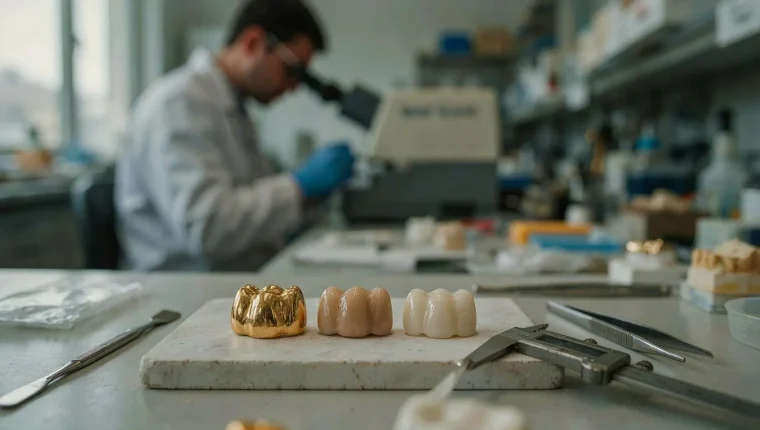
Two crowns can look identical on a quote sheet and behave very differently in your mouth. The difference usually comes down to material grade and the laboratory behind the work. Zirconia is the workhorse for molars and bridges: extremely strong, resistant to fracture, and now available in more translucent forms than the opaque blocks of a decade ago. Lithium disilicate (often sold as e.max) offers the best balance of strength and lifelike translucency for front teeth and premolars. Traditional metal-ceramic remains the budget option — durable and predictable, but with a grey line at the gum and a less natural light response.
Material choice should follow clinical need, not the lowest package price. A clinic that recommends the same crown type for every patient, regardless of position, bite force, or grinding habits, is cutting corners. Ask directly which lab fabricates the crown and whether it uses digital scanning or traditional impressions. Digital workflows reduce distortion and fit errors, but the technician’s skill still determines the final result.
Here is the honest part: lab quality and technician experience are the hardest things to verify from another country. Ask for the lab’s name, whether it is on-site or outsourced, and what warranty covers a remake. If a clinic cannot answer those questions clearly, treat that silence as information.
Planning a Dental Crown Trip From the U.S.: Timeline and Logistics

Timing a crown trip around real life is where most of the friction sits. A single crown is rarely a one-appointment job, because the lab that mills or layers the restoration needs working time between your first visit and your final fitting. Most clinics abroad structure this as two visits: the first for consultation, X-rays or scans, shade matching, and a temporary crown, and the second to seat and adjust the permanent one. The gap between them is the variable that decides how long you stay.
For a single crown, many patients plan roughly five to seven days on the ground, while multiple crowns or bridgework often push the stay toward ten days to two weeks. Your itinerary has to absorb more than chair time.
- Flights and arrival buffer: Book a day of rest before your first appointment so jet lag does not hit you mid-procedure.
- Passport and entry rules: Confirm your passport’s validity window and current visa or e-visa requirements well before booking.
- Travel insurance: Check whether it covers dental complications, not just medical emergencies.
- Buffer days: Leave two or three spare days before your return flight for lab delays or fit adjustments.
Build those spare days in deliberately. A crown that needs a second adjustment before you fly is far easier to handle in the clinic that made it than from across the Atlantic.
Risks, Follow-Up Care, and What Happens After You Fly Home
Crowns placed abroad can fail for the same reasons they fail at home: a margin that doesn’t seal, a bite that sits too high, lingering sensitivity, cement that washes out, or a restoration that simply needs replacing years down the line. What changes is what happens next. When a crown problem surfaces in Turkey, you’re still in the chair with the treating dentist. When it surfaces months later in Ohio or Arizona, you’re navigating it alone.
Most U.S. dentists will treat a failing crown regardless of where it was made, but few will warranty another clinic’s work. That means follow-up care is the real dividing line. A dentist who never saw the prep, the impressions, or the bite records has to diagnose from scratch, and any correction—re-cementing, recontouring the occlusion, or full replacement—is billed to you at local rates. A single redo can quietly erase a meaningful share of what the trip saved.
The practical move is to settle aftercare before you book, not after something goes wrong. Ask the Turkish clinic directly: How long is the warranty, and what does it actually cover? Do they offer remote support—photos, video consults, a point of contact who answers? If a correction is needed, who pays for the lab work, and who pays for a local dentist’s chair time? Get the answers in writing.
Then test the plan against reality. Call a dentist near you and ask what they’d charge to adjust or replace a foreign crown, and whether they’d even take it on. If the numbers still work and you have a clinic that stands behind its work, the risk is manageable. If the answers are vague, that vagueness is your answer.
Deciding Whether Dental Crowns Turkey for Americans Is Truly Worth It
At this point, the pieces of the decision are on the table, and the honest answer is that dental crowns Turkey for Americans can be worth it — but only for the right patient with the right case. The math is straightforward: add the quoted crown cost, flights, hotel, meals, and time off work, then compare that total against what you would actually pay at home after insurance. If your U.S. plan covers 50 percent of a crown and you have already met your deductible, the gap can shrink fast. Factor in the real possibility of one follow-up visit, a recementation, or a replacement down the line, and the savings may look smaller than the sticker price suggests.
Case complexity matters even more than cost. A single straightforward crown on a healthy tooth is a very different proposition from full-mouth reconstruction, multiple implants, or work on teeth with active gum disease. Complex cases need more chair time, more healing checks, and more chances for something to need adjustment after you fly home.
Some signals should stop you regardless of price: pressure to book before a written plan, no clear answer on who makes the crown, refusal to share credentials, or a quote that changes once you arrive. Before committing, insist on a written treatment plan and itemized quote that names materials, the lab, the number of visits, and what happens if a crown fails after you return. If a clinic will not put that in writing, treat it as a deal-breaker.
FAQs
How much can Americans typically save on dental crowns in Turkey compared to U.S. prices?
Americans typically save between 50 and 70 percent on dental crowns in Turkey compared to U.S. prices. A crown that costs roughly $800 to $1,500 per tooth in the United States often runs about $150 to $400 in Turkey, depending on the material and clinic. These savings reflect Turkey's lower labor and overhead costs rather than a difference in the crown itself, since many Turkish clinics use the same imported materials and CAD/CAM technology found in the U.S.
Are dental crowns in Turkey for Americans usually made with the same materials and quality standards?
Many clinics in Turkey use the same internationally recognized crown materials common in the United States, including zirconia, lithium disilicate (e.max), and porcelain-fused-to-metal, often sourced from the same global manufacturers such as Ivoclar, 3M, and Vita. Quality standards vary by clinic rather than by country, so accredited Turkish dental practices frequently follow ISO and CE protocols comparable to U.S. requirements. Because no universal regulatory body enforces identical standards across all Turkish providers, patients should verify materials, lab certifications, and dentist credentials before treatment.
How long should Americans plan to stay in Turkey to complete dental crown treatment?
Most Americans need to plan roughly 7 to 14 days in Turkey to complete a dental crown, since the process typically requires an initial visit for examination and tooth preparation, followed by a second appointment to fit and cement the permanent crown. Some clinics offer accelerated or same-day crown protocols using CAD/CAM technology, which can shorten the stay to about 3 to 5 days, but this depends on the clinic and the complexity of your case. It is wise to add a few buffer days in case adjustments or lab remakes are needed.