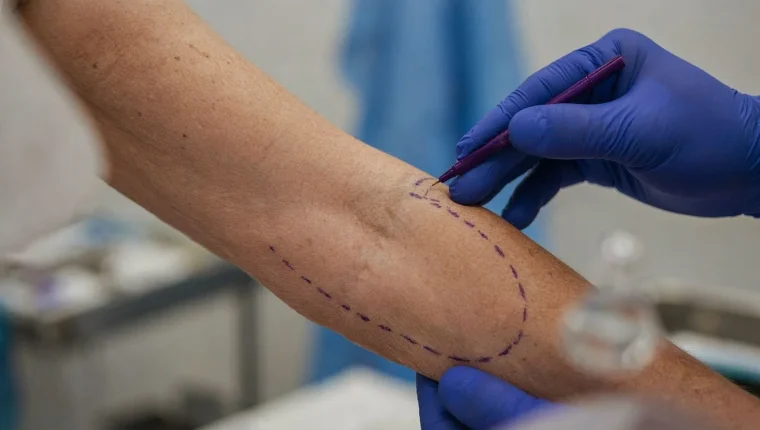
Loose skin under the upper arms rarely responds to diet or exercise and tends to stay once it appears. An arm lift remains the most reliable way to remove that extra tissue and reshape the contour from shoulder to elbow. The decision most patients face is not whether to have surgery, but how much surgery makes sense for their situation.
The choice between a mini arm lift and a full arm lift comes down to where the loose skin sits, how much needs to be removed, and what kind of scar you are willing to accept. Skin that hangs close to the armpit usually needs only a short incision. Skin that extends all the way to the elbow almost always requires a longer one. Liposuction alone may be enough when the tone is still good, but once the skin has lost its snap, tightening it becomes the main task. Understanding that difference is the first step toward picking the procedure that will actually deliver the result you want.
Understanding Arm Lift Surgery Options
When people first start researching arm rejuvenation, they quickly realize that “arm lift” is actually an umbrella term rather than a single procedure. Different techniques address different amounts of excess skin, fat distribution, and tissue laxity, which is exactly why a personalized consultation matters so much.
Most surgeons categorize upper arm contouring by the length of the incision and the surface area treated. A limited-incision brachioplasty targets the upper-inner arm near the armpit and is best suited for mild skin laxity close to the elbow crease. A traditional brachioplasty, sometimes called a full or standard lift, removes a longer ellipse of tissue along the inner arm from armpit to elbow, which allows for more dramatic tightening.
There is also a third path that often blurs the line between the two: liposuction-assisted skin tightening. When the skin still has reasonable snap-back quality, removing fat alone — sometimes with internal radiofrequency or laser energy — can create a visible lift without a long scar. Understanding which category a patient falls into usually depends on skin quality, the amount of redundant tissue, and how far the laxity extends down the arm.
Who Is an Ideal Candidate for a Limited-Incision Procedure?

Not everyone considering arm rejuvenation needs the same surgical approach, and that’s where the limited-incision option really shines. Patients who fall into a specific profile tend to see the most satisfying results from this technique, because the procedure is designed to address concerns that haven’t yet progressed to advanced laxity or extensive fat accumulation.
Plastic surgeons generally look for a combination of physical and lifestyle factors before recommending this route. The criteria below cover what tends to predict a smoother outcome, a more discreet scar, and a recovery that fits realistically into a busy schedule.
- Mild to moderate skin laxity located primarily in the upper third of the arm, near the armpit, rather than extending toward the elbow.
- Good overall skin elasticity in the lower two-thirds of the arm, allowing the tissue to retract naturally once underlying fat is removed.
- A stable, healthy body weight maintained for several months, since significant weight fluctuations can compromise the long-term result.
- Localized fat deposits that respond well to simultaneous liposuction, which is often paired with the limited-incision technique.
- Realistic expectations about what a shorter scar can achieve and a willingness to accept subtle contour improvements rather than dramatic tightening.
- No history of poor wound healing or keloid scarring, since even a small incision needs to heal cleanly for the best cosmetic result.
Meeting several of these criteria doesn’t automatically qualify someone, but it gives the surgeon a strong foundation for recommending the limited-incision path. A thorough in-person evaluation, including skin quality assessment and a discussion of personal goals, remains the most reliable way to confirm candidacy before scheduling any procedure.
How a Full Brachioplasty Differs in Scope and Results
A full brachioplasty is a far more comprehensive surgery than its limited-incision counterpart, and understanding that difference helps you set realistic expectations from the start. Rather than targeting a small area near the armpit, this procedure addresses the entire upper arm, from the elbow up through the shoulder, removing a longer segment of loose skin and, when needed, a significant amount of underlying fat.
Because the correction is so thorough, the visible results tend to be more dramatic. Patients who choose this route often see a complete reshaping of the arm contour, with smoother skin and a tighter silhouette along the full length of the limb. Trade-offs do exist: the incision length is longer, and contouring involves more extensive tissue repositioning. Most surgeons combine the lift with liposuction to refine the result and create a natural transition between the arm and the chest wall.
Recovery also tends to be more involved, since the surgical area is larger and the body has more healing to do. Compression garments are typically worn for several weeks, and strenuous activity is restricted longer than with a smaller procedure.
Comparing Scarring, Recovery Time, and Downtime
Scarring patterns differ more than most people expect between the two procedures. A limited-incision brachioplasty typically leaves a short scar tucked within the armpit crease, so it stays hidden even in sleeveless clothing. A full brachioplasty, in contrast, produces a longer incision that runs along the inner arm, sometimes from elbow to armpit, which means the trade-off for tighter skin is a much more visible scar.
Recovery time follows a similar split. After a mini lift, most patients return to light activities within a few days and feel comfortable resuming exercise in roughly two weeks. A full lift usually involves a longer healing window, with swelling, tightness, and movement restrictions lasting several weeks before normal workouts resume.
Downtime also tends to feel noticeably different. Because the mini approach is less invasive, the immediate post-op period is generally shorter and easier to manage. The full version, while more transformative, asks for more patience, more rest, and closer attention to wound care during the early stages of healing.
Planning time off work, childcare, or exercise routines around the procedure is easier when these timelines are realistic. Choosing the right option often comes down to how much recovery a patient can comfortably accommodate.
Cost Differences Between Mini and Full Arm Lifts

Cost often becomes the deciding factor once someone has narrowed the choice between a limited-incision approach and a full brachioplasty. The price gap between the two is usually noticeable, and it reflects real differences in what the operating room, the surgical team, and the recovery resources are being asked to cover.
Several variables shape the final number on a quote. The most common drivers include:
- Anesthesia time, which tends to run longer for a full brachioplasty because the work area extends from the armpit toward the elbow.
- Facility and OR fees, billed by the hour and therefore higher when the procedure requires more extensive tissue reshaping.
- Surgeon technique and complexity, since removing larger areas of redundant skin takes more operative precision than a short-incision tightening.
- Liposuction add-ons, often bundled into one arm lift but priced differently when combined with the other.
- Compression garments and post-op supplies, which may need to be upgraded or replaced more frequently after a full lift.
Geography and surgeon reputation shift those base numbers further, so a mini arm lift in one city may still cost more than a full brachioplasty elsewhere. What stays consistent is the underlying logic: the more skin addressed and the longer the surgery runs, the higher the investment on every line of the estimate. Reviewing a written breakdown before committing helps patients see exactly where each difference in price is coming from rather than comparing totals in isolation.
Making the Right Choice Based on Your Goals
Choosing between a limited-incision approach and a full brachioplasty really comes down to what bothers you most when you look in the mirror. If your main frustration is a small pocket of stubborn fat or a touch of crepey texture near the armpit, a shorter scar and quicker bounce-back often feel like the obvious win. On the other hand, when loose skin hangs noticeably along the length of the upper arm, no amount of toning exercises will tighten it, and a more comprehensive lift usually delivers the contour you’re actually hoping for.
Think honestly about your tolerance for downtime, your feelings about scarring, and how dramatic you want the change to look in clothing versus sleeveless outfits. A candid conversation with a board-certified plastic surgeon, paired with clear before-and-after photos of patients with similar arms, will make the decision far less abstract and far more personal.
FAQs
What skin laxity level typically makes someone a better candidate for a full arm lift rather than a mini version?
If your skin laxity extends well past the upper third of the arm—especially when there's noticeable drooping near the elbow or along the lower half—a full arm lift is usually the more effective choice. A mini lift simply can't address that much excess tissue, and trying to tighten it through a small incision often leads to underwhelming results or the need for a revision later. Patients with mild, isolated laxity near the armpit are typically the ones who do well with the mini version.
How do recovery times and scarring patterns differ between the two procedures?
Mini arm lift generally involves a shorter downtime of about one to two weeks, with swelling and bruising that fade relatively quickly, while a full arm lift usually requires two to four weeks before you feel back to normal and can return to more strenuous activity. Because the mini lift uses a smaller incision tucked in the armpit, the resulting scar is short and easily hidden, whereas a full arm lift leaves a longer scar running along the inner arm from the armpit toward the elbow, which takes longer to mature and flatten. Full arm lift scars may remain more noticeable for several months, while mini arm lift scars typically blend in within a shorter healing window.
Can the results of a mini arm lift be as dramatic as those of a full arm lift for patients with mild to moderate sagging?
A mini arm lift can deliver noticeable improvement for mild to moderate sagging, but it generally won't match the dramatic contouring a full arm lift achieves when there's significant excess skin. The mini approach is designed for subtle refinement rather than complete reshaping, so patients with more advanced laxity often see limited change. For the right candidate, the results can feel transformative on a smaller scale, but expectations should match what the limited-incision technique can realistically address.