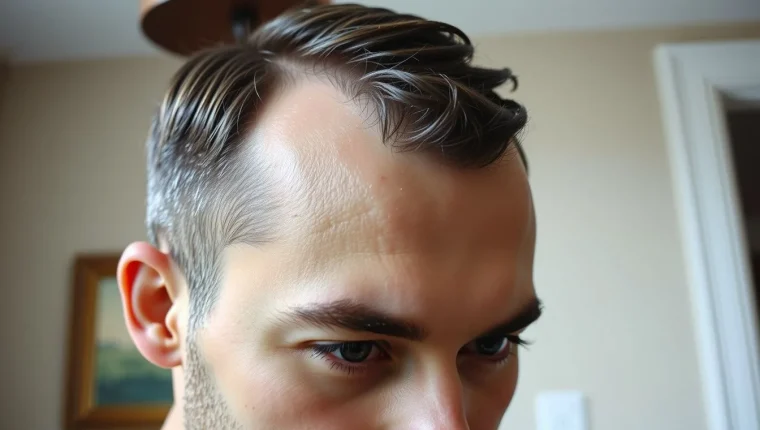
A visible bald spot on top of the head in women is neither rare nor random. It is a recognizable pattern of hair loss, most often female pattern hair loss, that develops when follicles at the crown gradually shrink and produce thinner, shorter hairs. Many women first notice it in a photo, under overhead light, or while parting their hair. The spot usually develops gradually rather than suddenly and rarely appears alone; diffuse thinning around the part often accompanies it. This pattern has identifiable drivers, including genetics and hormonal shifts, and can be distinguished from other forms of shedding. Proper evaluation, a confirmed diagnosis, and treatment options can help slow loss and support regrowth.
Why Women Lose Hair at the Crown: Understanding the Pattern
In women, crown thinning rarely appears overnight. It usually develops as a gradual widening of the part, a diffuse thinning that exposes more scalp under light, or a small circular patch that becomes more visible over months. Unlike telogen effluvium, which causes sudden, widespread shedding after stress, illness, or nutritional shifts, pattern hair loss at the crown is slow and progressive. It tends to concentrate at the top of the head while the frontal hairline often stays intact, which is one reason it is easily mistaken for normal aging or seasonal shedding.
The shape matters because it reflects what is happening beneath the scalp. This is the hallmark of female pattern hair loss, where follicles in androgen-sensitive areas gradually miniaturize. Hairs become finer, shorter, and less pigmented before they stop producing visible growth. That miniaturization explains why the crown looks sparser even when overall shedding counts seem normal. Recognizing this pattern is the first step toward understanding the hormonal and genetic drivers behind it.
Hormonal and Genetic Drivers Behind a Bald Spot on Top of the Head Woman

Female pattern hair loss is rarely caused by a single factor. Instead, it reflects a combination of inherited sensitivity and hormonal influence acting on the same hair follicles over time. The crown is one of the areas most vulnerable to this process because the follicles there appear to be genetically primed to respond to androgens, the group of hormones that includes testosterone.
In women, androgens are normally present in small amounts. The problem is not usually an excess of these hormones but an increased sensitivity of certain follicles to them. When androgen sensitivity is inherited, these follicles gradually shrink with each growth cycle, producing thinner, shorter hairs until the area looks sparse or bald. This is why a woman can have normal hormone levels on a blood test and still develop crown thinning.
Hormonal shifts across life stages can accelerate the process. Puberty, pregnancy, menopause, and conditions such as polycystic ovary syndrome can change the balance of androgens and estrogens, potentially triggering or worsening shedding in genetically susceptible follicles.
Genetics and hormones do not work in isolation. A family history of female pattern hair loss sets the stage, while hormonal changes determine how quickly and how visibly the pattern progresses. Understanding this interaction gives you a clearer picture to discuss with a clinician, who can then confirm whether this is the cause of your crown hair loss.
How Doctors Diagnose Female Pattern Hair Loss and Rule Out Other Causes
Diagnosis begins with a conversation rather than a device. A clinician will ask when the thinning started, whether it is gradual or sudden, how much hair appears on the pillow or in the shower drain, and whether there is itching, pain, or scaling. Family history of hair loss, recent pregnancies, menopause, major stress, crash diets, and new medications all matter, because they shape which causes are plausible.
The scalp examination comes next. Under good lighting, the doctor looks at the crown, the part line, and the frontal hairline, checking whether miniaturized hairs of varying lengths sit alongside healthy ones. That mix of thick and thin strands is the visible signature of pattern hair loss. A pull test, where a small bundle of hair is gently tugged, helps show whether shedding is currently active.
Blood tests then separate pattern loss from conditions that mimic it. Thyroid function, ferritin and iron levels, vitamin D, and sometimes hormones such as testosterone or DHEA may be checked. A dermatologist can also use dermoscopy to inspect the scalp surface, or in unclear cases take a small biopsy. These steps rule out thyroid disease, iron deficiency, telogen effluvium, and alopecia areata, each of which needs different care.
This is why an accurate diagnosis changes everything: a treatment aimed at the wrong cause wastes months, while the right one can begin before the crown thins further.
Treatment Options That Can Slow Shedding and Support Regrowth

Treatment for crown thinning in women is not designed to restore a full head of hair overnight. The realistic goal is to slow or stop further shedding while creating conditions where existing follicles can thicken and produce visible regrowth. Doctors group options by how they work, and each comes with its own timeline and demands on the patient.
Topical medications such as minoxidil are often the first step. They extend the growth phase of the hair cycle and can improve density over several months, but they require consistent daily use, and any benefit fades if application stops. Prescription oral options may be considered when topical treatment is impractical or insufficient, though they carry side effects that need careful discussion. Procedures like platelet-rich plasma or low-level laser therapy are sometimes used alongside medication, and hair transplantation may be offered for areas that no longer respond, though it does not prevent future loss in untreated zones.
Realistic timelines matter as much as the choice itself. Most treatments need three to six months before any change is noticeable, and results vary widely between individuals. No option works for everyone, and none reverses the underlying androgen sensitivity that drives pattern loss. That is why a clinician typically combines approaches and reviews progress rather than promising a guaranteed cure.
Everyday Habits, Styling Choices, and When to Seek Professional Help
Daily styling habits rarely cause a crown bald spot on their own, but they can make an existing one look worse and stress the hair that remains. Tight ponytails, buns, and braids pull continuously on the crown, and repeated tension in that area can thin the hairline further. Harsh chemical relaxers, frequent hot-tool use close to the scalp, and rough brushing while hair is wet all increase breakage. Switching to loose styles, letting hair air-dry when possible, and using a wide-tooth comb are simple ways to reduce that strain.
Scalp care matters too. Gentle cleansing keeps follicles clear without stripping natural oils, and avoiding heavy buildup from styling products helps the scalp stay healthy. A balanced diet with enough iron, protein, and vitamin D supports the growth cycle, though supplements should only be added after a clinician checks for a deficiency.
Some signals mean home management is no longer enough. Sudden or rapid shedding, an expanding patch, scalp itching, pain, or scaling, and hair loss that continues despite careful styling all warrant a professional evaluation. Seeing a doctor or dermatologist early gives the best chance to slow or stop further shedding and protect the hair still present.
FAQs
What causes a bald spot on top of head woman and how is it different from normal hair thinning?
A bald spot on top of a woman's head most often results from androgenetic alopecia, where hair follicles in the crown area shrink under the influence of androgens and eventually stop producing visible hair. Other causes include traction alopecia from tight hairstyles, telogen effluvium after stress or illness, and alopecia areata, an autoimmune condition. Unlike normal hair thinning, which spreads diffusely across the whole scalp and reduces overall density, a bald spot is a localized area of complete or near-complete hair loss with clearly defined borders.
Can a bald spot on top of head woman grow back without surgery or transplants?
Yes, many women regrow hair in a thinning bald spot on the top of the head without surgery or transplants, especially when the cause is androgenetic alopecia caught early. Treatments such as topical minoxidil, oral medications like spironolactone or finasteride, low-level laser therapy, and platelet-rich plasma can slow shedding and stimulate regrowth over several months. Results vary based on how long the follicle has been inactive, so a spot with complete scarring or longstanding smooth skin may respond poorly. A dermatologist can confirm the cause and build a treatment plan before considering more invasive options.
Which treatments work best for androgenetic hair loss in women with a bald spot on the crown?
For androgenetic hair loss with crown thinning in women, topical minoxidil 2% or 5% is the first-line treatment and often produces noticeable regrowth after several months of consistent use. Oral antiandrogens such as spironolactone or finasteride can be added when topical therapy is insufficient, and low-level laser therapy or platelet-rich plasma may support results as adjuncts. Because female pattern hair loss is progressive, treatment works best when started early and continued long term under a dermatologist's supervision.