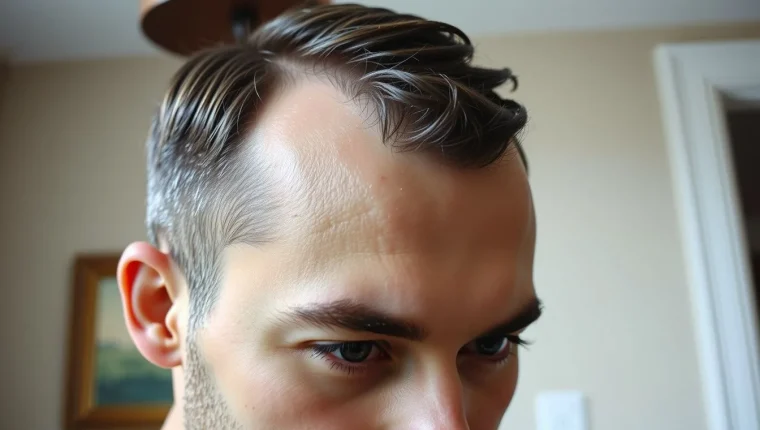
Thinning at the crown is one of the most common and visible forms of hair loss in adults. Because it develops at the back of the scalp, it is often noticed late—usually in a photo, from a mirror angle, or through a comment from someone behind you. Vertex baldness is not simply a variation of a receding hairline: it follows its own pattern, has its own causes, and responds to treatment in its own way. Understanding what is happening at the crown and why makes it easier to judge which options are worth pursuing and which are unlikely to help.
What Vertex Baldness Actually Means

The vertex is the area at the top of the scalp where hair usually grows in a circular pattern, often called the crown. When hair loss begins there, it typically appears as a gradually widening thin patch rather than a sudden bare spot. In the early stages, the scalp becomes visible through the hair under bright light, and over time the thinning area expands outward from the center.
This pattern is distinct from a receding hairline, which moves backward from the forehead, and from diffuse thinning, which spreads evenly across the scalp. Crown loss stays concentrated at the top-back region while the front and sides may remain relatively intact.
The distinction matters because the location of hair loss influences how it is assessed and which treatments are considered. A receding hairline and crown thinning can share underlying causes, but they do not always progress the same way or respond identically to treatment. Knowing whether your thinning fits the crown pattern gives you a clearer starting point for the next steps.
Why Hair Thins at the Crown: Key Causes

Crown thinning rarely has a single trigger. In most adults, several factors overlap and gradually weaken the same group of follicles at the top of the scalp. Androgenetic alopecia is the most common driver, but it is not the only one worth understanding.
Hormonal influence sits at the center of most cases. Dihydrotestosterone (DHT), a byproduct of testosterone, binds to sensitive follicles and shortens their growth phase over time. Follicles at the crown appear to carry a higher sensitivity to this process, which is why this area often thins before other regions. This will be explored in more detail later, but it is the primary mechanism behind most crown balding.
Genetics determine how susceptible those follicles are. A family history of hair loss at the crown or temples raises the likelihood considerably, and the pattern tends to follow a similar timeline across generations. Age compounds the effect: follicle cycles slow naturally, and the cumulative exposure to DHT increases.
Other contributors include chronic stress, nutritional deficiencies such as low iron or vitamin D, thyroid imbalances, and certain medications. These tend to cause more diffuse shedding, but the crown can still show it first because those follicles are already under hormonal pressure. The combination of location-specific sensitivity and systemic strain is what makes the crown so vulnerable.
How Hormones and Genetics Drive Crown Hair Loss
Crown hair loss follows a distinctive hormonal pathway. Testosterone, circulating throughout the body, is converted by the enzyme 5-alpha reductase into dihydrotestosterone (DHT). In genetically susceptible individuals, DHT binds to receptors in hair follicles and gradually miniaturizes them, shortening the growth phase and producing progressively finer, shorter hairs until the follicle stops producing visible hair altogether.
What makes this process especially relevant to the crown is that follicular sensitivity to DHT varies across the scalp. Hair at the vertex tends to carry a higher concentration of androgen receptors than hair in other regions, which is why this area often thins earlier and more aggressively than the sides or back of the head. The same hormonal exposure that barely affects one follicle can steadily shrink another.
Genetics determine both the pattern and the timing of this sensitivity. Inherited traits influence how many androgen receptors a follicle expresses, how efficiently the body produces 5-alpha reductase, and how quickly miniaturization progresses. This explains why crown thinning can begin in a man’s twenties or emerge decades later, and why the rate of loss differs so widely between individuals with similar hormonal profiles.
Because this mechanism is rooted in hormone-receptor interaction rather than external triggers, crown thinning tends to be progressive without intervention. Understanding this foundation is essential, since it shapes which treatment approaches can meaningfully slow or reverse the process.
Early Signs and Diagnosis of Vertex Thinning
Early thinning at the crown usually announces itself quietly. You may notice a widening gap at the part, a small patch where the scalp catches light more easily, or more hair than usual collecting on the pillow and in the shower drain. Because the vertex sits at the back of the head, many people first learn about changes there from a photograph, a mirror held at an angle, or a comment from someone standing behind them. This simple geography is why crown loss so often goes unnoticed until it has progressed.
Recognizing the pattern matters as much as spotting the hair itself. Crown thinning tends to begin as a diffuse, circular area of reduced density rather than a sharp bald spot, and it can be confused with a receding hairline or with temporary shedding after illness or stress. A proper evaluation therefore combines a focused history, a close look at the scalp, and sometimes a pull test or trichoscopy to measure hair diameter and density. Blood tests may be ordered when a thyroid problem, low iron, or another underlying condition is suspected. This assessment is what separates a treatable, ongoing process from a permanent one and guides what comes next.
Treatment Options for Crown Balding
Treatment for crown balding is organized around what each approach actually does, not around brand names or popularity. Because the mechanisms behind thinning at the vertex are largely hormonal and genetic, the most direct options target that process. Minoxidil is a topical treatment that can be applied to the crown itself, extending the growth phase and improving blood flow to the follicle. Finasteride works differently, blocking the conversion of testosterone into DHT, the hormone that drives follicular miniaturization in genetically sensitive areas. These two are often combined, since one addresses the hormone and the other supports the follicle directly.
For more advanced thinning, procedural options enter the picture. Platelet-rich plasma injections deliver growth factors to the scalp, while hair transplantation moves DHT-resistant follicles from the back of the head to the crown, where they can continue to grow. Low-level laser therapy is another non-invasive route that some people use alongside topical treatments.
Suitability depends on several factors: how much hair remains at the crown, how long the thinning has been present, and whether the underlying cause is purely genetic or compounded by stress or other triggers. A dermatologist or trichologist can assess the pattern and recommend a combination that fits the stage of loss. Starting earlier generally preserves more options, but even established crown balding can respond to the right approach.
FAQs
What actually causes vertex baldness to develop?
Vertex baldness primarily develops due to a genetic sensitivity to dihydrotestosterone (DHT), a hormone that gradually miniaturizes hair follicles in the crown area of the scalp. This inherited condition, known as androgenetic alopecia, causes affected follicles to produce thinner, shorter hairs until they eventually stop growing altogether. Age, hormonal changes, and family history all influence how early and how extensively vertex baldness appears.
Is vertex baldness different from a receding hairline?
Yes. Vertex baldness affects the crown or top of the head, while a receding hairline develops along the front hairline and temples. Both are common patterns of androgenetic alopecia, but they appear in different locations and can progress independently or together.
Which treatment options work best for vertex baldness?
For vertex baldness, minoxidil and finasteride are the most established options, with finasteride generally producing stronger results in the crown area. Many patients benefit from combining these medications with in-office treatments such as platelet-rich plasma or low-level laser therapy. In advanced cases where the follicle has stopped producing hair, a hair transplant focused on the vertex remains the most reliable way to restore coverage.