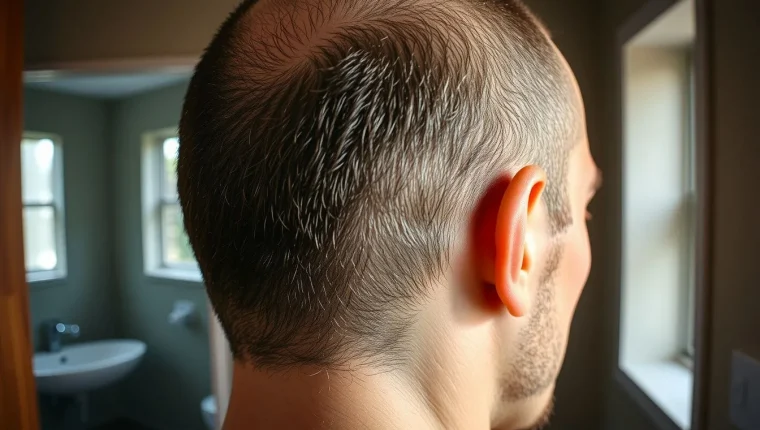
Male pattern baldness affects roughly half of men by age 50, and it usually starts long before that. You notice a receding hairline or thinning crown, and within a few months, the mirror reminds you every day. Rogaine, known generically as minoxidil, is one of the few FDA-approved treatments for this condition, so many men try it first. The real question is whether it actually regrows hair or simply slows the loss. The answer depends on where you are in the balding process, how consistently you apply it, and how long you are willing to wait. Rogaine for male pattern baldness works best on the crown and mid-scalp, with weaker results at the hairline. Understanding what it can and cannot do helps you decide if it deserves a place in your routine.
How Rogaine Works to Treat Male Pattern Baldness

Rogaine’s active ingredient, minoxidil, was originally developed as an oral medication for high blood pressure. Researchers noticed an unexpected side effect: patients grew hair in places they hadn’t before. That observation eventually led to a topical formulation designed specifically for the scalp, and it became one of the first FDA-approved treatments for androgenetic alopecia.
Male pattern baldness is driven largely by dihydrotestosterone (DHT), a hormone that gradually shrinks hair follicles along the temples and crown. As follicles miniaturize, the growth phase shortens and strands become thinner until they stop emerging altogether. Minoxidil does not block DHT or address the hormonal root of the condition. Instead, it works on the follicles themselves.
The exact mechanism is still not fully understood, but research points to several effects. Minoxidil appears to widen blood vessels in the scalp, improving circulation around the follicle. It also extends the anagen, or growth, phase of the hair cycle, pushing more follicles into active production at the same time. Some studies suggest it opens potassium channels in cell membranes, which may stimulate follicle cells directly and delay the transition into the resting phase.
The practical result is that existing follicles get more time to grow and produce thicker strands. Hair that has completely died, however, cannot be revived. This is why minoxidil tends to work best on thinning areas where follicles are still alive but weakened, rather than on completely smooth, bald patches.
What Clinical Evidence Says About Its Effectiveness

Clinical research on minoxidil, the active ingredient in Rogaine, has produced a substantial body of evidence. Multiple randomized, double-blind, placebo-controlled trials—the gold standard of medical research—have tested topical minoxidil in men with androgenetic alopecia. Across these studies, a consistent pattern emerges: participants using minoxidil experienced measurable hair regrowth compared with those using a placebo.
Objective measurements, including hair counts and hair weight, generally showed statistically significant improvements over baseline in the treatment groups. Researchers also evaluated subjective patient assessments, and users frequently reported that their hair looked fuller and that visible thinning had slowed. The quality of evidence varies across studies, with some trials being larger and better designed than others, and results measured through different methods can be difficult to compare directly.
Importantly, the evidence supports minoxidil as a treatment that manages rather than cures hair loss. Benefits were maintained only while the product was used consistently; when participants stopped applying it, gains typically reversed within several months. The clinical picture is therefore encouraging but realistic—minoxidil has demonstrated genuine effectiveness in controlled settings, yet individual results remain variable.
Who Is Most Likely to See Results
Response to minoxidil is not uniform, and the pattern of who benefits most comes down to two variables: how advanced the hair loss is and where on the scalp it is happening. Because the drug works by extending the growth phase of follicles that are still active, the men who gain the most are those whose follicles have not yet fully miniaturized. Once a follicle has shrunk to the point where it produces only fine, colorless vellus hair, there is little left for the medication to rescue. In practical terms, this means the window for a good response opens early and narrows as the condition progresses, which is why timing and location matter more than almost anything else.
The following groups tend to report the most noticeable improvement:
- Men in the early stages of thinning — crown and vertex thinning that has been progressing for less than five years responds best, since a larger share of follicles remain capable of producing pigmented terminal hair.
- Younger men, generally under 40 — age itself is less important than the duration of the loss, but younger men more often present while enough active follicles remain.
- Those with thinning at the crown or vertex — the vertex has historically shown the strongest response in trials, while receding temples and a receding frontal hairline respond far less reliably.
- Men who use it consistently twice daily — skipping doses or stopping after a few months limits results, because any regrowth depends on continuous stimulation.
- Those without extensive scarring or complete bald patches — smooth, shiny areas where follicles appear permanently lost rarely respond to topical treatment.
The clearest predictor is the density of miniaturized but still living hair in the treated area. A man with diffuse thinning across the crown has far more to gain than one with a fully bald, smooth vertex, even if both have been losing hair for a similar number of years. This is why an honest assessment of the scalp before starting treatment is more useful than any general statistic about success rates, and why expectations should be set according to what is actually present at the time treatment begins.
How Long Before You Notice Improvement
Timelines matter because they shape whether you keep going or give up too early. Most men want to know when the mirror will start showing something different, and the honest answer is that Rogaine works slowly and quietly before it works visibly.
The widely cited benchmark is four months. That figure comes from clinical trials of minoxidil, where hair counts and patient self-assessments were typically measured at the sixteen-week mark. Before that point, many users notice nothing at all, which is expected rather than a sign of failure. The drug has to accumulate in the follicle and influence the growth cycle, and hair grows on its own schedule.
Realistically, the experience tends to unfold in stages:
- Weeks 2 to 6: Some men shed more hair than usual. This temporary shedding happens as resting hairs are pushed out to make room for new growth, and it often alarms people who do not expect it.
- Months 2 to 4: Fine, light hairs may begin appearing in thinning areas, though they are easy to miss without close inspection.
- Months 4 to 6: Visible improvement usually becomes apparent, with the crown responding earlier than the hairline.
- Months 6 to 12: Results consolidate and reach their fullest expression for most responders.
Two practical points follow from this. First, stopping before four months makes it impossible to judge whether the treatment is working, since the early phase is largely invisible. Second, progress is easier to track with photos taken under the same lighting at regular intervals than with daily glances in the mirror, where change is too gradual to register. Patience is not a virtue here so much as a requirement of how the medication functions.
Risks, Side Effects, and Realistic Expectations
No topical treatment is entirely free of drawbacks, and minoxidil is no exception. The most common complaints are scalp irritation, dryness, flaking, and itching, often caused by the propylene glycol in the liquid version. Switching to the foam formulation, which typically contains no propylene glycol, resolves these issues for many men. Less frequent but more noticeable effects include unwanted facial hair growth, usually the result of the solution dripping onto the forehead or transferring from the pillow to other areas. A small number of users report a temporary increase in shedding during the first few weeks, which reflects the hair cycle shifting rather than treatment failure.
More serious reactions, such as contact dermatitis, rapid heartbeat, dizziness, or swelling of the hands and feet, are rare but warrant stopping use and consulting a doctor. Anyone with a history of heart conditions should discuss minoxidil with a physician before starting.
Realistic expectations matter just as much as side effects. Rogaine is not a cure, and it cannot restore hair on completely bald, shiny scalp areas where follicles are no longer active. Consistent twice-daily use is required indefinitely, because stopping typically reverses any gains within a few months. Set your goal around slowing loss and thickening existing hair, not regrowing a full head of hair, and you will judge the results far more accurately.
FAQs
Does Rogaine for male pattern baldness actually regrow hair or just slow down shedding?
Rogaine (minoxidil) does both: it slows down shedding and can regrow hair in men with male pattern baldness, though results vary by individual. It works best on the crown and vertex of the scalp, where clinical studies show measurable regrowth, while its effect on a receding hairline is generally weaker. Regrowth typically requires consistent, long-term use, and any new hair will gradually be lost if you stop applying the product.
How long do you need to use Rogaine before seeing results for male pattern baldness?
Most men using Rogaine for male pattern baldness notice early signs of improvement after about two to four months of consistent use, with more visible results typically appearing around the six-month mark. Full benefits often require at least twelve months of regular application twice daily. Because Rogaine works by slowing hair loss and stimulating regrowth, stopping treatment usually causes any new gains to reverse within a few months.
What happens if you stop using Rogaine for male pattern baldness?
Stopping Rogaine causes any hair you gained or maintained while using it to gradually shed, typically within a few months, as the drug's effects on the hair follicles wear off. Your hair then returns to the pattern and rate of loss you would have experienced without treatment. Rogaine only works while you keep using it, so continuous application is required to preserve results.