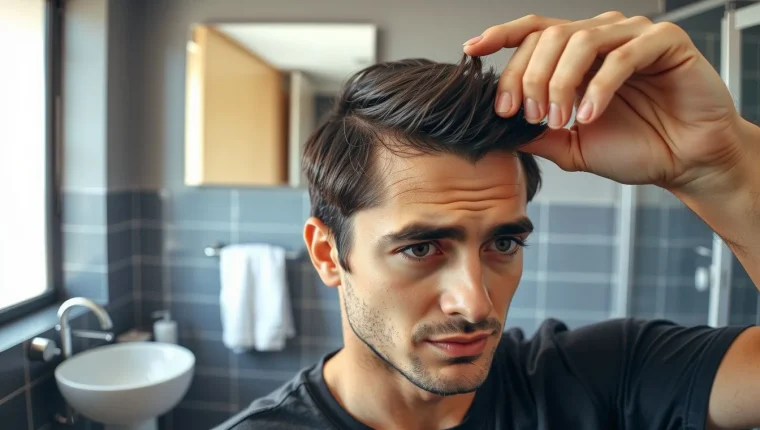
You notice it in a photo before you notice it in the mirror. The corners of your hairline sit further back than they did a year ago, and you start checking them every morning. That concern is legitimate, and it has a specific cause worth understanding. A changing hairline can reflect androgenic alopecia, the most common form of progressive hair loss in adults, but not every shift means the same thing. Recognizing the early signs, understanding how this pattern typically advances, and knowing why timing matters shape what you can realistically do next.
What an Early Receding Hairline Actually Looks Like
An early receding hairline rarely announces itself with a dramatic change. Instead, it shows up as small, specific shifts at the front of the scalp. The most common starting point is the temples, where the hairline gradually forms a subtle “M” shape. You may notice that the corners sit slightly further back than they used to, or that the forehead appears taller in photos taken from the same angle.
Another observable marker is a change at the hairline edge itself. The border may lose its defined shape and begin to look uneven or feathered, with fine, shorter hairs replacing thicker strands. In some people, a thin band of weaker hair lingers along the original line while the stronger hair retreats behind it, creating a diffuse, less solid edge.
These changes tend to follow the typical androgenic pattern, beginning at the temples and gradually extending toward the mid-frontal area. What makes early signs tricky is that they can be subtle enough to second-guess. That ambiguity is exactly why comparing what you see against normal hairline maturation matters before drawing conclusions.
How Androgenic Alopecia Progresses Over Time
Androgenic alopecia is not a random shedding event but a genetically influenced process that gradually miniaturizes hair follicles in specific regions of the scalp. In susceptible follicles, the growth phase shortens while the resting phase lengthens, so each new hair emerges thinner, shorter, and less pigmented than the one before it. Because these susceptible follicles cluster in predictable zones, the loss follows a recognizable shape rather than spreading evenly.
In the typical early stage, the hairline recedes at the temples, forming the well-known M-shaped pattern. Over months to a few years, this recession deepens and gradually merges with thinning along the mid-scalp. Meanwhile, the crown may begin to thin independently, and in many men the two areas eventually connect, leaving a horseshoe band of remaining hair. Women often experience a different distribution, with diffuse widening of the part and overall thinning rather than a distinct bald patch.
The pace varies widely. Some people lose noticeable density within a few years, while others see only slow changes across decades. This follicle miniaturization is the core mechanism driving every visible stage. Because miniaturized follicles are not permanently lost at first, the speed of progression matters: the sooner the process is recognized and addressed, the more viable follicles remain available for future treatment.
Distinguishing Normal Hair Maturation From True Thinning

A maturing hairline and early androgenic thinning can look similar at a glance, but they behave differently over time. Maturation is a slow, symmetrical shift: the hairline settles slightly higher at the temples, often forming a gentle “M” shape, while overall density stays stable. The key difference is what happens behind the hairline. In true thinning, you begin to see follicle miniaturization — hairs that grow back finer, shorter, and lighter than before. These miniaturized hairs cluster near the temples and crown, and the gap between them widens as cycles repeat.
You can track this yourself with a few observable cues. Compare photos taken in the same lighting every three to six months. Check whether the frontal hairline is receding backward or simply sitting higher. Look at the part width and whether individual hairs feel thinner when rolled between your fingers. Notice if shedding increases or if new growth looks wispy rather than full. A mature hairline changes shape once and then holds; active thinning keeps changing density, texture, and coverage.
That distinction matters because it changes what you do next. A stable mature hairline needs monitoring, not treatment. Confirmed miniaturization, by contrast, signals an active process that can be addressed — which is where professional evaluation and the options discussed later come in.
Why Acting Early Matters for Hair Follicle Survival

Timing matters because of how the follicle itself responds to androgens over time. In androgenic alopecia, the hormone dihydrotestosterone gradually shortens each hair’s growth phase and shrinks the follicle, a process already introduced as follicle miniaturization. Early on, this change is largely functional rather than structural: the follicle is smaller and produces thinner, shorter hairs, but it still has the capacity to recover.
The critical shift comes when a miniaturized follicle stays dormant long enough that the surrounding tissue changes. Blood supply to the region decreases, the follicle sits higher in the skin, and the stem cells needed to rebuild a thick hair become less responsive. At that point, even a treatment that lowers androgen activity can only work with what remains. This is why the window of reversibility narrows: the earlier the intervention, the more functional follicles are still present to respond.
Early action is therefore best understood as preserving options. It does not guarantee regrowth, and it cannot restore a follicle that has already scarred over. But it keeps more of the follicle population available for strategies that only work while tissue is still intact. Waiting does not simply delay results; it reduces the number of follicles that can still respond at all.
Treatment Options and Lifestyle Steps to Slow Further Loss
Slowing further loss usually means combining treatments that address the underlying androgenic process with daily habits that support overall follicle health. The most common medical options include topical minoxidil, which can extend the growth phase and slow miniaturization, and prescription oral medications such as finasteride, which reduce the hormone activity driving follicle shrinkage in men. Some clinicians also recommend ketoconazole shampoo or low-level laser therapy as supportive additions. These approaches are generally used to stabilize the hairline and preserve existing density rather than to regrow a fully receded hairline.
Lifestyle steps matter as supporting players, not replacements for treatment. Managing stress, avoiding tight hairstyles that pull on the hairline, and eating enough protein, iron, and vitamin D can help create better conditions for follicles. Quitting smoking and limiting excessive heat or chemical treatments also reduces unnecessary strain on already vulnerable hair.
Because every case differs in pattern, rate, and health history, the most reliable next step is a professional evaluation. A dermatologist or hair specialist can confirm whether the cause is androgenic, rule out other conditions, and build a personal plan that combines the right treatments with realistic expectations.
FAQs
What are the earliest signs of a receding hairline that I should not ignore?
The earliest signs of a receding hairline often include a gradual thinning at the temples, a widening forehead, or a subtle M-shaped pattern where the corners of the hairline pull back before the center does. You may also notice more hair than usual on your pillow, in the shower drain, or on your brush, along with finer or shorter hairs along the front edge. These changes can be easy to dismiss because they develop slowly, but catching them early matters since treatments for androgenetic hair loss tend to work best before significant follicle miniaturization occurs. If you spot any of these signs, consider tracking them with photos over a few months and consulting a dermatologist to confirm the cause and discuss options.
Can a receding hairline be reversed naturally without medication?
A receding hairline caused by androgenetic alopecia cannot be truly reversed by natural methods alone, because the underlying follicle miniaturization is driven by genetics and hormones like DHT. Lifestyle changes such as reducing stress, improving diet, and avoiding tight hairstyles may support overall hair health and slow further thinning, but they rarely regrow hair already lost at the temples. For measurable regrowth, clinically proven treatments like minoxidil or finasteride are typically necessary, so natural approaches work best as supportive measures rather than standalone solutions.
When should I see a doctor about my receding hairline and possible androgenic causes?
See a doctor if your hairline is receding rapidly, if you notice thinning at the crown or widening part alongside it, or if you are concerned about androgenic causes such as male or female pattern hair loss. A doctor or dermatologist can confirm whether the cause is androgenic alopecia or another condition like thyroid issues, nutritional deficiencies, or telogen effluvium. Early evaluation matters because treatments for androgenic hair loss work best when started before significant follicle miniaturization occurs. Seek care promptly if you also have scalp pain, itching, patchy loss, or other unexplained symptoms.