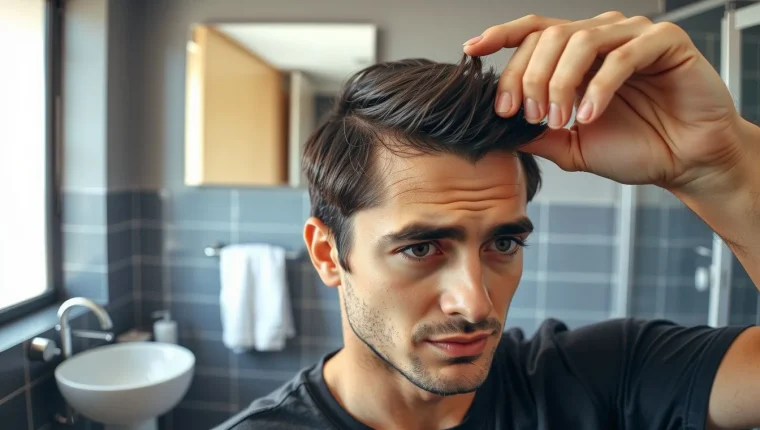
Most men notice it at the temples first: a corner that used to be filled in, now thinner in the mirror under bright light. That change raises a practical question, not a cosmetic one. Is this a normal maturing hairline, or the start of something progressive? Hairline loss in men usually follows a recognizable pattern driven by genetics and androgen activity, with identifiable mechanisms and defined treatment categories. Some men stabilize early and never progress far. Others lose ground steadily across the frontal zone. The difference matters because effective options depend on what is happening at the follicle level.
Understanding the Mechanisms Behind Hairline Loss in Men
Each hair on the scalp cycles through growth (anagen), transition (catagen), and resting (telogen) phases before shedding and being replaced. What makes the frontal hairline distinct is not the cycle itself, but the follicle’s location along the anterior scalp margin, where hairs are often finer and more densely packed than in other regions. This positioning leaves them uniquely vulnerable to changes in follicular behavior.
Recession becomes visible when individual follicles begin producing progressively thinner, shorter, and less pigmented hairs—a process known as follicular miniaturization. Over successive cycles, the anagen phase shortens while the telogen phase lengthens, so each new hair emerges smaller than the last. Eventually, a follicle may produce only a barely visible vellus hair or stop producing pigmented hair altogether, and the hairline moves back.
Not every shift at the temples signals pathology. Many men experience a gradual, symmetric maturation of the frontal hairline in their twenties that stabilizes without progressing. Distinguishing this benign pattern from progressive loss depends on whether miniaturization continues, whether recession follows a recognizable pattern, and whether other scalp regions become involved—questions that lead directly to the role of hormones.
How Androgens Drive Follicular Miniaturization and Pattern Progression
Androgens do not act on every scalp hair equally. Their influence depends on how sensitive a given follicle is to dihydrotestosterone (DHT), the potent androgen converted from testosterone by the enzyme 5-alpha reductase. In genetically predisposed men, DHT binds to receptors in susceptible hair follicles and gradually shortens the growth phase while shrinking the hair shaft itself. This process, known as follicular miniaturization, turns thick terminal hairs into fine, short, nearly invisible strands before they stop producing visible hair altogether.
Crucially, this sensitivity is not uniform across the scalp. Follicles along the temples and crown tend to carry the highest androgen receptor density and the greatest vulnerability, while those at the back and sides usually remain resistant. That uneven distribution explains why hairline loss follows a recognizable shape rather than appearing randomly. The pattern typically begins with recession at the temples, deepens into an M-shaped hairline, and may eventually merge with thinning at the crown—the classic Norwood progression.
Because androgens are the driving force behind miniaturization, blocking their action at the follicle level can slow or partially reverse the process. Reducing DHT production or interfering with receptor binding gives vulnerable follicles a chance to thicken and re-enter a longer growth phase. This is why androgen suppression remains the foundation of first-line therapy for pattern hairline recession.
Diagnosing the Type and Stage of Hairline Recession
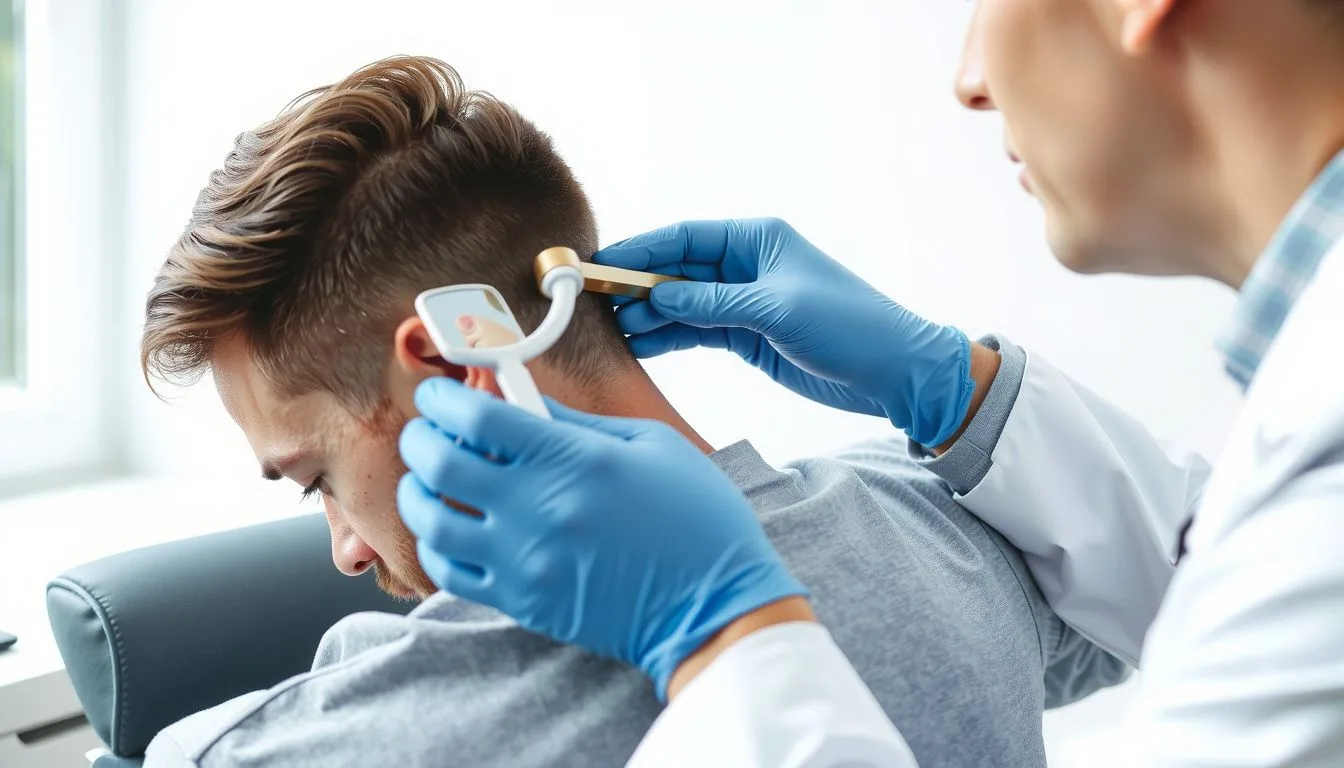
Diagnosis begins with structured self-observation and ends with a clinical assessment that distinguishes androgenetic recession from other causes. A man can start by noting where thinning appears: temple recession with preserved central density points toward a pattern process, while diffuse thinning or patchy loss suggests a different mechanism. Photographs taken under consistent lighting and angle help track change over months rather than days.
Clinicians then examine more than the hairline itself. They assess scalp density across regions, look for variation in hair caliber, and check whether follicles are miniaturizing. Miniaturization—the progressive shrinking of individual hairs—is the key finding that separates androgenetic alopecia from telogen effluvium, alopecia areata, or traction loss. A pull test, dermoscopy, and sometimes bloodwork for thyroid, iron, or other contributors help rule out competing explanations. Family history is also reviewed, since inheritance strongly influences both onset and pattern.
Staging systems provide a shared language for tracking progression. The Norwood scale remains the most widely used framework for male pattern hair loss, classifying recession from early temple changes through advanced crown and frontal involvement. Assigning a stage helps set realistic expectations: earlier stages generally respond better to treatment, while advanced stages may require different strategies. The diagnosed type and stage, not symptoms alone, should guide which treatment path is appropriate.
First-Line Androgenic Treatments: Finasteride and Dutasteride
When the diagnosis points to androgen-driven miniaturization, the first-line strategy is to interrupt the hormonal signal itself. Finasteride and dutasteride both belong to the 5-alpha-reductase inhibitor class, blocking the enzyme that converts testosterone into dihydrotestosterone (DHT), the androgen most responsible for shrinking susceptible hairline follicles. Finasteride inhibits the type 2 enzyme and is the longer-established option, while dutasteride inhibits both type 1 and type 2 enzymes, producing a more pronounced and consistent suppression of DHT.
That difference in potency shapes what each drug can realistically achieve at the hairline. Both are more effective at maintaining existing hair than at regrowing lost hair, and the frontal hairline tends to respond less dramatically than the crown. Noticeable change generally requires several months of continuous use, and benefits reverse if treatment stops, so commitment and patience matter as much as the prescription itself.
Tolerability is generally favorable, but a minority of men report reduced libido or sexual side effects, which usually resolve after discontinuation. Because these are prescription medications, dosing, monitoring, and any decision to switch between them should be guided by a clinician who can weigh your history and expectations.
Advanced and Alternative Options When Standard Therapy Falls Short

Standard therapy does not always deliver the result a man expects. Some patients respond poorly to finasteride or dutasteride, experience side effects they cannot tolerate, or present with loss advanced enough that preserving the hairline requires more than androgen suppression alone. In these situations, treatment moves from a single daily pill toward a broader plan.
Adjunctive options include topical minoxidil, which supports follicle growth independently of androgen pathways, and low-level laser therapy, which has modest but measurable supportive evidence. Procedural approaches such as platelet-rich plasma injections and hair transplantation address density and coverage directly, though transplantation redistributes existing hair rather than creating new follicles. Emerging strategies, including topical anti-androgens and prostaglandin analogs, remain under investigation and should be framed as promising rather than proven.
What matters most is combination therapy: matching interventions to the stage of loss, the patient’s tolerance, and his goals. No single option is universally best, and an individualized plan usually outperforms any isolated treatment.
FAQs
What are the most common causes of hairline loss in men?
The most common cause of hairline loss in men is androgenetic alopecia, a genetic sensitivity to dihydrotestosterone (DHT) that gradually miniaturizes hair follicles along the frontotemporal region. This pattern typically begins as a receding hairline and can progress to a widow's peak or broader frontal thinning. Other contributing factors include aging, chronic stress, nutritional deficiencies, and certain medical conditions or medications, though these are less frequent than hereditary DHT-driven loss.
How effective are androgenic treatment options for regrowing a receding hairline?
Androgenic treatments such as finasteride and dutasteride can slow or halt further hairline recession in many men, but they are generally more effective at preserving existing hair than regrowing hair that has already been lost. Minoxidil, often used alongside these agents, may support modest regrowth, particularly in the frontal and temporal regions. Results vary by individual, and the earlier treatment begins after hairline loss is noticed, the better the outcome tends to be.
When should men consider starting treatment for hairline loss?
Men should consider treatment for hairline loss as soon as they notice consistent thinning or recession, since early intervention preserves more existing follicles and generally produces better results. A doctor can confirm whether the cause is androgenetic alopecia and recommend options such as minoxidil, finasteride, or other therapies. Starting treatment early, rather than waiting for significant loss, gives the most reliable chance of slowing or partially reversing the process.