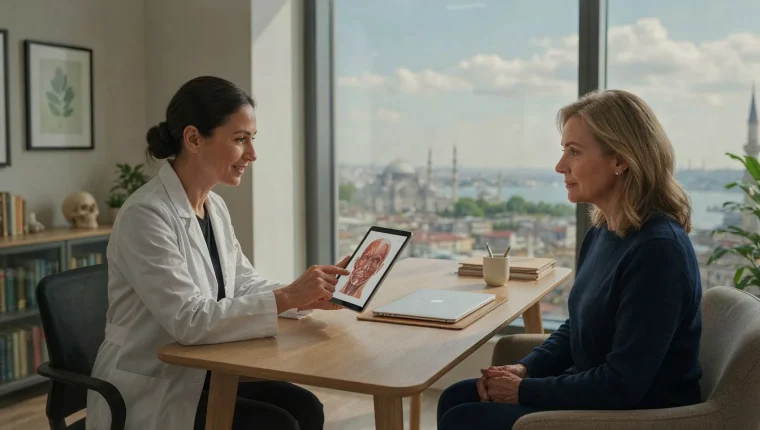
Do not choose a facelift clinic in Turkey based on a glossy Instagram ad. You are entrusting your face to a surgical team thousands of kilometers from home, so this choice affects your result, safety, and support after you fly back.
Comparing clinics does not have to feel overwhelming. What most patients lack is not information — it is a clear framework for evaluating it. That is exactly what this article provides: a practical, checklist-style approach covering credentials, before-and-after results, how clinics handle your first consultation, what pricing really includes, and what to expect for aftercare once you return home.
This guide is written for people seriously considering facelift surgery in Turkey — not general medical tourists browsing options. It is not medical advice, and it will not tell you whether a facelift is right for you. It will help you ask sharper questions and spot red flags before you commit.
Let’s start with why Turkey earned its reputation in the first place — and what that reputation does and doesn’t guarantee.
Why Turkey Has Become a Leading Destination for Facelift Surgery

Turkey’s rise in cosmetic surgery is not a marketing accident — it is the result of structure. The country performs one of the highest volumes of aesthetic procedures in the world, and that volume sustains a large ecosystem of dedicated clinics, experienced surgeons, and specialized operating facilities concentrated mainly in Istanbul, Ankara, and Izmir. High case numbers give surgeons the kind of repetition that shapes surgical skill over time.
The cost gap with Western Europe and North America also has practical explanations. Lower operating costs, favorable currency exchange rates, and a generally lower cost of living mean Turkish clinics can charge less while still maintaining international standards. Competition among hundreds of clinics pushes prices down further and drives service offerings like airport transfers and translator support.
However, the same abundance that makes Turkey attractive also creates wide variation in quality. For every well-accredited clinic, there are others that rely more on advertising than on medical rigor. That is why understanding the market alone is not enough — the sections ahead show you how to filter this crowded field and identify the clinics that genuinely deliver safe, natural-looking results.
What Accreditation and Surgeon Credentials Reveal About a Clinic
Credentials are the first filter every serious patient should apply, because they reveal whether a clinic is legally authorized to operate at all. Turkey’s Ministry of Health regulates all medical facilities, and legitimate clinics hold a health tourism authorization certificate alongside their standard operating license. Any clinic that hesitates to share these documents during initial contact is telling you something important before you even ask.
- International accreditation: Accreditation from bodies such as JCI (Joint Commission International) signals that a facility meets global standards for patient safety, hygiene, and surgical protocols.
- Board certification in plastic surgery: Confirm your surgeon is certified by the Turkish Society of Plastic, Reconstructive and Aesthetic Surgery or holds an equivalent international board qualification — not merely a “cosmetic surgery” certificate.
- Surgical volume: A surgeon who performs facelifts regularly, rather than occasionally, tends to have sharper judgment in intraoperative decisions and complication management.
- Hospital privileges: Surgeons with operating rights at established hospitals undergo additional vetting, which adds a layer of accountability beyond the clinic itself.
Credentials have honest limits. They prove a surgeon is qualified and a clinic is legal — they do not guarantee you will like your result, that communication will be smooth across time zones, or that aftercare will be handled well once you fly home. Think of accreditation as the entry ticket, not the review itself.
What credentials genuinely reveal is how a clinic responds to verification requests. Transparent providers send documents promptly and answer questions about their surgeons’ training without defensiveness. Evasive or vague responses at this stage often predict how the rest of your journey will unfold, so treat the credential check as an early test of the clinic’s overall professionalism.
How to Evaluate Before-and-After Results and Patient Reviews
A gallery of results is often the first thing a clinic will show you, and it deserves more scrutiny than a quick scroll. A trustworthy before-and-after gallery is built on consistent, unedited documentation: identical angles, neutral lighting, no makeup or filters, and clear timeframes showing when each photo was taken. Look for patients whose facial structure, skin type, and age resemble your own — a dramatic result on a 45-year-old with thick skin tells you little about what to expect if you are 62 with thin, lax tissue.
Cherry-picking is the most common form of manipulation. Be cautious when every photo shows the same handful of patients, when images are cropped to hide the neck or hairline, or when “before” photos are lit or angled to exaggerate sagging. Watermarked, professionally retouched images with smooth skin textures are another warning sign. Ask the clinic whether the results shown are from surgeries the surgeon personally performed, not just the clinic’s collective portfolio.
Patient reviews require the same critical eye. A high volume of five-star testimonials on the clinic’s own website carries far less weight than a steady pattern of feedback on independent, third-party platforms, where verification is harder to fake. Read the critical reviews first: how the clinic responded to complications, whether post-operative communication matched what was promised, and how patients describe the months after surgery — not just the first week.
Finally, pay attention to reviews written by international patients specifically. They reveal how well the clinic manages distance: remote follow-up, clear instructions, and honest expectations. Keep a shortlist of what you find, because the consultation is where these observations get tested directly.
Key Questions to Ask During Your Initial Consultation

The initial consultation is where most clinics quietly reveal who they really are. A confident, transparent team answers your questions directly and welcomes detail; a sales-driven operation changes the subject, pushes a package deal, or hands you off to a coordinator who cannot answer clinical questions. Preparing a short list of questions in advance gives you a reliable filter, because evasive answers are far easier to spot when you know exactly what you asked. The goal of this first contact is to test the clinic’s transparency — not to extract a final price or a guaranteed outcome, which no honest surgeon will offer at this stage.
- Who exactly will perform the surgery, and what is their role throughout my journey? Some clinics advertise a well-known surgeon but the operation is carried out by an assistant. Confirm the surgeon’s name, that you will meet them personally, and that they will handle your pre-operative assessment, the procedure itself, and your post-operative checks.
- Which technique do you recommend for my anatomy, and why? A skilled surgeon explains whether a deep plane, SMAS, or mini facelift suits your tissue quality and discusses the reasoning openly rather than selling one method to everyone.
- What are the realistic risks in my case, and how often do you encounter them? Honest clinics discuss nerve injury, hematoma, and asymmetry without hesitation and explain their complication rates.
- If a complication appears after I fly home, what is the protocol? You want a named contact, a written revision policy, and clarity on who covers costs.
- Can I speak directly with the anesthesiologist and see where the surgery takes place? Facility standards and anesthesia care matter as much as the surgeon’s skill.
Pay attention not only to the answers but to how they arrive. Clinics that put responses in writing, without you having to chase them, tend to behave the same way after payment. If a question is deflected with “we will discuss everything after you book,” treat that as meaningful data — the consultation itself is a rehearsal of your entire patient experience.
Understanding Costs: What Is Included in the Best Facelift Clinic Turkey Packages
Package pricing is where facelift comparisons get deceptive. Two quotes that look identical on a website can differ by thousands of dollars once you understand what each one actually covers. The most reliable way to compare offers is to ask every clinic for an itemized quote — a line-by-line breakdown rather than a single headline figure. Reputable clinics provide this without hesitation; hesitation itself is useful information.
Most Turkish packages are built around the surgical experience: the operation, anesthesia, hospital stay, and the logistics that make travel manageable. But the exclusions are where budgets break, and practices genuinely vary from clinic to clinic — always confirm in writing.
| Typically Included | Frequently Excluded — Clarify Before Booking |
|---|---|
| Surgeon and anesthesia fees | Pre-operative laboratory tests and imaging |
| Hospital or clinic stay | Post-operative medications and dressings |
| Airport and clinic transfers | Revision surgery policy and its costs |
| Hotel accommodation | Companion’s accommodation and meals |
| Interpreter assistance | Compression garments and follow-up products |
The revision policy deserves particular scrutiny. Ask whether a touch-up procedure is included, partially covered, or charged at full price, and under what conditions. Also confirm who pays if pre-operative testing reveals a condition requiring postponement. Getting these answers in writing before paying a deposit protects both your budget and your options.
Planning Your Recovery and Follow-Up Care After Returning Home
Recovery planning should shape your booking decisions as much as the surgery itself. Most surgeons recommend staying in Turkey for at least 10 to 14 days after a facelift. This window allows your team to monitor early healing, remove sutures, and confirm that swelling and drainage are progressing normally. Flying too soon carries real risks, including pressure-related complications and elevated blood pressure that can compromise healing incisions.
During the first two weeks, expect visible bruising and significant swelling. You will need to sleep with your head elevated, avoid bending or heavy lifting, and skip strenuous activity entirely. Most patients feel presentable enough for social settings around weeks three to four, while residual numbness and tightness can take several months to fully settle.
Plan your aftercare before you fly home. Identify a local physician or a trusted contact who can check your incisions if concerns arise, and confirm whether your clinic offers remote follow-up through video consultations and photo reviews. The strongest clinics document this follow-up care protocol in writing, so you know exactly who to contact and when.
FAQs
How much does a facelift cost in Turkey compared to the UK or the US?
A facelift in Turkey typically costs between $3,000 and $6,000, while the same procedure usually ranges from $10,000 to $15,000 in the UK and $12,000 to $20,000 in the US. This means patients can often save 50–70% by choosing Turkey, even after adding flights and accommodation. The lower prices mainly reflect reduced operating and labor costs rather than lower quality, as many Turkish clinics are internationally accredited and surgeons perform high procedure volumes.
What qualifications should I look for when choosing the best facelift clinic in Turkey?
Look for clinics where the surgery is performed by board-certified plastic surgeons with specific training and documented experience in facial procedures, such as membership in ISAPS or the Turkish Society of Aesthetic Plastic Surgery. Verify that the facility holds international accreditation (like JCI), has its own operating rooms, and can show before-and-after photos of real facelift patients. Check independent patient reviews and ask who will handle your aftercare and follow-up once you return home. Reputable clinics are transparent about surgeon credentials, complication rates, and all-inclusive pricing.
How long should I stay in Turkey for surgery and recovery?
Most patients should plan to stay in Turkey for 7 to 10 days after surgery, though the exact duration depends on the procedure. Minimally invasive treatments like hair transplants may require only 3 to 4 days, while major surgeries such as cosmetic, orthopedic, or bariatric procedures typically need at least a week for initial recovery and a follow-up check before flying. Your surgeon will confirm the safe timeframe based on your healing progress and give you medical clearance for travel.