Choosing a rhinoplasty surgeon in Turkey is rarely about picking the cheapest quote or the clinic with the flashiest website. It depends on whether a specific surgeon is the right match for your nose, your goals, and your tolerance for risk. Two people can have very different experiences with the same surgeon in the same operating room because rhinoplasty is a personalized procedure, not an assembly-line service.
Before you commit, it helps to separate what actually matters from what just looks convincing. Board certification and specialized training tell you something about a surgeon’s foundation. Before-and-after photos, when read critically, reveal more than the marketing around them. Reviews and testimonials hint at how a surgeon handles expectations, complications, and follow-up. A consultation should feel like a real conversation, not a sales pitch. And cost only makes sense once you understand what it includes and what it leaves out.
This is a decision you live with for years, so it deserves more than a quick scroll through Instagram results.
Why Certification and Specialization Matter in Turkish Rhinoplasty
Certification is the first filter that separates a qualified surgeon from a confident marketer. In Turkey, as elsewhere, the titles that genuinely matter are tied to recognized medical bodies. A surgeon may come from an ENT (otolaryngology) background or from plastic, reconstructive, and aesthetic surgery — both paths can produce excellent rhinoplasty results, but the training differs. ENT specialists typically bring deep knowledge of nasal function and airway anatomy, while plastic surgeons often train more heavily in aesthetic proportion and soft-tissue techniques. Neither background is automatically superior; what matters is whether the surgeon’s actual practice centers on the nose.
Here is where the language gets slippery. The phrase “rhinoplasty specialist” is, in most cases, a marketing label rather than a protected title. No universal governing body grants a legally exclusive right to that word, which means any clinic can print it on a website. What you can verify is board certification through official registries and membership in recognized associations. These records are public and confirm that a surgeon met a defined standard of training and examination — not that they are the right fit for your face.
That last point deserves honesty. Certification proves competence and accountability; it does not prove aesthetic alignment. A fully credentialed surgeon may favor a dramatic, scooped profile while you want something subtle and natural. Credentials tell you the surgeon is legitimately qualified to operate. Your consultation, and the questions you bring to it, tell you whether their vision matches yours.
How to Evaluate a Surgeon's Before-and-After Gallery
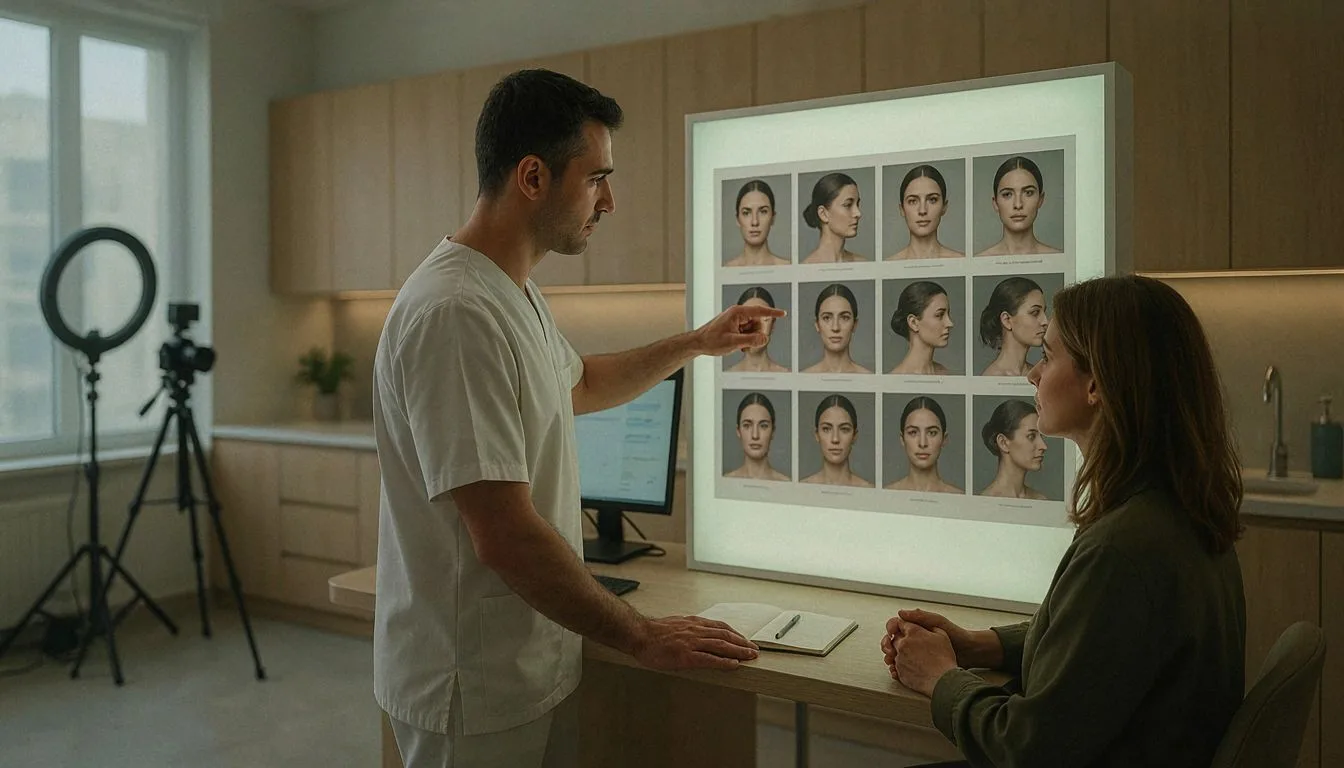
A before-and-after gallery is a portfolio, and like any portfolio, it rewards slow reading rather than quick scrolling. The first thing to check is consistency of presentation. In a credible gallery, every patient is photographed under the same lighting, from the same angles — typically front, both profiles, and a base view — and at a comparable point in recovery. When some photos are shot in soft studio light and others in harsh flash, or when angles shift between the “before” and “after” frames, the comparison is being flattered rather than shown. Subtle retouching, skin smoothing, or background blurring around the nose are also worth noticing, because they suggest the result needs help to look convincing.
Next, look at who is in the gallery. A surgeon who only shows young patients with thin skin and small dorsal humps is showing you a narrow slice of their practice. Ask yourself whether the gallery includes a range of nose types, skin thicknesses, and ethnic backgrounds, and whether any revision cases appear. Revision rhinoplasty is technically harder, so its presence — handled honestly — usually signals real experience rather than marketing confidence.
Then study the results themselves. Do the noses look like different people, or does every “after” photo converge on the same upturned tip and narrow bridge? A repeated aesthetic template can mean the surgeon applies one technique regardless of the face in front of them. Natural results vary; a signature look does not.
Finally, treat a small or heavily curated gallery as a question to raise in consultation, not as proof of anything. Ask how many of the surgeon’s cases are shown, how patients consented to publication, and whether you can see additional examples relevant to your own nose during your visit.
Reading Patient Reviews and Recognizing Red Flags
Reviews are useful, but only when you read them as data rather than as verdicts. A single glowing testimonial tells you almost nothing, and a single angry post tells you almost as little. What matters is the pattern across many reviews over time. If dozens of patients independently describe the same surgeon as patient, honest about limits, and available during recovery, that repetition carries weight. The same logic applies in reverse: when the same complaint appears again and again — breathing problems, a result that looks nothing like the simulation, or being rushed through appointments — that is a signal you should not dismiss.
Pay close attention to how a clinic handles criticism, because that response is itself information. A practice that replies calmly, acknowledges what went wrong, and explains how it was addressed is showing you how it behaves when things get difficult. Defensiveness, deleted comments, or aggressive replies to mild feedback reveal more about the culture than any five-star review. You should also be cautious with reviews that read like templates, appear in sudden bursts within the same week, or stay vague and generic. Genuine accounts tend to include specific details — dates, recovery milestones, how communication felt.
Finally, separate surgical complaints from logistics or communication complaints. A delayed airport transfer or a billing mix-up is annoying but says little about surgical skill. Concerns about the actual result, aftercare, or revision policy deserve far more weight. When reviews leave something unclear, that is exactly the kind of question to bring to a consultation.
What a Virtual or In-Person Consultation Should Cover

A consultation is where the surgeon moves from portfolio to your face. Whether it happens over video or in the clinic, the first thing to notice is whether the conversation starts with your goals or with a sales pitch. A good consultation opens with an honest discussion of what you want changed, how you breathe through each nostril, and what the anatomy of your specific nose allows. If a surgeon promises a certain look without examining or asking about your septum, cartilage strength, or skin thickness, that is a warning sign, not reassurance.
Ask directly whether imaging or morphing is offered and, more importantly, how it is explained. Simulation is a planning tool, not a guarantee, and a surgeon should say so plainly rather than using a flattering image to close the deal. The same honesty should apply to limitations: what can be improved, what cannot, and how likely a revision might be. A consultation that skips risks and recovery realities is incomplete.
Language support matters here too. If you do not speak Turkish, confirm whether an interpreter is available and whether the surgeon who consults with you is the same person who operates. In many clinics the surgeon who performs the surgery is not the one you meet at the initial visit, so clarify this before you commit. A rushed, vague consultation usually signals a rushed, vague surgical plan.
Comparing Costs Without Compromising Safety
Price is where the decision often gets emotional, so it helps to slow down and treat each quote as a package rather than a number. Ask what the figure actually covers: surgeon’s fee, anesthesia, operating room time, hospital stay, medications, and the follow-up visits that matter most in the first year. A quote that separates these items is easier to trust than a single lump sum, because you can see where the value sits and where it might be missing.
Hidden costs tend to appear later. Revision surgery is the big one, and policies vary widely — some surgeons include a revision within a defined window, others charge full price again. Extended hotel stays, additional nights in hospital, and aftercare once you are back home can quietly add hundreds or thousands. Before comparing totals, ask how long you are expected to stay in Turkey and who handles problems after you leave.
A very low price usually reflects a trade somewhere: shorter operating time, less experienced assisting staff, limited follow-up, or a clinic that runs on volume. None of these are automatically disqualifying, but you should know which one you are accepting. The most useful comparison is value per risk — what safety margin, surgeon attention, and aftercare you receive for the money, not which number is smallest.
Preparing Questions to Ask Before You Commit
Once you have compared credentials, galleries, reviews, consultations, and costs, the final step is converting all of that into a decision. The most reliable way to do this is to bring the same set of written questions to every surgeon you are seriously considering, so that you are comparing answers rather than impressions. A structured question list removes the pressure of thinking on the spot and makes evasive or rushed replies much easier to recognize.
Focus your questions on the details that shape your outcome and your safety. Ask which surgical technique the surgeon plans to use for your nose and why it suits your anatomy. Ask whether the procedure will be performed under general or local anesthesia with sedation, who administers it, and whether an anesthesiologist is present throughout. Ask directly about the surgeon’s revision policy: what percentage of patients require revision, what circumstances are covered, and what the cost would be. Ask who handles complications if they arise after you return home, and how emergencies are managed across time zones.
Follow-up deserves its own questions. Ask how many in-person follow-up visits are expected, how long you should plan to stay in the country, and how remote check-ins work once you are back home. Ask how you can send photos, how quickly the clinic responds, and who your point of contact will be. Then compare two or three surgeons side by side using identical criteria, so differences in clarity and consistency stand out.
Trust hesitation. If answers are vague, if the surgeon rushes past your questions, or if you feel pushed toward a decision before you are ready, that pattern matters more than any single answer. A surgeon who welcomes scrutiny and answers precisely is giving you the strongest signal that commitment is safe.
FAQs
How can I verify that a rhinoplasty surgeon Turkey is board-certified and experienced?
Check whether the surgeon holds certification from the Turkish Society of Plastic, Reconstructive and Aesthetic Surgeons (TSPRAS) or the Turkish Board of Plastic Surgery, and confirm registration with the Turkish Medical Association. You can also verify membership in international bodies such as ISAPS or EBOPRAS, which require documented training and examination standards. To assess experience, request before-and-after photos of rhinoplasty cases, ask how many of these procedures the surgeon performs annually, and look for reviews or testimonials from previous patients.
What should I ask about the surgeons revision rhinoplasty success rates before booking?
Ask how many revision rhinoplasty cases the surgeon personally performs each year and what percentage of those are secondary revisions, since high-volume, revision-focused practices tend to have more reliable outcomes. Request their revision rate and the definition they use for "success," including functional breathing improvement versus aesthetic result. Also ask to see before-and-after photos of revision patients specifically, and whether they track patient-reported satisfaction at one year or longer.
How do follow-up care and communication work after returning home from surgery in Turkey?
After returning home from surgery in Turkey, most clinics schedule follow-up contact through phone calls, video consultations, or email within the first few days and weeks to check wound healing, manage pain, and review test results. Your surgeon or an assigned coordinator typically provides a written recovery plan, medication instructions, and emergency contact details before discharge, and many hospitals offer remote monitoring through secure messaging apps. If complications arise once you are back in your home country, the Turkish clinic may coordinate with your local doctor or refer you to a nearby specialist, though you should confirm this arrangement in advance.