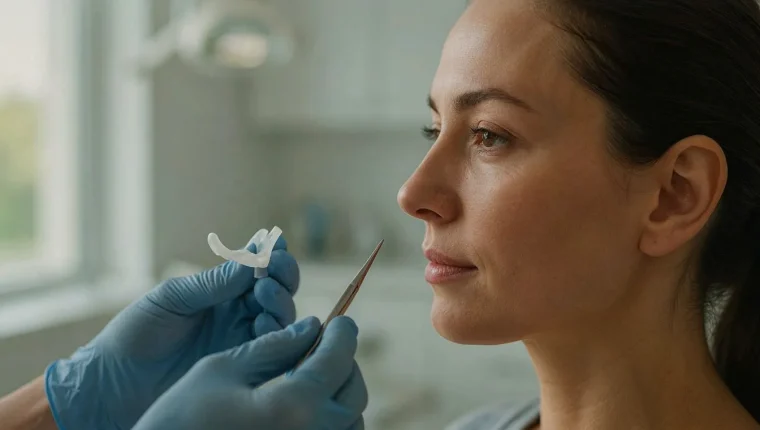
Adults considering rhinoplasty encounter two labels: open rhinoplasty and closed rhinoplasty. Both reshape the nose, are performed by the same surgeons, and can produce excellent results. The main difference is how much of the nasal framework the surgeon can see and reach during the procedure; it affects recovery, scarring, and control over subtle refinements.
What makes the decision frustrating is that neither technique is universally better. The right choice depends on the anatomy of your nose, the changes you want, and whether you’ve had previous nasal surgery. A technique that’s ideal for one patient can be the wrong tool for another with a different goal.
The practical path forward is understanding how each approach works, what it offers, and where its limits lie — so you can walk into a consultation with the vocabulary to ask the right questions and judge whether a surgeon’s recommendation genuinely fits your case.
What Open and Closed Rhinoplasty Actually Mean

In closed rhinoplasty, every incision stays inside the nostrils. The surgeon works through the natural openings of the nose, lifting the soft tissue lining just enough to reach the bone and cartilage beneath. Nothing is cut across the strip of skin between the nostrils, so the nasal framework is reshaped from within. Because the view is limited to what those internal openings allow, this approach is sometimes called the endonasal technique.
Open rhinoplasty adds one small step: a short incision across the columella, the narrow strip of tissue between the nostrils. That single cut lets the surgeon fold the skin flap upward, exposing the entire nasal framework in direct view. The trade-off is straightforward — one visible external incision in exchange for unrestricted access to the structures being reshaped.
What matters here is that both approaches reach the same anatomy and pursue the same goal: a nose that fits the face and functions well. The difference is the route, not the destination. One works through the nostrils; the other lifts the skin to see the framework directly.
That distinction in access is what shapes everything that follows — how much the surgeon can see while operating, and how that visibility influences the precision of the result. Understanding where the incision sits is the foundation for judging which route suits a given nose.
How the Surgical Approach Affects Visibility and Precision
Visibility during rhinoplasty is not about cosmetic preference — it determines how much the surgeon can actually control. When more of the underlying framework is exposed, reshaping becomes a series of deliberate decisions rather than educated estimates. That principle sits at the heart of how the two approaches differ in practice.
In open rhinoplasty, the surgeon works through a small external incision across the columella, lifting the skin envelope to reveal the full cartilaginous and bony structure. This direct, unobstructed view allows precise assessment of asymmetries, graft placement, and suture techniques, particularly in the nasal tip where cartilage is delicate and small adjustments produce visible changes. The surgeon can see the effect of each maneuver as it happens, which supports controlled, incremental refinement.
Closed rhinoplasty relies on internal incisions, preserving the columella but limiting exposure. The surgeon operates through the nostrils, viewing the framework indirectly and relying on tactile feedback alongside partial sight. For straightforward dorsal hump reduction or minor tip adjustments, this can be entirely sufficient. The trade-off is that complex tip reshaping or correcting subtle irregularities becomes harder to execute with the same level of precision, because the surgeon cannot fully verify the result until swelling subsides.
This distinction matters most in revision cases, where scar tissue and altered anatomy obscure landmarks. The broader exposure of the open technique often gives the surgeon a clearer map of what needs correcting, while closed surgery may leave certain structural issues difficult to identify or address. Neither approach is inherently superior — the question is whether the specific reshaping task demands the visibility that only one method reliably provides.
Key Differences in Recovery Time and Postoperative Swelling
Recovery from rhinoplasty is not a single event but a staged process. In the first 48 to 72 hours, swelling and bruising peak, and most patients spend that period resting with their head elevated. Over the following weeks, the majority of visible swelling resolves, though the nose continues to refine for months. The surgical approach influences this timeline mainly through how much the soft tissues are lifted and stretched during the procedure.
With the open technique, the columella is divided and the nasal skin is elevated more extensively to expose the framework. This broader dissection typically produces more pronounced early swelling and bruising, particularly around the tip and the bridge. Closed rhinoplasty, which works through internal incisions, tends to disturb less tissue, so patients often see a slightly faster initial recovery and less dramatic bruising in the first week. These differences are real but usually modest rather than dramatic.
Visible healing milestones follow a similar pattern. Most patients look presentable enough to return to work or social settings within one to two weeks, once the worst bruising has faded. By the one-month mark, residual swelling is subtle enough that others rarely notice it, though the tip may still feel firm. By three to six months, the nose has largely settled, and by the one-year point, the final result is typically visible. Open rhinoplasty patients may notice their tip swelling lingering a little longer, but the gap narrows considerably after the first few months.
It is worth remembering that individual healing varies widely. Skin thickness, age, the extent of reshaping performed, and how closely aftercare instructions are followed all shape the recovery experience. The surgical approach is only one factor among several, and a slower start does not mean a worse final outcome.
Scarring, Risks, and Complication Profiles Compared
Where the incisions are placed determines where the scars end up. In closed rhinoplasty, all cuts sit inside the nostrils, so there is no visible external scar at all. In open rhinoplasty, the surgeon adds a small incision across the columella — the strip of skin between the nostrils — which typically heals into a faint, thin line that most patients find barely noticeable once fully matured. That external mark is the trade-off for the wider exposure the open approach provides.
Complication profiles overlap more than people expect. Infection, bleeding, and unfavorable healing can occur with either technique, and neither approach eliminates those shared risks. What differs is where the specific concerns concentrate. The open method carries a slightly higher chance of scar-related issues and temporary numbness or stiffness around the tip, largely because more tissue is disrupted. The closed method, working through narrower internal access, can make certain asymmetries or residual irregularities harder to correct in a single pass, occasionally prompting revision.
Neither list should be read as a scoreboard. The honest framing is one of informed trade-offs: a hidden scar versus a small external one, broader surgical control versus a more limited working field. Which set of trade-offs matters more depends on your anatomy, your goals, and your surgeon’s experience with each method — factors worth raising directly before you decide.
Choosing the Right Technique for Your Nose and Goals

The features of your nose and the outcome you want carry more weight in this decision than any general preference for one approach. Certain case profiles tend to favor open rhinoplasty: a complex or bulbous tip that needs precise reshaping, significant asymmetry, a crooked or previously broken bridge, and revision surgery where scar tissue from an earlier procedure makes the anatomy harder to read. In these situations, the direct visibility of the nasal framework gives the surgeon more control over small adjustments that shape the final result.
Closed rhinoplasty tends to suit cases where the changes are more modest. A dorsal hump reduction, a slight tip refinement, or a narrow bridge adjustment can often be handled through internal incisions alone, with no external scar and typically less early swelling. If your goals lean toward subtle enhancement rather than major restructuring, the closed approach may offer a smoother path with fewer visible trade-offs.
Your goals shift the calculus just as much as your anatomy does. Wanting a natural-looking refinement rather than a dramatic transformation often points toward a less invasive route, while a full restructuring of tip, bridge, and projection may call for the exposure that open techniques provide. The honest answer is that no single factor decides this on its own — the features of your case and the result you’re aiming for have to be weighed together.
What matters most is that your surgeon’s assessment of your nasal anatomy drives the recommendation, not habit or convenience. A surgeon who defaults to one technique for every patient may not be reading your case closely enough. The right choice should follow from what your nose actually needs and what you genuinely want, which is exactly the ground you’ll want to cover in consultation.
Questions to Ask Your Surgeon Before Deciding
The consultation is where a technique recommendation should be justified rather than assumed. Ask your surgeon how many of these procedures they perform each year and what proportion of their practice is revision work—both numbers tell you how often they encounter the complications that follow a poorly chosen approach. Then ask them to explain, for your specific nose, what an open approach would let them see or do that a closed approach would not.
Listen for trade-offs, not guarantees. A surgeon who recommends a closed technique should be able to say what they would give up in exchange, and one favoring an open approach should acknowledge the visible columella incision and the slower early recovery it brings. Ask directly: “If my anatomy were different, would you still choose this?” A clear answer shows the recommendation was reasoned, not default.
Finally, ask what happens if the result falls short of your goal and how revisions are handled. Their response tells you whether the plan fits your priorities or simply the surgeon’s habits.
FAQs
Which approach gives the surgeon better visibility and control during reshaping of the nasal tip?
Open rhinoplasty generally gives the surgeon better visibility and control during nasal tip reshaping. By elevating the skin flap and exposing the underlying cartilage framework through a small columellar incision, it allows direct, three-dimensional access to the tip structures. This makes precise suturing, grafting, and repositioning easier, especially in complex or revision cases. Closed rhinoplasty preserves the tip's soft-tissue envelope but offers a more limited, indirect view.
How does recovery time and postoperative swelling typically compare between open and closed techniques?
Most surgeons find that closed rhinoplasty produces less immediate swelling and bruising because the procedure avoids disrupting the columellar skin and soft tissue, so many patients look presentable within about a week. Open rhinoplasty, with its small columellar incision, tends to cause more early swelling that can take two to three weeks to settle noticeably. By the three-to-six-month mark, though, the two techniques converge, and long-term recovery timelines and final swelling resolution are broadly similar.
Are there specific nasal deformities or revision cases where one approach is clearly preferred over the other?
For significant tip deformities, severe asymmetry, or complex revision cases with scar tissue and weakened cartilage, the open approach is generally preferred because it gives the surgeon direct, wide visualization of the underlying structures. Closed rhinoplasty tends to work well for more limited dorsal hump reduction or minor tip refinement where the framework is already stable and predictable. In revision surgery especially, the added exposure of the open technique usually outweighs the tradeoff of a small external scar.