If you’re an American considering a nose job overseas, you’ve probably noticed how often Turkey comes up. The pitch is hard to ignore: experienced surgeons, modern clinics, and prices that can be a fraction of what you’d pay in the U.S. But is it worth it, or just a tempting headline?
The answer depends on what you value most. Rhinoplasty in Turkey for Americans has become a genuine option, not a fringe one. Thousands of patients fly in each year, and many return satisfied. Still, the gap between a good outcome and a regrettable one usually comes down to research, not luck.
This guide covers the real costs, the quality of care, the risks, and the logistics you need to weigh before booking a flight. By the end, you’ll have a clearer sense of whether Turkey fits your situation, or whether staying closer to home makes more sense.
How Much Do Americans Actually Save on Rhinoplasty in Turkey?
When Americans start comparing quotes, the first number that jumps out is usually the surgeon’s fee. In the United States, primary rhinoplasty commonly runs between $6,000 and $15,000, and that figure often excludes anesthesia, operating room charges, and follow-up visits. In Turkey, all-inclusive packages for the same procedure typically land between $2,500 and $5,000, covering surgery, hospital stay, anesthesia, medications, and airport transfers. On paper, that gap can reach $8,000 or more for a single operation.
But the honest comparison isn’t just the surgical fee — it’s the total trip cost. Add round-trip airfare from a major U.S. city, roughly $700 to $1,400 depending on the season, plus 7 to 10 nights in a hotel near the clinic, which often runs $60 to $150 per night. Many Turkish clinics bundle accommodation and transfers into the package, which narrows the real-world difference. Even with flights and lodging counted separately, most American patients still come out $3,000 to $6,000 ahead compared with a comparable U.S. quote.
Two variables decide whether those savings hold up:
Revision risk. If a patient needs a second surgery, the savings evaporate quickly. A revision in the U.S. can cost $10,000 or more, and paying for it out of pocket after an overseas primary procedure wipes out the original discount. This is why the cheapest package is rarely the smartest one.
Surgeon selection. The price spread inside Turkey is wide. A board-certified plastic surgeon with a strong revision portfolio charges more than a clinic advertising bargain rates — and that premium is usually worth it.
Currency movement matters too. Because most Turkish clinics quote in euros or dollars, the exchange rate rarely changes the sticker price for American patients, though it does affect local costs like meals and transport. The genuine savings, then, come from lower operating costs and overhead in Turkey, not from a temporary currency advantage.
What Qualifications Should You Verify in a Turkish Rhinoplasty Surgeon?

Credentials are where the real decision gets made. Two surgeons can quote the same price and show you equally polished before-and-after galleries, yet only one may hold the specific training and legal standing that gives you recourse if something goes wrong. Turkey’s health tourism sector is regulated, but the rules apply to clinics and hospitals, not to every provider who advertises online. That gap is exactly where American patients get into trouble, so verification needs to happen before you pay a deposit — not after you land in Istanbul.
The single most important document to confirm is board certification from the Turkish Ministry of Health in plastic, reconstructive, and aesthetic surgery. General practitioners and ENT specialists can legally perform some nasal procedures in Turkey, but only a certified plastic surgeon completes the multi-year residency that covers both function and aesthetics.
- Ministry of Health certification: Ask for the surgeon’s registration number and verify it through the official physician inquiry system rather than trusting a screenshot.
- ISAPS or EBOPRAS membership: International society affiliations require documented case volumes and peer review, which filters out cosmetic-only operators.
- Hospital privileges: Confirm the surgeon holds operating rights at a JCI-accredited facility, since that accreditation imposes its own credentialing checks.
- Rhinoplasty-specific case volume: Request a portfolio of at least 100 primary and revision noses, and look for patients whose facial structure resembles yours.
- Revision rate and complication policy: A surgeon who tracks and discloses revision percentages is more transparent than one who claims a perfect record.
Documentation matters as much as the surgeon’s name. Board certificates, malpractice or professional liability coverage, and a written contract that specifies what happens if a revision is needed should all be provided in English before you commit. If a clinic resists sharing these, treat that hesitation as your answer. The surgeons worth flying for will hand over verification without being asked twice.
How Does the Consultation and Surgery Process Work for American Patients?
For most American patients, the journey begins long before boarding a flight to Istanbul. The typical path starts with an online consultation, usually conducted over video or through detailed photo submissions. You’ll be asked for front, profile, and base-view images, along with a clear description of your breathing concerns and aesthetic goals. A reputable surgeon or their coordinator reviews these materials and responds with a preliminary assessment — often within 24 to 72 hours. This is your first real chance to judge communication quality, since everything that follows depends on how clearly the clinic explains what’s realistic and what isn’t.
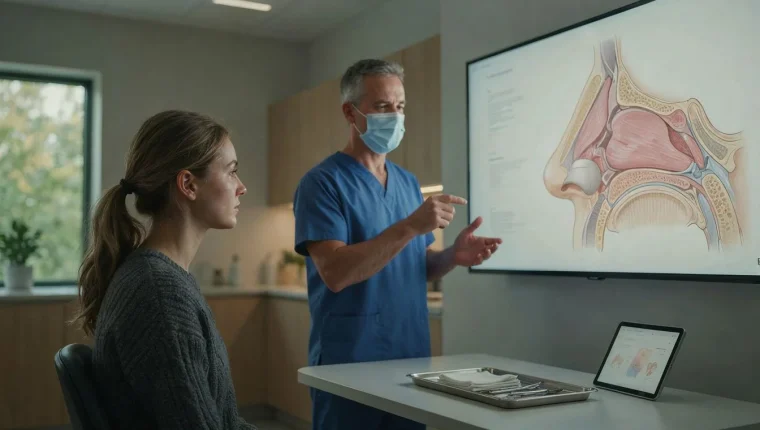
Once you accept a quote, the clinic typically arranges a surgical package that bundles the procedure, hospital stay, medications, and sometimes accommodation and airport transfers. You’ll usually be asked to arrive in Turkey three to five days before surgery. That window covers the in-person examination, blood tests, and a final face-to-face consultation where the surgeon confirms the plan and marks your nose. This step matters more than most patients expect: a physical exam can reveal cartilage strength, skin thickness, or airway issues that photos simply cannot show.
Surgery itself takes place in a hospital or accredited clinic and generally lasts two to four hours under general anesthesia. Most American patients stay one night in the hospital, then move to a hotel for the remainder of their trip. A follow-up visit is scheduled before you fly home, where the surgeon removes splints or stitches and checks that healing is on track. The entire in-country stay usually runs seven to ten days.
What makes this process workable for Americans is the compressed timeline: consultation, surgery, and initial recovery all fit into a single trip. The trade-off is that you won’t have the same easy access to your surgeon for minor questions once you’re back in the United States. That’s why asking upfront how post-operative communication is handled — and who answers your emails — is worth doing before you commit.
What Does Recovery Look Like Before Flying Back to the United States?
Most American patients stay in Turkey for roughly 7 to 10 days after surgery, and the recovery timeline is built around one fixed deadline: the flight home. The first 24 to 48 hours involve nasal packing or splints, significant swelling, and a nurse or coordinator checking you regularly. Expect to sleep propped up, avoid blowing your nose, and take prescribed antibiotics and pain relief on schedule.
By day 3 or 4, most patients are walking, eating normally, and moving around the hotel with a light activity level. Bruising around the eyes usually peaks in the first 72 hours and begins fading by the end of the first week. The critical appointment is splint removal, typically on day 6 or 7, when your surgeon inspects the result and confirms you are fit to travel. This is the moment that determines whether your departure date holds.
Before your surgeon clears you to fly, several conditions should be met:
- No active bleeding, infection, or uncontrolled swelling
- Splints and stitches removed or scheduled for removal
- Written clearance and post-operative instructions for your flight
- A direct contact method for follow-up questions after you land
Air travel itself adds risk. Cabin pressure and dry air can increase swelling, and long-haul flights raise the chance of minor nosebleeds. Most surgeons ask patients to avoid heavy lifting, strenuous exercise, and any activity that raises blood pressure for at least two to three weeks. Compression and elevation remain your main tools during the flight: keep your head elevated, hydrate often, and use saline spray if your surgeon approves it.
Once home, the timeline continues. Swelling resolves gradually over 6 to 12 months, with the tip of the nose often the last area to settle. Your Turkish surgeon should provide a structured remote follow-up plan, and you should arrange a local ENT or plastic surgeon for in-person checks during the first few months.
Which Risks and Revision Scenarios Should Americans Consider?

Every surgery carries risk, and a nose job is no exception. What makes the decision harder for someone flying thousands of miles is that complications do not wait for a convenient moment. A problem that appears on day three in Istanbul is manageable; the same problem on day ten, after you land in Chicago or Dallas, is a different situation entirely. Understanding which risks are common, which are serious, and what a revision would actually require is part of making an informed choice rather than an optimistic one.
The most frequently discussed concern is revision rhinoplasty, and the numbers matter. Primary rhinoplasty has a revision rate that most surgeons place between 5 and 15 percent, even in the best hands. That figure does not improve simply because the surgery happened abroad; if anything, the logistics of a second procedure become more complicated when your surgeon is in another country. Beyond revision, American patients should weigh the following scenarios before booking:
- Breathing problems: A deviated septum or narrowed internal valve can persist or emerge after surgery, sometimes requiring a functional correction rather than a cosmetic one.
- Infection or delayed healing: Signs such as fever, spreading redness, or unusual discharge need prompt medical attention, and you should know in advance which local clinic or hospital your surgeon coordinates with.
- Asymmetry or an unsatisfactory result: Minor irregularities often settle over six to twelve months, so surgeons typically ask patients to wait before judging the final outcome.
- Anesthesia and general surgical risks: Blood clots, adverse reactions, and cardiovascular events are rare but real, which is why the surgical facility and anesthesia team deserve the same scrutiny as the surgeon.
- Travel-related complications: Flying too soon after surgery, or developing a clot during a long return flight, can turn a routine recovery into an emergency.
If a revision becomes necessary, the practical questions shift. Most reputable Turkish surgeons offer a revision policy, but it usually covers only the surgical fee, not flights, hotels, or time away from work. Some policies require you to return within a defined window, often six to twelve months, and a few exclude cases where the patient did not follow post-operative instructions. Ask for the revision policy in writing before you pay a deposit, and confirm whether it applies to functional problems as well as cosmetic ones.
Is Rhinoplasty Turkey for Americans the Right Choice for Your Goals and Budget?

The honest answer is that this decision rarely comes down to price alone. You already know what the numbers look like, what recovery demands, and where the risks sit. What remains is matching those facts to your own situation rather than to someone else’s before-and-after story.
Start with your goal, not the discount. If you want a subtle refinement — a small dorsal hump smoothed, a tip slightly rotated — you may be a strong candidate for a primary procedure abroad. If you need complex structural work, revision rhinoplasty, or you have a history of breathing problems, the calculus shifts. Revision cases demand a surgeon who has seen your specific pattern many times, and the pool of those surgeons is smaller everywhere, including in Turkey.
Then weigh your budget honestly. A quote thousands below a U.S. price is real money, but build the full picture: flights, lodging for you and possibly a companion, time off work, and the cost of a revision if the first result misses. Ask yourself whether you could absorb that second surgery financially and emotionally. If the answer is no, a lower-priced primary operation may not be the bargain it appears.
Consider your tolerance for distance. Follow-up visits happen in Turkey, not down the street. If a concern arises at week three or month six, you will manage it by video, photos, and possibly a local ENT who did not perform the surgery. Some patients handle this well; others find it isolating.
Finally, be clear about what “worth it” means to you. If your priority is a skilled surgeon, a transparent package, and meaningful savings — and your case is straightforward — Turkey can be a genuinely sound choice. If your priority is immediate access to your surgeon for years of follow-up, or your case is complex, staying closer to home may serve your goals better. Neither answer is wrong; only a mismatched one is.
FAQs
How much can Americans realistically save on rhinoplasty in Turkey compared to U.S. prices?
Americans typically save 60 to 80 percent on rhinoplasty in Turkey, paying roughly $2,500 to $4,500 compared with $8,000 to $15,000 in the United States. These figures usually include surgeon fees, hospital stay, anesthesia, and follow-up visits, though travel and lodging are extra. The gap is driven mainly by lower labor and operating costs in Turkey, not by lower surgical standards at accredited clinics.
Is rhinoplasty Turkey for Americans safe enough given the risks of traveling abroad for surgery?
Rhinoplasty in Turkey can be safe for Americans when performed by board-certified plastic surgeons at accredited, JCI-certified hospitals that meet international standards. The main risks come less from the surgery itself than from travel-related factors such as flying too soon after the procedure, limited follow-up care, and difficulty managing complications once back home. Choosing an experienced surgeon, allowing adequate recovery time before flying, and arranging postoperative follow-up with a doctor in the US substantially reduce these risks.
What should Americans check about a Turkish surgeons credentials before booking a nose job?
Verify that the surgeon holds current certification from the Turkish Medical Association and, for hospital-based work, Ministry of Health approval, since these are the core legal credentials for practicing medicine in Turkey. Check whether the surgeon completed a recognized plastic, reconstructive, and aesthetic surgery residency and whether they belong to the Turkish Society of Plastic, Reconstructive and Aesthetic Surgeons, which enforces specialty standards. Confirm that their claimed board certification is verifiable through the issuing body rather than only through clinic marketing materials. Ask specifically about the surgeon's rhinoplasty volume, revision rates, and who provides follow-up care once you return to the United States.