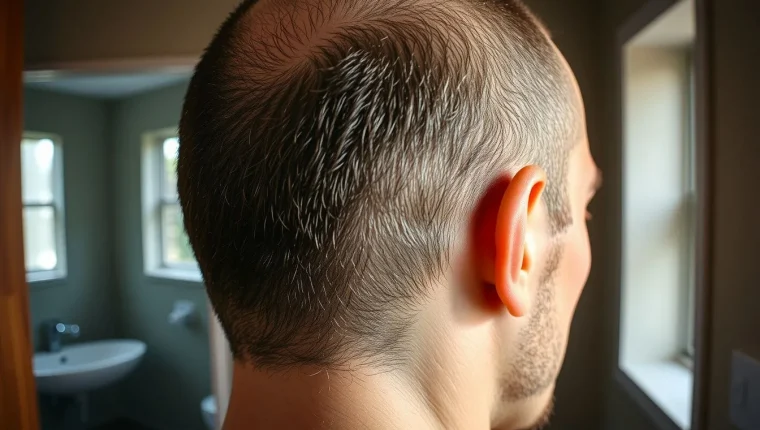
Noticing a small, smooth patch of thinning hair at the crown is one of the most common experiences in adult men. It rarely appears overnight. More often, it develops gradually, starting as subtle density loss that becomes easier to see in certain lighting or in a photo taken from behind. For many men, this raises a practical question: is this normal hair loss, or will it keep progressing?
The answer usually sits within a well-documented pattern called androgenetic alopecia, the leading cause of a male bald spot. Understanding what that patch signals, how it differs from a receding hairline, and which treatments can realistically slow or restore growth helps you move from uncertainty to a clear decision.
Recognizing the Earliest Signs of a Thinning Crown
Most men first notice a change in the crown through indirect signals rather than a clear patch. A photograph taken from above, a barber’s comment, or the sudden visibility of the scalp under bright overhead light often prompts the first real look. At this stage, the thinning is usually diffuse, which is why it can go unnoticed for months.
The earliest visual signs are subtle: the part line at the crown appears wider, the hair no longer sits as densely when wet, and styling products that once added volume seem to fall flat. In stronger light, the scalp becomes faintly visible through the hair rather than clearly exposed. Some men also notice more hairs than usual on the pillow or in the shower drain.
Tactile cues matter too. Running fingers across the crown may reveal a softer, less resistant texture and reduced density compared with the sides. This is the key distinction: patterned thinning concentrates at the crown and spares the surrounding areas, while normal shedding is spread evenly across the scalp. A useful reality check is to compare the crown with the back and sides, where androgenetic loss typically lags behind.
These signs deserve attention when they persist and progress over several months, since early evaluation gives the widest range of options. Occasional shedding after illness or stress usually reverses on its own; gradual, localized crown thinning does not.
How Androgenetic Alopecia Affects Hair Follicles Over Time

Androgenetic alopecia is driven by a genetically inherited sensitivity to dihydrotestosterone (DHT), a hormone derived from testosterone. In susceptible men, DHT binds to receptors in certain hair follicles and gradually disrupts the normal growth cycle. Follicles in the crown and frontal scalp tend to be the most vulnerable, which is why thinning often appears there first.
Over time, this hormonal influence causes a process called follicular miniaturization. Each affected follicle becomes smaller and its growth phase shortens, so the hair it produces grows back thinner, shorter, and lighter with every cycle. Eventually, some follicles stop producing visible hair altogether.
This progression is slow and cumulative, which explains the timeline of a developing bald spot. What begins as barely noticeable thinning can, over years, widen into a clearly defined area. Because miniaturization is gradual, the follicles are not lost immediately—they remain present but diminished. This is why early intervention matters: acting while follicles are still active gives the best chance of preserving existing hair.
Distinguishing a Receding Hairline From Vertex Hair Loss
Hairline recession and vertex thinning follow different paths, even though both stem from the same underlying condition. A receding hairline typically begins at the temples, where the hairline gradually moves backward and forms the familiar M-shaped pattern. This progression is usually slow and symmetrical, and it changes the shape of the frontal hairline rather than creating a distinct patch. Vertex loss, by contrast, starts as a circular thinning area on the crown, often expanding outward while the frontal hairline remains largely intact for years.
The key distinction lies in location and progression pattern. Hairline recession moves along the front of the scalp, while vertex thinning develops behind the top of the head. Many men experience both simultaneously, which is why pattern recognition matters. If your temples are receding but your crown feels full, your loss is primarily frontal. If your hairline is stable but the crown is thinning, the vertex is the main concern.
This difference affects treatment choices. Topical treatments spread easily across the frontal hairline, while the crown may respond differently to the same product. Knowing your pattern helps you track changes accurately and discuss realistic options with a clinician.
First-Line Treatments for Early-Stage Male Pattern Baldness
For early-stage male pattern baldness, two medications form the standard first line of treatment: minoxidil and finasteride. Both are supported by decades of clinical use, and both work best when started before significant follicle loss has occurred. Minoxidil is a topical solution or foam applied directly to the thinning area. It extends the growth phase of the hair cycle and improves blood flow to the follicle, which can thicken existing hairs and encourage regrowth. Finasteride is an oral prescription that blocks the conversion of testosterone into dihydrotestosterone (DHT), the hormone responsible for follicular miniaturization. By reducing DHT, finasteride slows or halts further shrinkage of susceptible follicles.
The two treatments differ in what they realistically achieve. Minoxidil tends to produce visible regrowth in some men, but its main benefit is maintaining current density. Finasteride is more effective at slowing loss and preserving hair over the long term, though regrowth is modest and varies. Neither restores hair in areas that have already gone completely bald, which is why timing matters. Combining both is common and often more effective than either alone.
Matching a treatment to your stage and pattern is essential. If thinning is concentrated at the crown, minoxidil foam is easy to apply and well tolerated. If the hairline is receding, finasteride may be the stronger choice because topical application at the front is less practical. A dermatologist can confirm the diagnosis and rule out other causes of hair loss. Most men see initial results within three to six months, and consistent use is required to maintain any benefit.
Advanced Options When Initial Therapies Fall Short

When first-line treatments such as minoxidil and finasteride produce only limited regrowth or fail to slow thinning, the next step is a professional evaluation rather than simply switching products. A dermatologist can confirm whether the diagnosis is androgenetic alopecia, rule out other causes, and assess how much viable follicular miniaturization remains in the crown.
Advanced categories generally fall into two groups. Procedural options include platelet-rich plasma injections, low-level laser therapy, and hair transplantation, which redistributes healthy follicles to the thinning area. Medical additions may involve oral minoxidil, dutasteride, or topical anti-androgens, often used when standard dosing has plateaued.
Combination strategies tend to outperform any single approach, since they target different stages of the same process. Hair transplantation can restore density in a defined bald spot, but it works best when ongoing medical therapy protects the surrounding native hair from further loss.
Choosing among these options depends on pattern, age, budget, and how much donor hair is available. Professional guidance is essential, because the right sequence and combination matter as much as the individual treatments themselves.
FAQs
What are the earliest signs of a male bald spot that most men overlook?
The earliest sign of a male bald spot is usually a subtle thinning at the crown or vertex, where the scalp becomes slightly visible under bright light before any real patch appears. Many men also notice increased hair in the shower drain or on the pillow, along with finer, shorter hairs at the temples and crown. A widening part or a change in how the hair sits after styling often points to early androgenetic alopecia. Recognizing these cues early allows treatments like minoxidil or finasteride to work best while hair is still present.
How quickly can androgenetic hair loss progress once a male bald spot starts forming?
Progression varies widely, but many men notice visible thinning or expansion of the bald spot within one to five years once it begins. Some advance slowly over decades, while others lose ground quickly due to genetics, age, and hormone sensitivity. Because early treatment works best, a man who spots the first signs should consider evaluation and proven options like minoxidil or finasteride rather than waiting.
Which treatments actually regrow hair on a male bald spot, and which ones only slow it down?
Minoxidil and finasteride are the two treatments with the strongest evidence for regrowing hair on a male bald spot, though results vary and are usually modest, with best outcomes in early stages. Minoxidil prolongs the growth phase and can thicken existing follicles, while finasteride lowers DHT to reverse miniaturization on the crown and mid-scalp. Procedures like platelet-rich plasma, low-level laser therapy, and hair transplantation can also restore density, but medications such as these mainly work to slow or stop further loss when the follicle is still active. Once a follicle is fully scarred and dormant, only surgical transplantation reliably regrows hair in that area.