If you are a Canadian considering chin augmentation in Istanbul, you are weighing meaningful savings and skilled surgeons against distance, unfamiliar clinics, and the risk of getting it wrong. This guide is built for that decision. It covers your surgical and non-surgical options, how to vet Istanbul surgeons and clinics, what to prepare before you fly, what recovery looks like, how to budget and pay, and how to protect your results long after returning home. Think of it as practical decision support, not medical advice. First, know exactly what you are choosing between.
Why Canadian Patients Choose Istanbul for Chin Augmentation

Canadians who start researching chin augmentation abroad usually arrive at the same question from two directions: they want a result they feel confident about, and they want the decision to make practical sense. Istanbul tends to enter the conversation because it sits at the intersection of both. The city has developed a substantial medical-travel infrastructure — internationally connected private hospitals, clinics accustomed to foreign patients, and surgeons who routinely work with facial proportions across different ethnic backgrounds. For a Canadian with a specific chin goal, that exposure matters.
The motivations are rarely identical. Cost is one driver, though the real gap depends on the procedure, the surgeon, and what aftercare is included, so exact savings should be confirmed case by case rather than assumed. A second driver is access: some patients feel their options at home are limited for the particular correction they want. A third is simply the trip itself — combining a procedure with time in a city that draws visitors for reasons beyond medicine.
The trade-offs deserve equal weight. Distance from home, language differences, and the reality of follow-up care across time zones all shape the experience. None of these are reasons to rule Istanbul out, but they are reasons to plan deliberately rather than react to a price tag.
Understanding Chin Augmentation: Surgical vs. Non-Surgical Options
Chin augmentation splits into two broad families: surgical and non-surgical. Surgical options change the bone or replace its contour. A chin implant is a prefabricated shape, usually silicone, placed against the jawbone through a small incision either under the chin or inside the mouth. A sliding genioplasty cuts the chin bone itself, moves it forward, backward, or vertically, and fixes it with plates and screws. Implants are faster to place and easier to remove; genioplasty moves your own bone and can correct height and asymmetry as well as projection.
Non-surgical options add volume instead of restructuring bone. Dermal filler, typically a hyaluronic acid gel, is injected to build projection and smooth the jawline. Fat transfer harvests your own fat, purifies it, and injects it into the same area. Filler is the more predictable of the two because it can be dissolved if you dislike the result; fat transfer is less reversible once it takes.
The decision factors are permanence, reversibility, recovery, and revision potential. Implants and genioplasty are effectively permanent and involve real surgery with swelling and downtime. Filler is temporary, usually lasting months to a couple of years, with minimal recovery. Fat transfer sits between them. Suitability is a clinical judgment about your bone structure, soft tissue, and goals, not a preference you can simply choose.
How to Evaluate a Clinic and Surgeon in Istanbul
Evaluating a surgeon in Istanbul comes down to verifying credentials, not admiring marketing. Start with board certification and specialty training: a qualified plastic or maxillofacial surgeon should hold recognized certification and be able to explain where and how they trained specifically in facial procedures, including the chin.
Ask for before-and-after cases that show actual chin work, not generic facial galleries. Request the surgeon’s revision policy in writing, and confirm that your consultation happens directly with the operating surgeon rather than a sales coordinator. If a clinic pushes you toward a deposit before you have spoken to the doctor, or refuses to give clear pricing, treat that as a red flag.
Language and consent matter too. Ask whether an interpreter is provided for your consultation and whether consent documents are available in English. You should understand every term you sign, including what the procedure involves and how complications are handled.
Finally, verify hospital privileges and where the surgery will take place. A surgeon who operates in accredited facilities and answers your questions without pressure is a stronger signal than any advertisement.
Preparing for Your Chin Augmentation Journey from Canada
Once you have chosen a surgeon, the weeks before your flight become a logistical project as much as a medical one. Most Istanbul clinics will ask you to complete a pre-operative consultation and send recent photographs or imaging so the surgical plan can be refined before you arrive. You will also be asked to review your medications, because blood thinners, certain anti-inflammatories, and some supplements need to be paused on a schedule your surgeon sets. Blood work and any required imaging are usually arranged close to your travel date so results stay current.
Your paperwork deserves the same attention as your medical prep. Check that your Canadian passport has at least six months of validity beyond your return date, confirm current entry requirements for Turkey, and request copies of relevant medical records from your family doctor.
- Flight timing: Book arrival at least one full day before your scheduled consultation, so a delay cannot push your surgery date.
- Accommodation: Choose a hotel within walking distance of the clinic for the first few nights, when travel across the city is uncomfortable.
- Companion planning: If someone travels with you, brief them on pickup times, pharmacy runs, and when you will need help.
- Time off work: Arrange leave that covers the procedure, the early recovery days in Istanbul, and the flight home.
Mental preparation matters just as much. Write down your questions, agree on realistic expectations with your surgeon, and accept that swelling will hide your result for a while. Arriving calm, organized, and informed makes the days around surgery far easier to manage.
What to Expect During the Procedure and Recovery
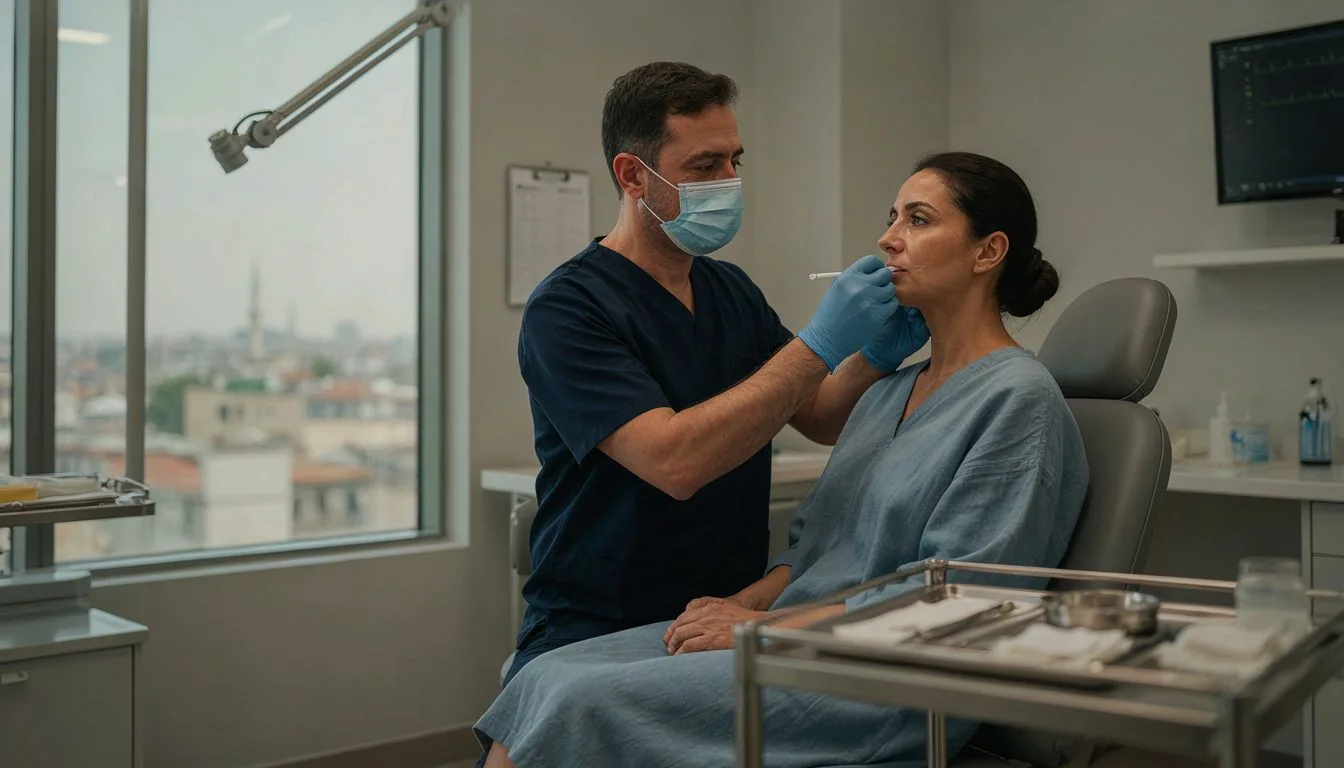
On the day of surgery, you will typically arrive at the clinic a couple of hours early for final markings, consent paperwork, and a last conversation with your surgeon. Most chin augmentations are performed under local anesthesia with sedation or general anesthesia, and the procedure itself usually takes between 45 minutes and two hours, depending on whether you are receiving an implant, filler, or a sliding genioplasty. If an implant is placed, a small incision is made either inside the mouth or under the chin, and dissolvable sutures are common. You will spend a short time in a recovery area before being cleared to return to your hotel with a companion.
The first 48 to 72 hours bring the most noticeable swelling and bruising. Cold compresses, head elevation, and a soft or liquid diet help limit discomfort. Most patients manage pain with over-the-counter medication, though your surgeon may prescribe something stronger. Expect to avoid strenuous activity, bending, and heavy lifting for at least a week. Sutures, if non-dissolvable, are usually removed around day five to seven.
Swelling subsides gradually over two to three weeks, with residual puffiness fading over several months. Contact your surgeon promptly for fever, spreading redness, unusual asymmetry, or pain that worsens rather than improves. Mild bruising, tightness, and numbness around the chin and lower lip are normal and typically resolve on their own.
Managing Costs, Travel, and Aftercare Logistics
Budgeting for chin augmentation abroad means looking past the surgeon’s quote. The full picture includes the surgeon fee, hospital and anesthesia charges, the implant or filler product itself, medications, and any follow-up visits. Ask for an itemized written estimate so nothing arrives as a surprise later.
Payment is usually handled through a deposit to secure your date, with the balance due before surgery. Confirm in writing what the deposit covers, whether it is refundable, and which cards or transfers the clinic accepts. Currency conversion fees and international transaction charges from your Canadian bank are easy to overlook, so factor those in.
Travel logistics depend on how long you stay. Most patients plan around seven to ten days in Istanbul, allowing time for the procedure, an initial check, and a follow-up before flying home. Book flexible flights where possible, and choose lodging close to the clinic to reduce stress in the early days.
Aftercare does not end at the airport. Arrange remote check-ins by video or photo, and identify a local physician in Canada who can review healing if needed. Keep your surgical notes and implant details handy for any provider you see afterward.
| Item | What to Confirm |
|---|---|
| Surgeon & hospital fees | Itemized quote, inclusions |
| Anesthesia & implants | Type, brand, cost |
| Medications | Post-op supply, refills |
| Deposit & payment | Refund policy, methods |
| Flights & lodging | Flexible dates, proximity |
| Follow-up | Remote checks, local doctor |
Ensuring Safe Results and Long-Term Satisfaction
Even a technically successful chin augmentation can leave a patient disappointed if expectations were never aligned with what the procedure can realistically deliver. A chin implant or filler adds projection and improves proportion, but it cannot reshape the jawline, correct a bite problem, or slim the lower face. Before surgery, ask your surgeon to walk through your imaging or simulation and to state plainly which of your goals are achievable and which are not. Patients who hear that conversation up front tend to be far more satisfied six months later.
Knowing the warning signs of complications matters as much as choosing the right surgeon. Persistent fever, spreading redness, increasing pain, numbness that does not fade, or a shifting implant all warrant urgent contact with a medical professional. Because you will likely be back in Canada during the early healing weeks, arrange in advance which local physician or walk-in clinic you would contact, and keep your surgical records and implant details accessible.
If results fall short, revision surgery is possible, though timing is critical: most surgeons wait at least six months for swelling to resolve and tissues to settle. A minor asymmetry may need only filler adjustment, while implant repositioning or replacement is a larger undertaking. Ask whether your original surgeon offers revision terms and whether a Canadian surgeon would take on follow-up. Long-term satisfaction usually comes down to honest expectation-setting, vigilant aftercare, and a clear plan for the months and years after you fly home.
FAQs
How much does chin augmentation in Istanbul typically cost for Canadian patients compared to prices in Canada?
Chin augmentation in Istanbul typically costs between $2,500 and $5,000 for Canadian patients, depending on whether the procedure uses fillers, implants, or bone surgery, while the same procedures in Canada generally range from $4,000 to $10,000 or more. The savings usually come from lower operating and labor costs in Turkey, and many Istanbul clinics offer package deals that include hospital fees, anesthesia, and follow-up visits. Canadian patients should factor in flights, accommodation, and potential revision costs, since these are not always covered in quoted prices.
What should Canadian patients know about recovery time and flying home after chin augmentation in Istanbul?
Most patients can fly home about 7 to 10 days after chin augmentation in Istanbul, once initial swelling and bruising have eased and your surgeon confirms you are fit to travel. Long-haul flights raise the risk of blood clots, so plan to walk regularly, stay hydrated, and follow any advice on compression stockings or blood thinners. Full recovery takes several weeks, with residual swelling settling over 3 to 6 months, so arrange a follow-up with a Canadian doctor or the clinic for stitch removal and monitoring before you leave.
Which Turkish clinics or surgeons are most experienced in treating Canadian patients seeking chin augmentation in Istanbul?
Clinics in Istanbul that regularly treat international patients, including Canadians, for chin augmentation include established plastic surgery groups such as Estetik International, ClinicPlast, and the practices of surgeons like Dr. Serkan Aygin and Dr. Naci Celik, who have documented experience with jaw and chin implants and genioplasty. Many of these providers offer English-speaking coordinators, virtual consultations, and packages that include airport transfers and hotels, which Canadian patients often rely on. Because results depend heavily on the individual surgeon's technique and your specific anatomy, it is best to verify current credentials, before-and-after cases, and patient reviews directly rather than relying on reputation alone.