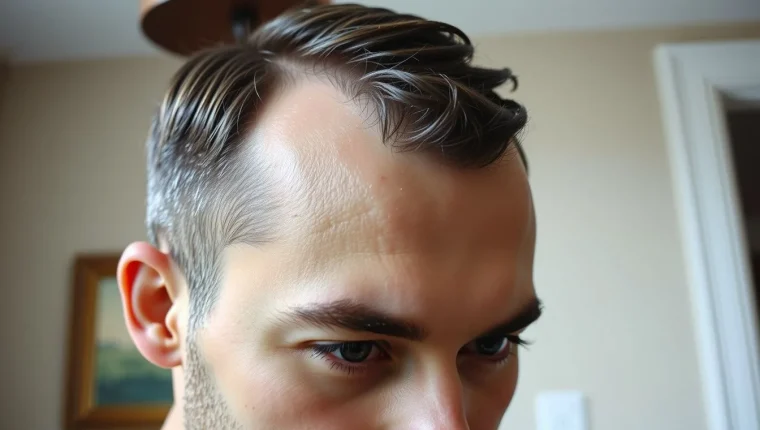
You notice it in a photo before you notice it in the mirror: the corners of your hairline sit further back than they used to, or the front edge has thinned enough to change how your face reads. That moment often brings uncertainty because hairline change is common, but advice about it is inconsistent. “Fixing” a hairline can mean slowing loss, thickening what remains, or rebuilding the front edge entirely. Which path fits depends on the cause and stage, not urgency alone. The options below are realistic, with limits on what each can do.
Why Your Hairline Is Changing and What It Actually Means
A changing hairline is not automatically a losing one. Many men experience a gradual shift in the first two to three centimeters above the brow during their twenties and thirties — a process called a maturing hairline. The line moves back slightly, often forming a gentle M shape, then stabilizes. It is a normal adult contour, not a disease, and it does not require treatment.
Active hairline loss looks different. It keeps progressing, the recession deepens unevenly, and the hair behind the front line thins as well. That pattern points to androgenetic alopecia, driven by genetics and the hormone dihydrotestosterone (DHT) acting on susceptible follicles. Age, thyroid problems, iron deficiency, and stress-related shedding can mimic or accelerate the same change, which is why the visible pattern matters more than the mirror alone.
Distinguishing between a stable mature hairline and active pattern loss is the single most useful step you can take, because it decides whether you need to act at all. Knowing the cause and the stage — early thinning versus established recession — changes which options are worth considering and which would be wasted effort.
Can You Really Fix My Hairline Without Surgery

The short answer is yes, but with a clear limit. Non-surgical options can genuinely help a hairline that is thinning or in the early stages of change. They work by slowing loss, strengthening existing follicles, and supporting modest regrowth. Where they cannot help is a hairline that has already vanished. Once a follicle stops producing visible hair for long enough, no topical product or supplement brings it back.
This is the line worth understanding before you spend money. Non-surgical routes are best at maintenance rather than reconstruction. If your hairline is miniaturizing but still present, the right treatment can hold ground and sometimes thicken what remains. If the corners are smooth and bare, you are asking a non-surgical method to do something it was never designed to do.
That does not make surgery the automatic next step. It simply means the honest choice depends on how much living follicle you still have. When the answer is “not much,” surgical restoration becomes the more realistic route rather than a last resort.
Medical Treatments That Slow Hairline Loss and Support Regrowth

Medical treatment for a receding hairline splits into two clear goals: holding onto what you still have and coaxing back what you have recently lost. The first group works by interfering with the hormone that drives pattern loss. Finasteride, taken as a daily pill, lowers DHT and is the most studied option for slowing further recession at the temples and crown. Topical minoxidil, applied directly to the scalp, sits in the second group — it extends the growth phase and can thicken finer hairs, but it does not address the underlying cause.
These routes suit different situations. If your hairline is actively receding, an anti-androgen approach targets the driver; if the concern is thin, weakened hairs along the edge, a growth stimulant may add visible density. Neither reliably rebuilds a hairline that has fully smoothed over, and results fade when you stop — this is maintenance, not a cure.
Expect a slow timeline. Shedding can occur in the first weeks, and meaningful change usually takes three to six months, with the best response around a year. A clinician can confirm whether your pattern fits these treatments or whether another route makes more sense.
Proven Surgical Options for Restoring a Receding Hairline
Surgery becomes relevant when a hairline zone has stopped responding to medical treatment and the follicles there are no longer producing visible hair. The most established option is follicular unit transplantation, where healthy follicles are moved from the back and sides of the scalp into the thinning hairline. Modern techniques place these grafts one by one to follow the natural direction and irregularity of a hairline, which is why results can look far more natural than the older plug-style transplants.
A second proven approach is follicular unit extraction, where individual grafts are removed directly rather than through a strip of scalp. It tends to suit people who want shorter hairstyles or less visible scarring, though it is more time-consuming and not every donor area is suitable. Strip harvesting can still be the better choice when a large number of grafts is needed in one session.
Candidacy matters as much as technique. You need a stable donor supply, a settled pattern of loss, and realistic expectations about density. Recovery usually involves scabbing for about a week, shedding of transplanted hairs, then growth that becomes visible over several months and matures over a year or more.
Results depend heavily on long-term planning. Surgery restores hair in specific areas rather than stopping future loss, so continuing medical treatment is often needed to protect the remaining native hair.
Everyday Habits and Styling Choices That Protect Your Hairline
Daily choices matter more than most people expect. Tight hairstyles, constant pulling, and harsh chemical treatments can create traction damage that accelerates thinning along the hairline over time.
At the same time, simple styling adjustments help you look better while you decide on treatment. Looser styles, gentle drying, and avoiding heavy tension all reduce stress on fragile follicles. A traction alopecia pattern is often reversible when the pulling stops early enough, which makes these habits genuinely protective rather than merely cosmetic.
These same routines also support whatever path you choose later, from medical maintenance to surgical restoration results, by keeping the scalp calm and the remaining hair healthy.
FAQs
What are the most realistic non-surgical ways to fix my hairline without surgery?
The most realistic non-surgical options for fixing your hairline include FDA-approved medications like minoxidil and finasteride, which can slow hair loss and regrow thinning areas when used consistently. Low-level laser therapy and platelet-rich plasma (PRP) injections may also help stimulate follicles in mild to moderate cases. For areas where the hairline has receded significantly, scalp micropigmentation or strategic hair styling and fibers can create the appearance of a fuller hairline. Results vary by individual, so a consultation with a dermatologist or hair restoration specialist is the best way to match treatments to your specific pattern of loss.
How soon can I see results after a hairline treatment, and how long do they last?
Visible results depend on the treatment: topical medications like minoxidil and finasteride typically take three to six months to show noticeable improvement, while hair transplant surgery produces initial growth around three to four months with fuller results at twelve months. Non-invasive options such as microneedling or PRP may show early changes within a few weeks but usually require multiple sessions. Results last only as long as you continue the treatment, since medications and PRP need ongoing maintenance, whereas transplanted hair from stable donor areas is generally permanent.
Which hairstyles and styling tricks can hide a receding hairline while I decide on treatment?
You can camouflage a receding hairline by adding volume at the front with a textured fringe or a side-swept part, which breaks up the visible scalp line and draws the eye upward. Choosing a shorter, layered cut on top while keeping the sides tight also reduces contrast between thick and thinning areas. Styling with matte, fiber-based products and blow-drying hair forward or diagonally gives the appearance of fuller coverage without exposing the temples. These are temporary cosmetic fixes, so use them while you research treatments like minoxidil, finasteride, or hair transplant options with a dermatologist.