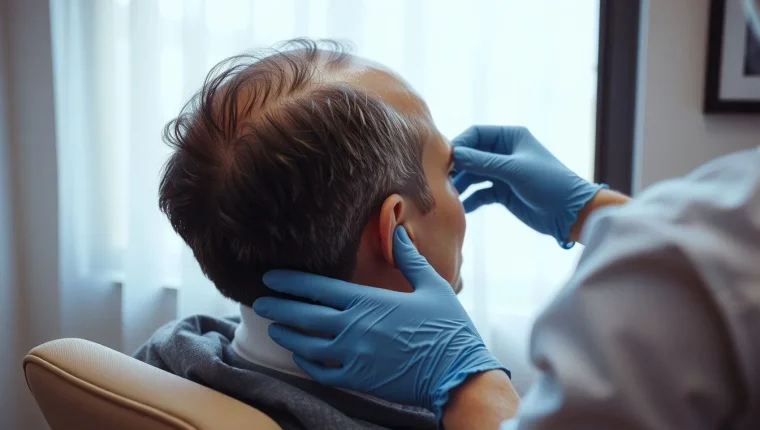
You notice it in a photo before you notice it in the mirror: the temples sit a little further back than they used to, and the forehead looks wider than it did a year ago. What follows is usually uncertainty, not alarm. Is this a normal mature hairline, or the start of something that will keep progressing? That question is harder to answer than it should be because hairlines rarely change overnight, and the front of the scalp behaves differently from the rest of the head. The follicles along the hairline have their own sensitivity to hormones, their own growth timing, and their own response to stress and genetics. Understanding how that area works separates a treatable early stage from a cosmetic worry.
What an Early Receding Hair Line Actually Looks Like
Many adults mistake a maturing hairline for the onset of baldness, but the two are not the same. A mature hairline simply sits slightly higher than it did in adolescence, often rising by a centimeter or so across the frontal line without further progression. True recession behaves differently: it deepens selectively at the temples, creating the characteristic M-shaped pattern rather than a uniform shift.
What separates the two in practice is asymmetry and texture. Early recession rarely advances evenly on both sides. One temple typically recedes faster, and the hairs along that edge grow finer, shorter, and lighter than the surrounding strands. You may also notice that the frontal hair no longer lies flat when styled, because individual follicles are producing thinner shafts. This change in caliber, not just position, is the clearest visual signal that something active is happening.
Comparing old photographs taken under similar lighting is more reliable than checking the mirror daily, since gradual change is easy to overlook. A hairline that has moved back and thinned at the same time deserves attention; one that has simply shifted upward and stayed stable usually does not.
How Hair Follicle Miniaturization Drives Thinning at the Temples

Thinning at the temples is not a sudden event. It is the visible result of a slow, silent process happening inside each hair follicle, and understanding it explains why those shorter, finer hairs you may have noticed are not a random fluctuation but a predictable stage of change.
Each hair follicle follows a growth cycle: a long growing phase, a brief transition, and a resting phase before the hair sheds and the cycle restarts. In androgenetic hair loss, this cycle is disrupted by follicle miniaturization. Under the influence of dihydrotestosterone (DHT), susceptible follicles gradually shrink. The growing phase shortens, the hair shaft becomes thinner and shorter, and the follicle sits higher in the skin. Over successive cycles, what was once a thick, pigmented terminal hair becomes a fine, pale vellus hair — and eventually may stop producing visible hair altogether.
At the temples, this process tends to follow a recognizable pattern. The hairs along the frontotemporal hairline are among the most sensitive to DHT, so miniaturization often begins there first. You may notice the hair feels softer, lies flatter, or takes longer to grow back after a haircut. Because each cycle lasts months to years, the change is gradual — which is precisely why early recognition matters. Once a follicle has fully miniaturized, it is far harder to restore, so the window for effective intervention is widest while hairs are still present, just thinner.
Genetic and Hormonal Triggers Behind a Receding Hair Line
Hairline recession rarely happens by chance. In most adults who notice thinning at the temples, the cause traces back to an inherited sensitivity that makes certain follicles react strongly to hormones the body already produces. This process is known as androgenetic alopecia, and it explains why some people lose hair at the front of the scalp while others keep a full head of hair well into later life.
The key mechanism involves dihydrotestosterone (DHT), a hormone derived from testosterone. In genetically susceptible individuals, DHT binds to receptors in vulnerable hair follicles and gradually shortens their growth cycle. Follicles along the temples and frontal hairline tend to carry more of these receptors, which is why recession often begins there before spreading backward.
Inheritance does not follow one simple line. The relevant genes can come from either parent, and having a bald father does not guarantee the same outcome for a son. What is inherited is the sensitivity, not the hair loss itself. Hormonal shifts, including those during puberty, pregnancy, or later life, can influence how quickly that sensitivity translates into visible change. The trigger is internal and largely predetermined, which means early recession is not a sign of poor grooming, stress, or neglect. Understanding this distinction matters, because it separates what is fixed from what can still be influenced.
Everyday Habits and Health Conditions That Accelerate Hairline Loss

Genetics and hormones set the stage, but daily behavior and overall health often determine how quickly the script plays out. It helps to separate two categories: factors that accelerate existing genetic thinning versus those that can trigger hairline loss on their own. Most everyday habits fall into the first group — they worsen a process already underway rather than starting it from scratch.
Chronic stress is the most cited accelerator. Elevated cortisol can push follicles into a resting phase earlier than normal, and stress-related shedding often shows up at the temples first. Nutritional shortfalls matter too: iron deficiency, low vitamin D, and insufficient protein all deprive the follicle of what it needs to sustain growth. Smoking impairs circulation to the scalp, and crash dieting can shock the system into diffuse shedding.
Certain health conditions deserve attention. Thyroid disorders, both underactive and overactive, commonly cause hair thinning. Scalp conditions like seborrheic dermatitis create inflammation that may hasten miniaturization. Some medications, including certain antidepressants and blood pressure drugs, list hair loss as a side effect. The honest caveat: these factors are frequently overstated online. Fixing them rarely regrows a hairline on its own, but leaving them unaddressed can quietly speed up what genetics already set in motion.
Treatment Options for Slowing and Reversing Hairline Recession
Treatment choices fall into two broad goals: slowing further loss and attempting regrowth. Which one fits your situation depends largely on how much follicle miniaturization has already occurred, since follicles that still produce fine hairs can sometimes respond, while fully scarred or dormant follicles generally cannot be revived by medication alone.
Prescription options such as finasteride and minoxidil are the most studied approaches for slowing progression. Finasteride works on the hormonal driver behind androgenetic alopecia, while topical minoxidil extends the growth phase and can thicken existing hairs. Both demand consistent, long-term use; stopping usually returns you to your baseline within months.
Procedural routes include hair transplantation, which relocates resistant follicles to the temples, and low-level laser therapy, which some users find supportive but which has weaker evidence. Platelet-rich plasma injections are another emerging option with mixed results.
Realistically, no category restores a full juvenile hairline. The strongest outcomes come from starting early, combining approaches under medical guidance, and accepting that maintenance, not reversal, is often the achievable goal.
FAQs
What are the earliest signs that a receding hair line is starting to form?
The earliest signs of a receding hairline often include a subtle thinning or slowing of growth at the temples, which gradually creates a deeper M-shaped pattern along the front of the scalp. You may also notice more hairs than usual on your pillow, in the shower drain, or on your comb after styling. In many cases, the hairline itself begins to shift slightly backward on one or both sides before any obvious bald patches appear. Catching these changes early allows for more effective intervention with treatments such as minoxidil, finasteride, or lifestyle adjustments.
Can a receding hair line be reversed naturally without medical treatment?
A receding hairline cannot be fully reversed without medical treatment, because the underlying cause is usually genetic sensitivity to DHT that gradually miniaturizes hair follicles. Natural approaches such as reducing stress, improving diet, and avoiding tight hairstyles may support overall hair health and slow further loss, but they rarely regrow hair already lost along the temples. For noticeable regrowth, clinically proven options like minoxidil, finasteride, or procedures such as hair transplantation are typically required.
Which hairstyles and treatments work best to hide or manage a receding hair line?
Choosing a shorter, textured cut with volume at the front, or styling hair forward with a side part, helps minimize the appearance of a receding hairline. Products like volumizing mousse, root-lifting sprays, and tinted scalp concealers can add lift and reduce contrast between hair and scalp. For longer-term management, treatments such as minoxidil, finasteride, and low-level laser therapy may slow further recession and support regrowth when used consistently.