You part your hair the same way you always have, and the mirror shows a hairline that no longer matches the one you remember. The corners sit further back, the front edge looks thinner, and you cannot tell whether this is ordinary aging or something worth acting on. That uncertainty is the real problem, because a hairline only means something when it is compared to a baseline. Two forces usually drive the change: genetics sets your pattern, while hormones shift in midlife and can alter how hair grows and sheds. Neither explains your case on its own. First, you need a clear picture of what a normal hairline looks like for men and a way to judge your own against it.
Understanding the Standard Male Hairline as a Baseline

A normal male hairline is not a single fixed line but a range of shapes that shift with age, ethnicity, and family pattern. Many men in midlife compare their forehead to a teenage photo and assume any difference means loss, yet the most common mature hairline is a gentle recession at the temples that develops slowly and then stabilizes. This pattern, sometimes called a mature hairline, typically sits about one to one-and-a-half centimeters above the highest crease of the forehead and forms a soft “M” or “V” shape rather than a straight edge.
Shape varies widely. Some men keep a low, straight hairline into their fifties, while others show deeper temple recession early. Ethnic background influences this: men of European descent often recede at the temples first, whereas men of African, Asian, or Indigenous descent may thin more diffusely along the frontal edge. A family history of similar hairlines is a useful clue, because the mature hairline tends to follow the pattern seen in fathers and grandfathers.
The key distinction is pace and stability. A hairline that recedes gradually over years and then holds steady is usually normal maturation, not active loss. Rapid change, uneven thinning, or recession that continues without pause deserves closer attention, which is where hormonal factors come into the picture.
How Menopause Hormone Shifts Affect Hairline for Men
Hair follicles are hormone-sensitive structures, which is why midlife hormonal shifts can visibly change the scalp even when nothing else about a man’s routine has changed. Estrogen and progesterone support the growth phase of the hair cycle and help keep follicles in a productive state, while testosterone circulates in the bloodstream and is converted by the enzyme 5-alpha reductase into dihydrotestosterone (DHT). DHT is the androgen most closely linked to follicular miniaturization, but its effect depends heavily on how sensitive a given follicle is to it — sensitivity that is largely inherited.
Around menopause and andropause, this balance shifts in two directions at once. As estrogen and progesterone decline, the protective counterweight that softened androgen activity fades, so existing DHT sensitivity can express itself more strongly. At the same time, testosterone levels may fall gradually as well, which does not necessarily spare the hairline; it simply changes the hormonal environment in which miniaturization proceeds.
This is why two distinct patterns can appear together. Diffuse hormonal shedding spreads across the whole scalp and tends to be temporary and stress- or hormone-linked, while androgen-driven recession is localized to the temples and crown and is progressive. A man may notice both simultaneously, which makes the hairline look worse than either process alone would suggest.
Hormonal change by itself rarely reshapes a hairline on its own; it more often accelerates a sensitivity that was already present. That distinction matters when judging what you see in the mirror.
Early Signs of Hairline Recession During Andropause and Menopause
Early changes are usually subtle. At the temples, you may notice the corners receding gradually, creating a slightly deeper “V” than before. The part line can appear wider, and the crown may show a small, diffuse thinning spot that becomes visible under bright light. These shifts often develop over months, not weeks, which is why a single glance in the mirror rarely tells the full story.
Shedding patterns differ from true recession. Diffuse hormonal shedding tends to spread evenly across the scalp, while early recession follows a predictable path along the frontal hairline and crown. Because of this, timing and rate matter more than any one snapshot. A hairline that looks slightly different today may simply reflect lighting or styling, but a consistent change over three to six months is worth documenting.
To track changes simply, take photos under the same lighting and angle every four to six weeks. Note the date, and compare the temple depth, part width, and crown coverage side by side. This record helps you see whether the change is stable, slow, or accelerating — information that becomes valuable if you later decide to seek professional evaluation.
Distinguishing Normal Aging Thinning From Pattern Hair Loss
Two processes can produce a similar-looking change at the front of the scalp, yet they behave very differently. Age-related thinning tends to be diffuse and slow. Hair gradually loses density across the top and sides rather than retreating from one specific point, and the change is often noticed as a general reduction in fullness over years, not months. The hairline may soften or lose some density, but it usually keeps its basic shape.
Androgenetic alopecia, by contrast, follows a pattern. Recession concentrates at the temples and crown, the frontal hairline moves backward in a recognizable shape, and progression is steady rather than random. Family history often provides a clue, though its absence does not rule the condition out. Speed matters too: patterned loss typically advances faster than the gradual thinning of normal aging.
The difficulty is that these two processes overlap. A man can have age-related thinning and early pattern loss at the same time, and the combined picture can look like neither condition on its own. This overlap is why self-diagnosis from photographs or memory is unreliable, and why a professional assessment is the only way to separate the two with confidence.
When to Seek Evaluation for a Changing Hairline

A changing hairline does not always require a doctor’s visit, but certain patterns should prompt one. Rapid thinning over weeks, sudden diffuse shedding, or loss accompanied by itching, burning, scaling, or tenderness suggests something beyond gradual hormonal change. Patchy bald spots, breakage, or loss on the eyebrows and body hair also warrant attention. These signs can point to thyroid disorders, iron deficiency, medications, or scalp conditions rather than androgens alone.
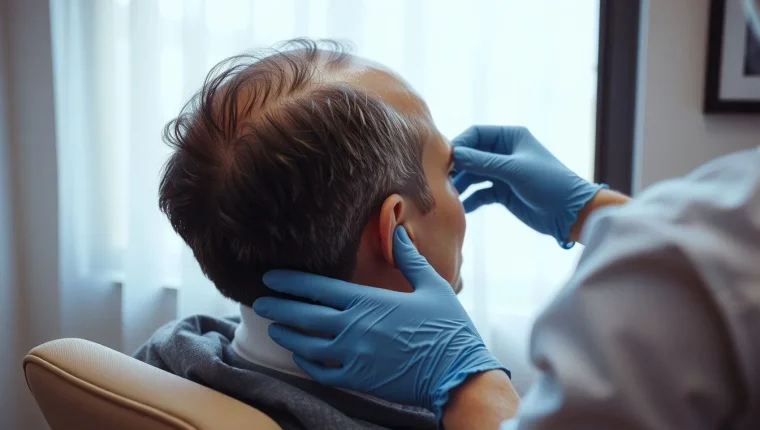
When you book an evaluation, expect a focused history: timing, rate of change, family pattern, medications, and recent stressors. A clinician will examine the scalp and hair density, sometimes with a pull test or dermoscopy. Blood tests may check ferritin, thyroid function, and hormone levels. What evaluation can confirm is whether a treatable cause exists; what it cannot do is reverse genetics. That distinction matters, because it separates monitoring from intervention.
FAQs
Does menopause actually change a mans hairline, or is it mainly genetics?
Menopause does not directly change a man's hairline, since it is a hormonal transition specific to women. A man's hairline is shaped primarily by genetics and androgen sensitivity, particularly the effect of DHT on hair follicles. If a man notices hairline changes during a partner's menopause, this timing is coincidental rather than caused by her hormonal shift.
How can I tell if my hairline for men is normal or thinning?
A normal hairline for men typically keeps a relatively straight or gently rounded shape with a stable position over time, while thinning usually shows up as a receding M-shape, a widening part, or a visible reduction in density at the temples and crown. You can track changes by comparing photos taken every few months under similar lighting and hairstyle conditions, since gradual shifts are easier to spot over time than in a single glance. Noticeable increases in shedding, a scalp that becomes more visible, or a hairline that moves back faster than about a centimeter per year are signs worth discussing with a doctor or dermatologist.
What does a typical male hairline look like at different ages?
A typical male hairline stays relatively straight or slightly rounded through the teens and twenties, then often begins to recede gradually at the temples during the thirties and forties. By the fifties and beyond, many men show further recession that can create an M-shaped or more deeply receded pattern, though the exact timing and extent vary widely based on genetics and hormones. Recognizing these gradual shifts helps distinguish normal age-related changes from more sudden thinning, which matters when evaluating hairline concerns alongside other midlife transitions such as menopause.