One morning the mirror shows a hairline that sits a little farther back than it used to. The change is rarely dramatic. A few thinner strands at the temples, a wider gap at the corners, or a forehead that suddenly looks taller can all be easy to explain away as lighting, a bad haircut, or stress. That quiet, gradual shift is why an early balding hairline gets missed. Recognizing the first real signals matters, because the earlier you understand what is happening, the more clearly you can judge whether it is normal shedding, a maturing hairline, or the start of pattern loss, and when it is time to act.
What an Early Receding Hairline Actually Looks Like
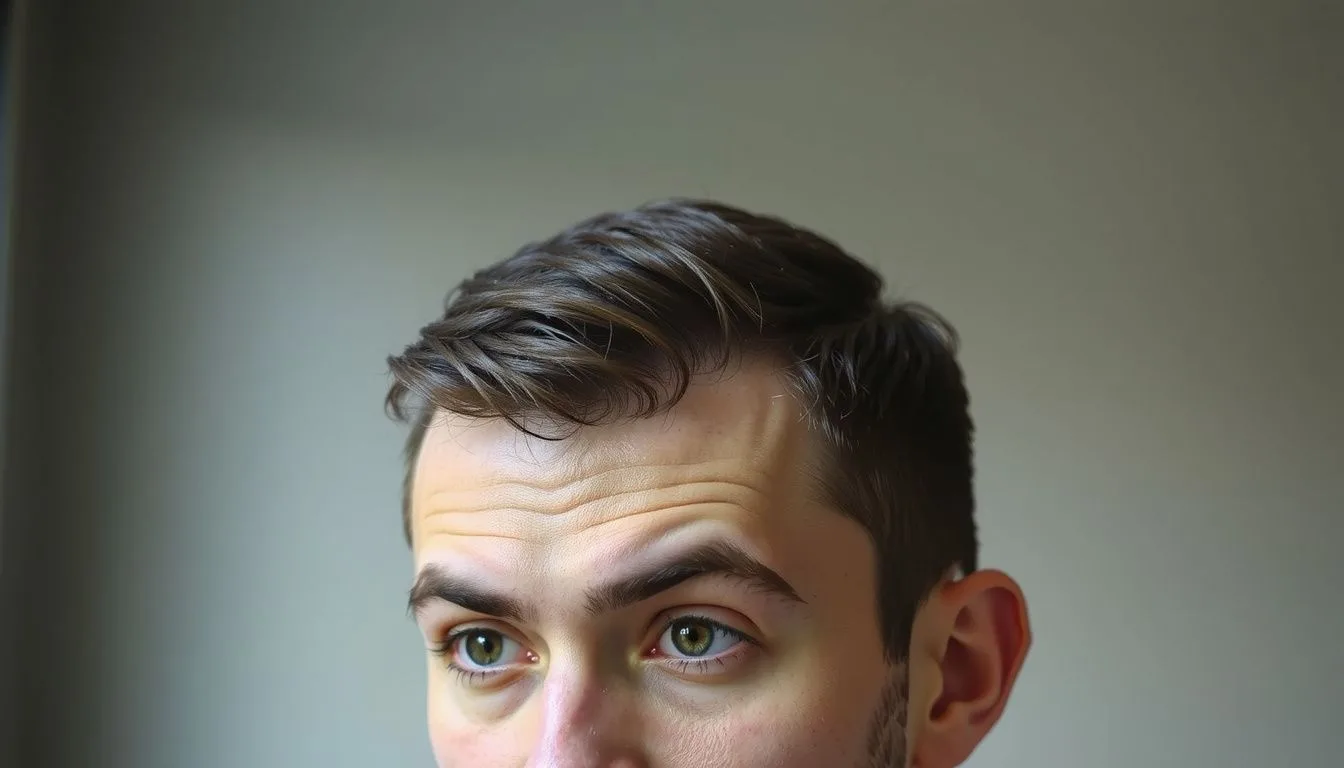
An early receding hairline rarely announces itself with a dramatic change. Instead, it shows up as subtle shifts in the shape of the hairline, most often at the temples. You might notice that the corners of your forehead appear slightly deeper than they used to, forming a gentle “M” or “V” shape rather than a straight line. The hair at the very front edge may look thinner when pulled back or wet, and baby hairs along the border can seem sparser than before.
What makes this stage easy to miss is that the change is gradual. The temple recession typically starts with a few millimeters of retreat on each side, then slowly widens and moves backward over months or years. Some people also see the central forelock stay relatively stable while the sides thin, which can make the contrast more obvious in photos taken from above or in certain lighting.
A practical way to compare your own hairline is to look at old photographs where your forehead is clearly visible, especially ones taken from the same angle. Pay attention to the distance between your eyebrow and the front hairline, and whether the corners have moved upward or backward. Your hairline can also change with age, so a slight shift is not automatically a problem — but a consistent, one-directional retreat at the temples is the pattern worth watching.
How to Tell Normal Shedding Apart From Pattern Thinning
Losing hair is not, by itself, a sign of a problem. The scalp runs on a cycle in which individual follicles grow, rest, and eventually release their strand before starting again. Because these cycles are staggered, a healthy head of hair sheds roughly 50 to 100 strands a day without ever looking thinner. You may notice more loose hair after washing, brushing, or wearing a tight hat, and that fluctuation is expected. The key question is not how much hair falls out, but whether what remains is changing in a recognizable shape.
Pattern thinning behaves differently from ordinary shedding. Instead of an even, temporary loss that the scalp replaces, the hair gradually miniaturizes in specific zones. On the scalp, this shows up as a patterned distribution rather than a random scatter. A receding hairline, a widening part, or a thinning crown are all examples of loss concentrated in defined areas while other regions stay dense. Over time, the replacement strands grow back finer and shorter until they stop emerging altogether.
To judge your own situation, look at where the loss is happening and whether it is recovering. Normal shedding is diffuse and reversible; you lose hair everywhere and regrow it everywhere. Pattern thinning is localized, progressive, and does not fully bounce back on its own. If your hairline is moving backward or your part is widening month after month, the change is structural rather than seasonal, and it deserves closer attention.
Why Hairline Changes Begin Earlier Than Most People Notice

Hairline changes rarely appear overnight, yet they are underway long before the mirror confirms them. This gap exists because the follicle and the reflection move on different clocks. The scalp does not lose hair all at once; it gradually produces thinner, shorter strands as follicles shrink across repeated growth cycles.
Each hair follows a cycle of growth, rest, and shedding, and in a thinning follicle that cycle shortens while the growth phase produces less visible density. Because only a fraction of hairs are in the shedding phase at any moment, the shift stays hidden. The growth cycle masks the loss, trading volume slowly enough that daily styling and lighting disguise it.
By the time a change becomes obvious, months of gradual miniaturization have already occurred. This delay shapes what people notice first: not the loss itself, but the point at which it can no longer be hidden.
Key Risk Factors That Accelerate Frontal Hair Loss
Genetics remain the strongest single influence on how quickly the frontal hairline changes. If close relatives lost hair early, the same sensitivity to dihydrotestosterone (DHT) may already be shortening the growth cycle in susceptible follicles along the temples and forehead. This hormonal effect is largely fixed, but it explains why some people progress faster than others with similar habits.
Certain factors are more within reach. Chronic stress, poor sleep, and crash dieting can push more follicles into a resting phase, making existing thinning look worse. Smoking and heavy alcohol use may reduce blood flow and nutrient delivery to the scalp. Tight hairstyles that pull constantly on the front hairline can add mechanical damage over time.
Medical conditions also matter. Thyroid imbalances, anemia, and uncontrolled scalp inflammation can speed up shedding. Some medications list hair loss as a side effect. Separating fixed influences from adjustable ones helps readers focus on what they can realistically change while monitoring the rest.
When to See a Specialist and What Treatment Options Exist
Most hairline changes do not require urgent care, but some patterns deserve a professional opinion sooner rather than later. A consultation is reasonable when the recession is clearly progressing over months, when thinning extends beyond the temples into a broader patterned distribution, or when shedding is accompanied by scalp itching, pain, or patchy loss. Sudden or rapid changes, hair loss during or after a serious illness, and loss alongside fatigue or other systemic symptoms also warrant medical assessment, since these can point to causes unrelated to common pattern thinning.
A specialist visit typically begins with a history and scalp examination, sometimes supported by blood tests or a pull test to rule out thyroid issues, iron deficiency, or other contributors. From there, treatment directions generally fall into a few broad categories: topical agents that support the growth cycle, oral medications that reduce the effect of dihydrotestosterone (DHT) on susceptible follicles, and procedural options such as hair transplantation for areas where follicles no longer produce visible hair. Each carries its own suitability, timeline, and limitations, and none guarantees a specific result.
The value of an evaluation lies less in choosing a single product than in matching options to your pattern, health history, and goals. A clinician can confirm whether the change reflects typical balding hairline progression or something treatable by other means, then build a plan that is monitored and adjusted over time rather than followed blindly.
FAQs
What are the earliest signs that your hairline is starting to recede?
The earliest signs of a receding hairline often appear as a subtle thinning or widening at the temples, creating a slight "M" or "V" shape over time. You may also notice more hairs than usual on your pillow, in the shower drain, or on your brush, along with finer, shorter hairs along the front edge of your hairline. A change in the density of your frontal hair, where the scalp becomes more visible in certain lighting or when your hair is pulled back, is another common early indicator.
How can you tell the difference between a maturing hairline and balding?
A maturing hairline typically shifts back gradually and symmetrically, forming a subtle M-shape while the hairline itself stays relatively dense. Balding, by contrast, involves noticeable thinning, a receding hairline that continues past the temples, and often visible scalp or reduced density along the front and crown. You can also track changes over six to twelve months; if the recession stabilizes, it is likely maturation, but if it keeps progressing, it points toward male pattern baldness.
When should you see a doctor about a balding hairline?
See a doctor once you notice a receding hairline that is progressing quickly, occurs alongside patchy loss, itching, or scaling, or begins before your late twenties. You should also seek medical advice if you have other symptoms such as fatigue, weight changes, or unusual hair shedding on the body, since these can point to thyroid problems, nutritional deficiencies, or autoimmune conditions. A doctor or dermatologist can confirm whether the cause is ordinary pattern baldness or an underlying medical issue and recommend treatments that work best when started early.