Blepharoplasty can refresh your appearance and improve vision blocked by drooping lids. The price changes dramatically depending on where you have it done. The difference in eyelid surgery cost in Turkey vs the USA can be thousands of dollars for the same procedure.
In the United States, surgeon fees, anesthesia, and facility charges add up fast, and insurance rarely covers cosmetic eyelid work. Turkey, by contrast, has built a reputation for high-volume clinics that keep overhead low while offering modern operating rooms and experienced surgeons.
But cost alone does not tell the whole story. Travel, aftercare, revision risk, and how you verify credentials all matter. Below, we break down real numbers, what is included on each side, and the questions worth asking before you book.
What Determines Eyelid Surgery Cost in Turkey vs the USA
Several variables interact to set the final price of blepharoplasty, and understanding them explains why quotes differ so dramatically between the two countries. The most influential factor is surgeon fees, which reflect training, reputation, and demand in a given market. A board-certified American plastic surgeon commanding premium rates in a major city will charge far more than a Turkish surgeon with equivalent credentials, even when the surgical technique is identical.
Geography matters just as much within each country. In the USA, a procedure in Manhattan or Beverly Hills can cost two to three times what it does in a smaller regional market, because rent, staffing, and insurance costs scale with the local economy. Turkey shows a similar internal spread, with Istanbul clinics generally priced above those in Ankara or Izmir, though the gap is narrower in absolute terms.
Anesthesia and facility fees form the next layer of the calculation. General anesthesia requires an anesthesiologist, monitoring equipment, and a licensed surgical suite, all of which carry fixed costs that clinics pass to patients. Whether a procedure is performed under local anesthesia with sedation or full general anesthesia can shift the total by several hundred dollars on its own.
The complexity of your case also plays a role. Upper eyelid surgery alone is typically less expensive than a combined upper and lower blepharoplasty, and revisional surgery after a previous procedure costs more than a primary operation. Additional elements such as ptosis repair, fat grafting, or canthopexy add surgical time and skill requirements.
Finally, currency exchange rates create a moving target. Because Turkish clinics often price in lira while international patients pay in dollars or euros, the effective cost can fluctuate with the exchange rate. This is one reason Turkish quotes can appear unusually attractive during periods of lira weakness, and it is a factor that has no equivalent in the American pricing structure.
Average Price Ranges for Blepharoplasty in Both Countries
Once you strip away the variables, most patients still want one thing before anything else: a realistic number. Blepharoplasty pricing in Turkey and the USA does not overlap much, and seeing the actual ranges side by side makes that gap concrete. The figures below reflect typical quotes for upper and lower eyelid surgery, usually combining surgeon fees, anesthesia, and facility use unless stated otherwise. Prices shift with city, clinic reputation, and whether the procedure is functional or cosmetic, so treat these as starting points rather than fixed rates.
A standard upper blepharoplasty is the most common version, and it is also where the two markets diverge most sharply. In Turkey, patients frequently see quotes between $1,500 and $3,500 for a single eyelid procedure, while the same operation in the USA typically lands between $4,000 and $8,000. When both upper and lower lids are treated together, Turkish clinics often price the combined work at $2,500 to $5,000, whereas American surgeons commonly quote $6,000 to $12,000. These ranges assume no revision surgery and no major medical complications.
- Upper eyelid surgery in Turkey: Usually $1,500–$3,500, with Istanbul and Izmir clinics competing closely on price.
- Upper eyelid surgery in the USA: Typically $4,000–$8,000, with major metro areas pushing toward the higher end.
- Combined upper and lower blepharoplasty in Turkey: Often $2,500–$5,000, sometimes including a short hotel stay.
- Combined upper and lower blepharoplasty in the USA: Commonly $6,000–$12,000, driven by surgeon and anesthesia fees.
- Revision or complex cases: Turkey may charge $3,000–$6,000, while the USA can exceed $10,000.
These numbers show a different pricing structure, not just a price difference. Turkish quotes often bundle transfers, medications, and follow-up visits into one figure, which makes the total easier to predict. American quotes tend to separate surgeon, anesthesia, and facility charges, so the final bill can climb once each line item is added. That structural difference matters more than any single dollar amount when you start comparing real offers.
Why Turkish Clinics Charge Less: Labor, Overhead, and Currency
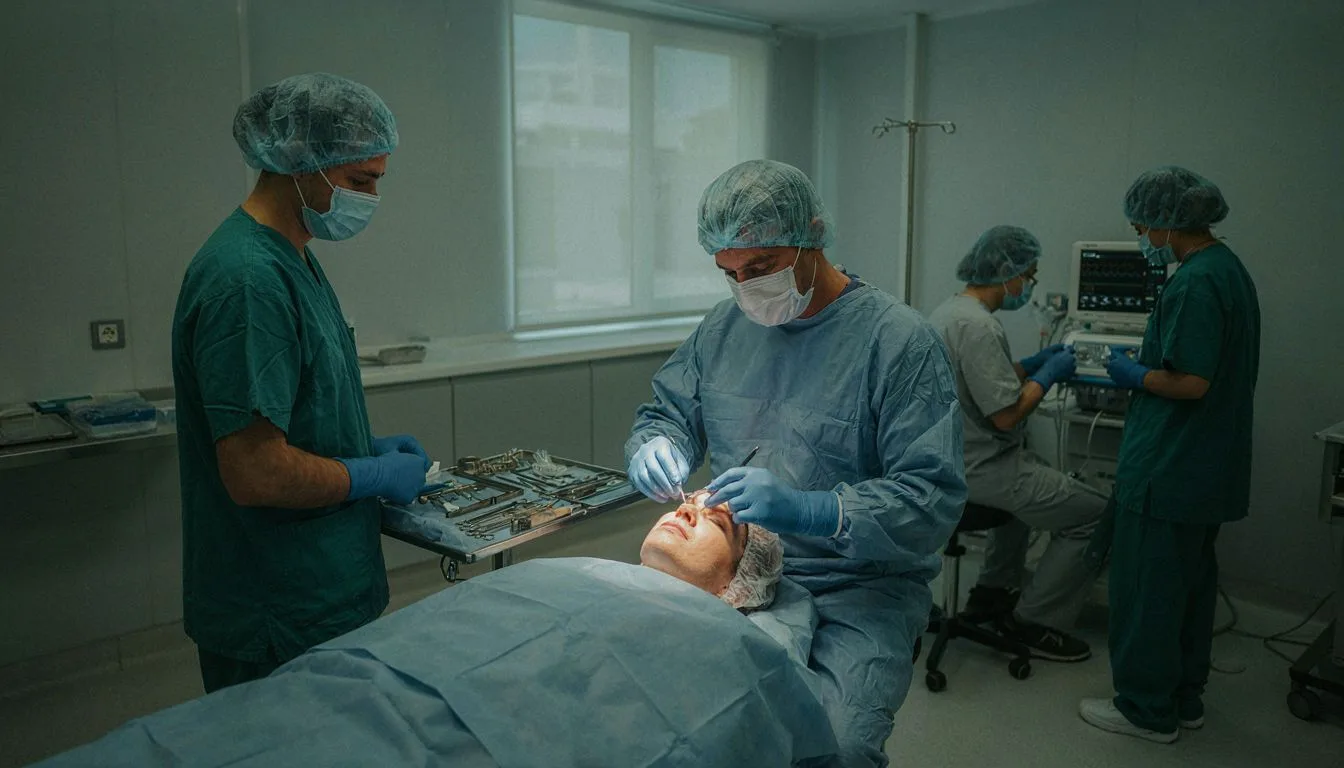
Three structural forces explain the gap between Turkish and American price tags: labor costs, operational overhead, and currency dynamics. None of them reflect a compromise in surgical skill. They reflect economics.
Labor is the largest single driver. A board-certified plastic surgeon in the United States carries malpractice premiums, medical school debt, and a cost of living that push consultation and surgical fees into the thousands. In Turkey, surgeon fees are lower because the broader cost structure around them is lower. The same applies to supporting staff — nurses, anesthesiologists, and surgical assistants — whose salaries are set against a domestic wage scale rather than a Western one.
Overhead compounds the difference. American clinics pay premium rents in competitive medical districts, carry expensive liability insurance, and navigate complex billing and insurance administration. Turkish clinics, particularly those in Istanbul and Antalya that serve international patients, operate with leaner administrative layers and lower facility costs. Many are purpose-built medical tourism centers where volume offsets margin.
Then there is currency exchange rates. The Turkish lira has weakened significantly against the dollar and euro in recent years. This means a price set in lira converts to a far lower dollar figure than an equivalent service priced in the United States. A procedure that costs a Turkish patient a substantial sum in local currency may appear remarkably affordable to an American paying in dollars.
These three factors — labor, overhead, and currency — interact rather than operate independently. A weaker lira lowers the dollar price, but it also means Turkish clinics can offer competitive rates while still covering their own costs comfortably. That is why the price difference between the two countries is not a sign of lower quality; it is a reflection of two very different economic environments. Understanding this helps you evaluate whether the savings are structural or superficial when you compare quotes side by side.
What the USA Price Includes: Surgeon Fees, Anesthesia, and Facility Costs
When a US clinic quotes you a price for blepharoplasty, that number is not a single fee. It is a bundle of separate charges that are usually presented together as one all-inclusive figure. Understanding what sits inside that bundle explains why American prices land where they do.
The largest component is the surgeon’s fee. This covers the surgeon’s time, expertise, and the pre-operative planning and post-operative follow-up visits tied to your case. For upper eyelid surgery alone, the surgeon’s portion commonly runs between $1,500 and $3,000, and it climbs quickly for combined upper and lower procedures or revision work.
Anesthesia is billed separately. A certified anesthesiologist or nurse anesthetist charges based on the type of sedation used and the length of the procedure. Local anesthesia with light sedation costs less; general anesthesia costs more. Expect a few hundred to over a thousand dollars depending on complexity.
Facility costs form the third pillar. This is the operating room itself: rent or ownership of the surgical suite, nursing staff, sterile equipment, monitoring devices, and recovery room time. Accredited surgical centers and hospital operating rooms charge premium rates, which is a major reason US quotes are higher than many patients expect.
Some quotes also fold in lab work, pre-operative medical clearance, prescriptions, and compression or wound-care supplies. Others leave these out, which is exactly why two US clinics can quote very different totals for what sounds like the same operation. Always ask which items are included and which are billed separately before you compare any two prices.
Hidden Expenses and Aftercare Differences Between Turkey and the USA
Quoted prices rarely tell the whole story. The gap between an advertised package in Istanbul and a final invoice in the United States often widens once you account for the costs that never appear on a website — and the aftercare that follows you long after you fly home. These are the practical differences that separate a genuine bargain from an expensive surprise.
In the USA, the surgeon’s quote is typically just the starting point. Ancillary costs — the fees layered around the procedure itself — can add hundreds or even thousands of dollars, and they vary widely by clinic and city.
- Anesthesia and facility fees: In the USA, these are frequently billed separately from the surgeon’s fee, while many Turkish packages fold them into one all-inclusive price.
- Pre-operative testing: Blood work, ECG, and medical clearance are usually itemized in the USA; Turkish clinics commonly include them in the quoted package.
- Medications and supplies: Prescriptions, eye drops, and dressings are often billed individually in the USA but bundled abroad.
- Revision policy: US surgeons may charge reduced or full rates for a touch-up; Turkish clinics sometimes offer a free revision within a set period, though you must return to Turkey to claim it.
- Travel and accommodation: Flights, hotels, and extended stays are rarely covered in the USA but are frequently packaged into Turkish offers.
Aftercare is where the two systems diverge most sharply. In the USA, follow-up visits are local and easy to schedule, and your surgeon is legally accountable under US medical standards. In Turkey, most clinics provide remote check-ins by video or messaging once you return home. If a complication arises weeks later, you may need to see a local doctor who has no connection to your procedure — and that visit is not covered by your Turkish package.
The takeaway is simple: compare total costs, not headline prices. Ask every clinic — in either country — for a written breakdown of what is included, what is excluded, and how aftercare works once you leave.
Is Lower-Cost Eyelid Surgery in Turkey Worth the Savings?

The savings are real, but “worth it” depends on what you are actually buying with the difference. When you compare eyelid surgery cost in Turkey vs the USA, the price gap is not a discount on the same product. It reflects a different market with different economics, different regulatory rhythms, and different patient expectations. The relevant question is not whether Turkey is cheaper, but whether the lower price still delivers the outcome you need.
Start with what the money buys. In the USA, a large share of your quote covers malpractice premiums, hospital facility fees, and a surgeon’s fee shaped by years of training and high local overhead. In Turkey, those same categories exist but at a fraction of the cost, and many clinics run high-volume blepharoplasty practices that keep per-case pricing lean. For straightforward upper eyelid surgery, this is where the savings are most reliable. The procedure is technically well-defined, recovery is predictable, and a skilled Turkish surgeon can deliver results comparable to a US surgeon at a much lower price.
The picture changes when complexity enters. Revision cases, combined upper and lower blepharoplasty, and patients with underlying eyelid function problems demand more surgical judgment, more operating time, and more robust aftercare. Here, the cost advantage narrows because the risks are higher and the margin for error smaller. A low price on a complex case is not a bargain if it comes with limited follow-up or unclear revision terms.
Weigh the full equation, not the sticker. Add flights, accommodation, time off work, and the cost of any follow-up you may need back home. Then ask whether the surgeon’s credentials, the facility standards, and the aftercare plan match what you would accept in the USA. If they do, the savings are genuine. If they do not, the lower price is simply a different, thinner package.
For many healthy patients with uncomplicated upper eyelid concerns, Turkey offers a credible, well-priced option. For those with complex anatomy or a low tolerance for uncertainty, paying more in the USA can be the more rational choice. The savings are worth it when the clinical quality holds up, not merely when the number is smaller.
FAQs
What is the average price difference for eyelid surgery between Turkey and the USA?
Eyelid surgery (blepharoplasty) in Turkey typically costs between $1,500 and $3,500, while the same procedure in the USA averages $4,000 to $8,000 or more depending on the surgeon and city. This means patients usually save 50% to 75% by choosing Turkey over the USA. The price gap mainly reflects lower labor, facility, and overhead costs in Turkey rather than a difference in surgical technique.
Does the eyelid surgery Turkey vs USA cost gap still hold when travel and accommodation are included?
Yes, the cost gap typically persists even after adding flights and hotel stays, since eyelid surgery in Turkey often runs $1,500 to $3,000 while the same procedure in the USA commonly costs $4,000 to $8,000 or more. A round-trip flight and a week-long hotel stay usually add $1,000 to $2,500, which still leaves most patients spending less in Turkey than on surgery alone in the USA. The gap narrows for premium clinics or long stays, but it rarely disappears entirely.
How much can patients save on eyelid surgery in Turkey compared to USA prices without compromising safety standards?
Patients typically save 60 to 80 percent on eyelid surgery in Turkey, paying roughly $1,500 to $3,000 compared to $4,000 to $8,000 in the United States. These savings hold at accredited private hospitals and clinics that employ board-certified plastic or oculoplastic surgeons and meet international safety standards. The price gap mainly reflects lower labor, facility, and administrative costs in Turkey rather than reduced surgical quality. Choosing a facility accredited by bodies such as JCI or TEMOS is the key step to ensuring safety is not compromised.