Heavy, disproportionate breasts do more than alter your shape — they strain your neck, dig grooves into your shoulders, and make movement feel like work. When you decide enough is enough, the next decision is which breast reduction technique your surgeon will use and why it matters.
Most candidates end up comparing vertical breast reduction with the classic anchor breast reduction. Both remove excess tissue and lift the breast, but they differ in scar pattern, recovery, and the degree of sagging they can correct. The right choice depends on how much skin needs to be removed, your breast size, and your priorities around scarring and long-term shape.
Understanding these two approaches side by side makes the surgical consultation far less intimidating.
Scar Patterns and Long-Term Healing
One of the first things women notice when comparing the vertical and anchor approaches is how the skin is closed. Vertical reduction leaves a single scar that circles the areola and runs straight down to the inframammary fold, often called a lollipop scar. The anchor method adds a horizontal incision along the crease, creating the classic inverted-T pattern.
Because the vertical technique removes less skin, the resulting closure is shorter and sits within the natural shadow of the breast. Many patients find it blends well over time, especially as tension is distributed vertically rather than along the fold. The anchor scar, while longer, is placed in a predictable crease where it is typically hidden when wearing a bra or swimsuit.
Long-term healing depends less on scar length and more on skin quality, genetics, and how well post-op instructions are followed. Both patterns tend to flatten and fade within 12 to 18 months, though the horizontal segment of an anchor closure can occasionally stay pink or slightly raised. Silicone therapy, sun protection, and early scar massage all help both incision types mature smoothly.
Candidate Suitability Across Breast Types
Not every breast responds to the same surgical approach, which is why matching the technique to the individual anatomy matters more than chasing a single “best” method. The two reduction methods serve slightly different ranges of breast size, shape, and tissue behavior, and understanding that range helps a woman picture where her own case might fall before she ever sits down for a consultation.
Surgeons tend to weigh a handful of defining features when recommending one technique over the other, including breast volume, the degree of ptosis (drooping), and the width of the breast base relative to the chest wall.
- Smaller reductions with mild to moderate ptosis usually fit a vertical pattern well, since the technique reshapes a modest amount of tissue and lifts the nipple without needing the wider horizontal access.
- Larger breasts with significant ptosis often call for the anchor approach, because removing heavier volume and repositioning the nipple over a longer distance requires the broader surgical access.
- Narrow breast base with good skin elasticity tends to recover predictably with a vertical closure, as the tissue redistributes smoothly along the new contour.
- Wide breast base or stretched, inelastic skin envelope typically benefits from anchor incisions, since the horizontal limb allows tension to be distributed across the entire lower fold.
- Asymmetric breasts where one side is notably larger may need the flexibility of an anchor pattern to balance volume and lift evenly on both sides.
- Patients with prior breast surgery often lean toward whichever technique the existing scar pattern can accommodate, which sometimes narrows the choice from the start.
Seeing how breast volume, ptosis, and skin quality each nudge the decision in one direction or another makes it easier to understand why two women with similar cup sizes can end up on completely different surgical paths.
Comparing Operative Technique and Surgical Complexity
The technical choreography behind each approach reveals where the real differences live. A vertical breast reduction relies on a superomedial pedicle to preserve blood supply and nipple viability while removing tissue through a single vertical excision. The surgeon sculpts the breast from the inside, reshaping the parenchyma into a more conical, lifted form. In an anchor reduction, the same pedicle concept may be used, but the dissection extends wider across the horizontal incision, and tissue removal often happens in a more segmented, wedge-like fashion across both vertical and horizontal planes.
Operative time typically runs longer for an anchor technique, especially when significant ptosis correction and large-volume removal are required. The vertical approach, while not minor, tends to be more focused: fewer incision lines, less undermining, and a more direct route to reshaping. That streamlined dissection is part of why surgeons often describe the vertical method as technically more demanding in terms of intraoperative judgment; there is less room to hide asymmetries, so every suture and tissue decision counts.
Complexity also shifts depending on revision scenarios. A woman who previously had an anchor reduction and now seeks refinement may face scar tissue that alters the second operation’s difficulty, regardless of which technique the new surgeon selects.
Recovery Timeline and Downtime Differences

The honest truth is that downtime between these two techniques can feel surprisingly different, even when the surgery itself seems comparable on paper. With the vertical approach, most women find themselves moving more comfortably within the first week because the incision footprint is smaller and there’s less tension pulling on the surrounding skin. By the end of week two, light daily activities typically resume, and many patients report feeling “back to normal” energy-wise by the four-week mark, provided they avoid heavy lifting.
The anchor technique usually asks for a longer pause. Because the procedure reshapes a larger tissue volume and leaves a more extensive incision pattern, surgeons often recommend a full two weeks before returning to desk work and closer to six weeks before any strenuous activity. Swelling can linger longer too, especially along the horizontal crease, and final settling of the shape may take several months.
The gap isn’t always as dramatic as it sounds. Someone having a modest anchor reduction may bounce back faster than a patient undergoing a complex vertical lift with extensive reshaping. The real differentiator tends to be how much tissue was removed and how your skin responds to its new position, not just the incision pattern alone.
Impact on Nipple Sensation and Breastfeeding
Beyond appearance and recovery, many women weighing surgical options want honest answers about what happens to nipple sensation and the ability to breastfeed afterward. The two reduction techniques handle these concerns differently because of how they preserve the connection between the nipple-areola complex and the underlying tissue.
Both approaches aim to keep the pedicle — the stalk of tissue carrying nerves, blood vessels, and milk ducts — attached to the nipple. The difference lies in which pedicle is used and how much stretching it endures during reshaping. The vertical approach typically relies on a superomedial pedicle, which generally maintains strong nerve pathways for sensation and keeps the central ductal system more intact. The anchor approach may use either a similar pedicle or an inferior one, depending on the degree of reduction required.
- Nipple sensation loss is uncommon but possible with either technique; temporary numbness often resolves within several months.
- The superomedial pedicle used in vertical reduction preserves the dominant nerve supply to the nipple more reliably in smaller reductions.
- Anchor reductions performed on very large breasts may require a free nipple graft, which permanently eliminates breastfeeding potential and reduces sensation.
- Breastfeeding remains possible in many cases when the pedicle and a significant portion of the ductal tissue stay connected during surgery.
- Pregnancy after reduction can change breast shape regardless of technique, so discussing future plans with the surgeon before either method is chosen matters.
For women who feel strongly about preserving nipple feeling or who may want to nurse in the future, this conversation should happen early — ideally before the operative plan is finalized. A surgeon experienced in both methods can explain which pedicle choice suits the specific breast size and what trade-offs come with each path.
Aesthetic Outcomes and Shape Retention Over Time
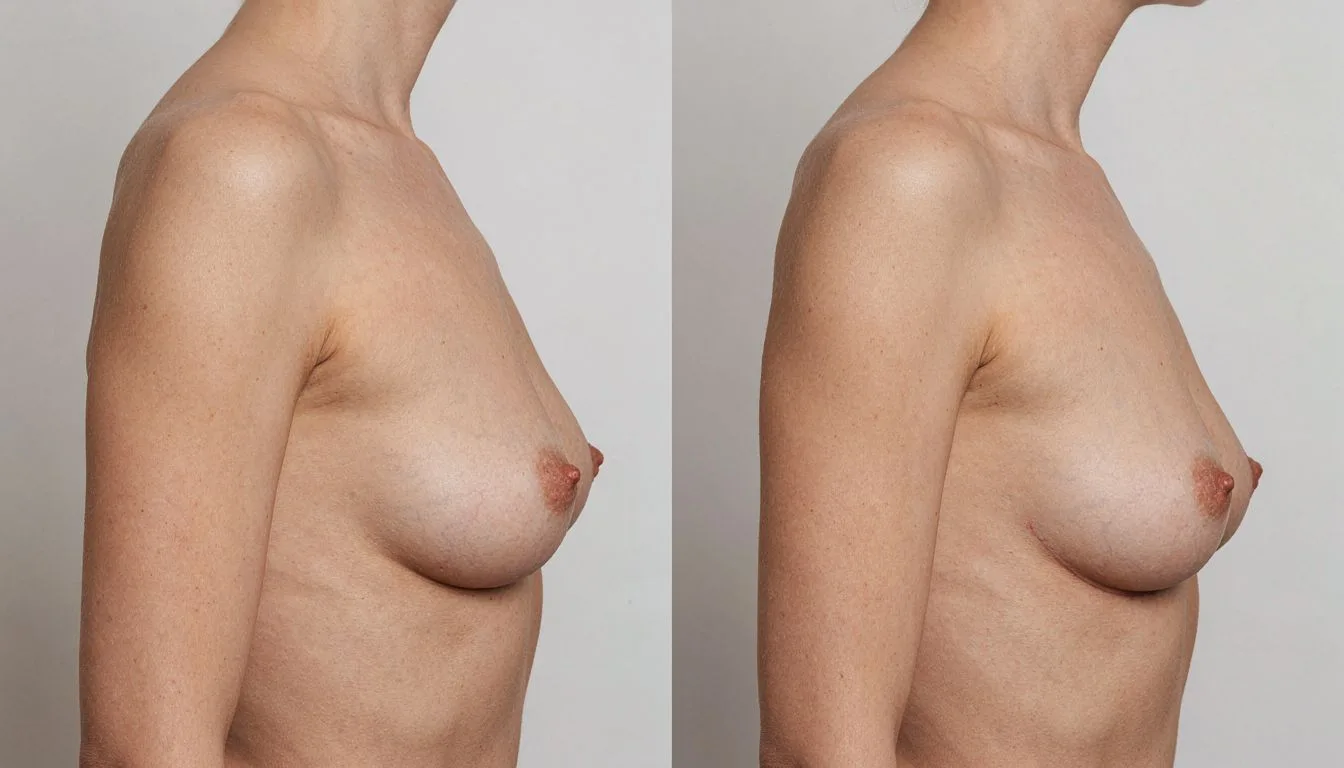
Breast shape changes more during the first twelve months than at any later point, and how each technique holds up through that settling phase is where the most visible differences appear. A vertical lift projection tends to give a rounder, slightly higher contour early on, then relaxes into a softer teardrop as gravity and tissue remodeling settle in.
The anchor approach often looks flatter right after surgery because the wider undermining allows more tissue redistribution, but the horizontal component offers a stable base that resists bottoming out over the years. With proper internal support, both methods can keep a pleasing silhouette long term, though the lollipop pattern may show mild bottoming out in very large reductions where tissue weight is substantial.
Skin quality plays a quiet role in how well each result ages. Elastic skin redrapes smoothly after a vertical reduction, while inelastic skin sometimes holds a squared-off upper pole with the anchor method because the wider resection tightens the envelope more aggressively.
FAQs
What are the main differences between vertical and anchor breast reduction techniques?
The vertical technique uses a lollipop-shaped incision around the areola and straight down to the crease, which suits moderate reductions and tends to preserve nipple sensation while creating a more rounded, lasting shape. The anchor (or inverted-T) technique adds a horizontal incision along the breast crease, giving the surgeon greater control for larger reductions and significant reshaping, but it leaves an extra scar. Recovery is similar, though the anchor approach may carry a slightly higher risk of wound-healing issues at the crease junction because of the longer incision.
Which method leaves more visible scarring after healing?
The anchor technique tends to leave more visible scarring because it uses three incision lines—one around the areola, one vertically down to the breast crease, and one running horizontally along the crease itself—creating a more noticeable anchor-shaped scar pattern. The vertical method, by eliminating the horizontal crease incision, results in only a lollipop-shaped scar, which is generally shorter and less conspicuous once fully healed. Scar appearance also depends heavily on individual healing factors like skin type, genetics, and how well post-operative care instructions are followed.
Is vertical reduction suitable for patients who need a significant size decrease?
Vertical reduction is best suited for patients who need a moderate decrease, and it can handle somewhat larger reductions, but it has practical limits. When a significant amount of tissue needs to be removed, the skin may not retract smoothly with the vertical technique alone, which can lead to a less refined shape. In those cases, an anchor pattern is often the safer and more predictable choice.