Turkey has many experienced hair transplant doctors, but the quality of care can vary widely between clinics. The key question is not simply whether a doctor operates in Turkey, but who will perform the procedure, how carefully patients are assessed, and whether the treatment plan suits their hair loss. Techniques such as FUE and DHI can produce natural-looking results when performed by a qualified medical team, yet outcomes also depend on the donor area, graft placement, hair density, and aftercare. Before choosing hair transplant doctors in Turkey, patients should review verified credentials, clinical experience, before-and-after photographs, patient feedback, and the level of medical supervision provided. This guide explains how to compare doctors and clinics, which warning signs to watch for, and what questions to ask before booking treatment.
How to Find Qualified Hair Transplant Doctors in Turkey
Finding a qualified hair restoration specialist in Turkey requires more than comparing clinic websites or package prices. Start by confirming who will personally examine you, design the graft plan, perform the critical parts of the procedure, and manage follow-up care. In some clinics, technicians carry out much of the work, so this distinction should be discussed before booking.
Review the doctor’s medical profile, surgical experience, and specific training in hair restoration. Look for verifiable registration with the relevant Turkish medical authorities, hospital or clinic affiliation, and evidence of ongoing professional education. Before-and-after photographs can be useful, but assess whether they show consistent lighting, camera angles, hair lengths, and comparable patterns of hair loss.
A reliable consultation should include an assessment of your donor area, hair-loss pattern, scalp condition, and long-term expectations. The doctor should explain whether you may need medical treatment, additional sessions, or a conservative approach to protect future hair density. Be cautious if someone promises a guaranteed result, recommends an unusually large number of grafts without examination, or avoids explaining potential risks.
Ask for a written treatment plan that identifies the surgeon, technique, estimated graft range, clinic setting, anesthesia arrangements, and aftercare process. Independent reviews may reveal communication or follow-up problems, but they should support—not replace—your own medical evaluation. A transparent consultation is one of the clearest signs that you are dealing with a properly qualified provider.
What Credentials Should a Hair Restoration Surgeon Have?

A surgeon’s credentials can reveal whether they are trained to diagnose hair loss, design a safe restoration plan, and perform the procedure personally. Look for a physician who is licensed to practise medicine in the country where the surgery takes place and who has formal training in a relevant surgical or dermatological specialty. Hair restoration requires more than familiarity with graft placement; the doctor should understand scalp anatomy, hair follicle characteristics, donor-area limitations, and the medical causes of thinning.
Membership in recognised professional organisations can provide an additional reference point, although membership alone does not prove surgical ability. Ask which board certifications, specialist registrations, and hair restoration qualifications the surgeon holds, then verify them through the relevant medical authority or professional body. It is also useful to confirm how long the doctor has performed FUE, DHI, or other proposed procedures and how frequently they carry them out.
Before choosing a clinic, establish who will perform each stage. In some facilities, technicians extract or implant grafts while the doctor provides limited supervision. A reputable consultation should clearly explain the surgeon’s role, the planned number of grafts, and who will make the incisions or place follicles in the recipient area.
Reviewing consistent, dated patient photographs can help you assess hairline design, density, donor-area management, and long-term growth. Ask whether the examples represent patients with a similar pattern of hair loss. A responsible surgeon should also discuss medical alternatives, possible complications, realistic results, and the follow-up available after you return home.
Which Hair Transplant Techniques May Suit Your Needs?

The most suitable hair restoration method depends on your hair loss pattern, donor supply, scalp condition, and expectations for density and recovery. A consultation should determine whether your follicles are strong enough for surgery and which extraction and implantation approach can protect them most effectively.
Follicular unit extraction (FUE) removes individual follicular units from the donor area before placing them in the recipient area. It may suit people who prefer short hairstyles and want to avoid a linear scar, although the procedure still requires careful planning to prevent overharvesting. The technique can also be adapted for beard or eyebrow restoration in selected cases.
- Standard FUE: This approach uses a small punch to harvest grafts individually and may be appropriate for many common patterns of male or female hair loss.
- DHI: Direct hair implantation places prepared grafts with an implanter device, allowing the surgeon to control the direction and angle of placement in suitable areas.
- FUT: Follicular unit transplantation removes a narrow strip of scalp and separates it into grafts. It can provide a substantial number of grafts but leaves a linear scar and may be less suitable for people who wear very short hair.
- Combined planning: Some patients may benefit from different methods or staged procedures when the donor area, coverage goals, or extent of thinning make one session insufficient.
The chosen technique does not determine the final result by itself. Graft quality, hairline design, recipient-site placement, existing hair preservation, and realistic expectations all influence growth. Ask the surgeon why a particular method fits your case, how many grafts are recommended, and whether ongoing hair-loss treatment may help protect untreated follicles.
How Are Clinics, Graft Plans, and Treatment Costs Compared?
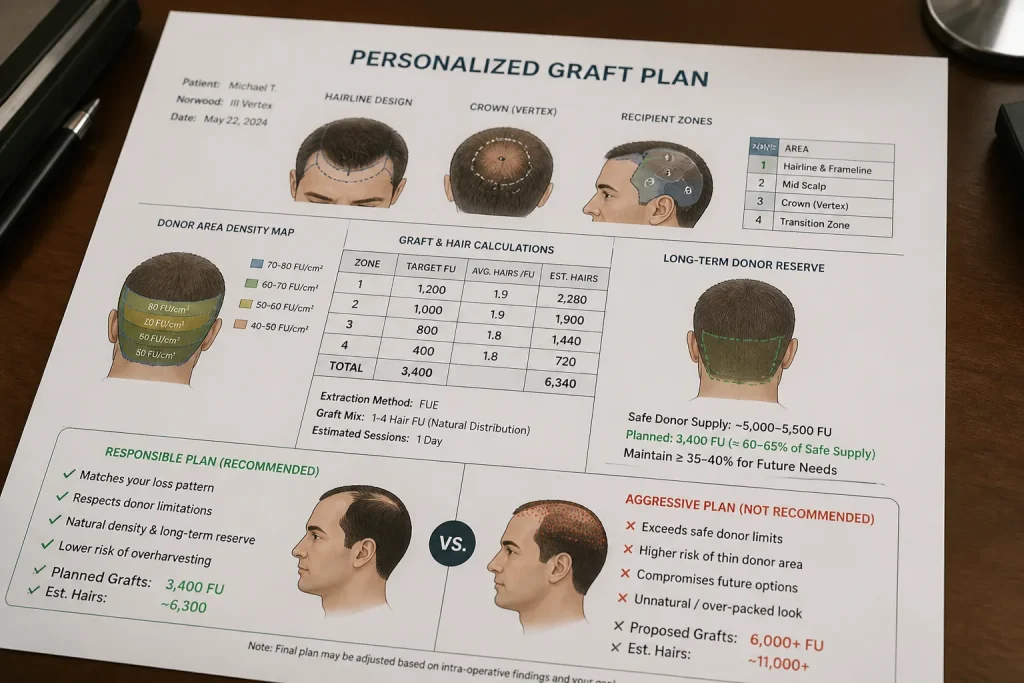
Comparing clinics requires more than looking at a package price or the number of grafts advertised. A reliable assessment connects the proposed graft plan with the patient’s hair-loss pattern, donor supply, recipient area, and long-term goals. The surgeon should explain why a specific number of grafts is recommended and whether the donor area can support future procedures if hair loss continues.
Ask whether the consultation includes a documented evaluation of the hairline, crown, hair shaft characteristics, and donor density. A responsible plan should distinguish between follicular units and individual hairs, clarify which areas will be treated, and identify the doctor performing the extraction and implantation. Extremely high graft numbers may sound attractive, but overharvesting can weaken the donor area and leave fewer options later.
Graft calculation should therefore be based on clinical assessment rather than a standard package. Compare treatment plans by the surgeon’s involvement, technique, facility standards, included aftercare, and the transparency of the quotation. Costs can vary according to the number of grafts, procedure complexity, doctor experience, accommodation, medication, and follow-up arrangements. A low price is not necessarily good value if essential medical care is excluded.
Before booking, request written details about what the fee covers, possible additional charges, cancellation terms, and who will manage complications or questions after returning home. Independent before-and-after photographs, realistic expectations, and a clear explanation of limitations are more useful than promotional claims.
What Should You Expect During Recovery and Follow-Up Care?

Recovery after a hair transplant is gradual, and your clinic should explain what is normal at each stage. Mild swelling, redness, tenderness, tightness, and small crusts may appear around the recipient area during the first few days. The donor area can also feel sensitive, particularly after FUE or DHI. Follow the clinic’s washing instructions carefully, avoid rubbing or scratching the scalp, and protect the treated areas from direct sun and unnecessary pressure.
Most patients can return to light daily activities relatively soon, but strenuous exercise, swimming, heavy lifting, alcohol, and smoking may need to be limited for a period recommended by the surgeon. Medication may be prescribed to manage discomfort or reduce the risk of infection. Contact the clinic promptly if you develop increasing pain, spreading redness, pus, fever, or unusual bleeding.
A key part of the process is postoperative follow-up. Your surgeon may review the scalp remotely or in person to assess healing, graft survival, and the condition of the donor area. Temporary shedding of transplanted hairs can occur before new growth begins, so visible improvement is usually measured over several months rather than weeks. Hair density continues to develop gradually, and the final assessment may require around 9 to 12 months, depending on individual growth.
Before treatment, ask who will monitor your recovery, how follow-up appointments are arranged after returning home, and whether you can contact the medical team if concerns arise. Clear aftercare instructions and accessible follow-up support are essential parts of choosing a clinic.
FAQs
How can I verify a Turkish hair transplant surgeon’s experience?
Check the surgeon’s medical credentials, specialist training, professional registration, and experience with FUE or DHI procedures. Request independent before-and-after photos showing comparable hair loss patterns, ask how many procedures they personally perform, and verify whether follow-up care is included. A consultation should also cover graft planning, donor-area assessment, realistic hair-growth expectations, risks, and recovery.
Is hair transplantation in Turkey safe for international patients?
Hair transplantation in Turkey can be safe for international patients when performed by a licensed surgeon at an accredited clinic with qualified medical staff. Before booking, verify the surgeon’s credentials, clinic standards, infection-control practices, realistic outcomes, and aftercare arrangements, including support after returning home. FUE and DHI are generally well-established techniques, but individual risks such as infection, scarring, poor hair growth, or overharvesting should be discussed during a medical consultation.
How long does it take to see natural hair growth after surgery?
Most people notice new hair growth about 3–4 months after a hair transplant, while visible improvement usually develops between 6 and 9 months. The final result, including increased hair density, may take 12–18 months as the transplanted follicles mature. Temporary shedding during the first few months is common, and individual recovery varies based on the procedure, grafts, and aftercare.