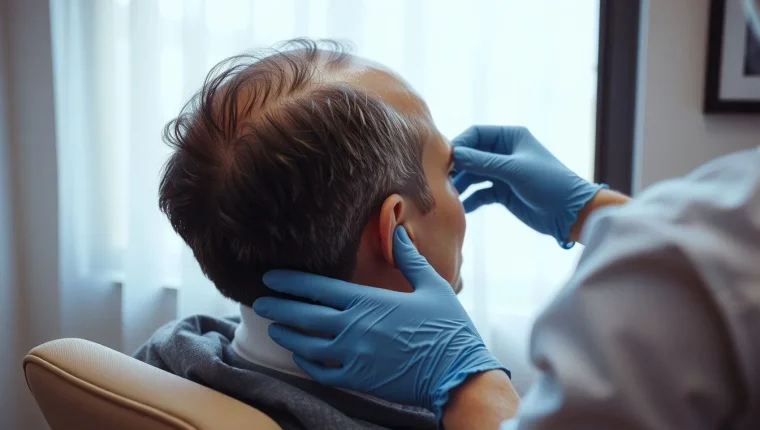
Noticing more hair than usual on your pillow, in the shower drain, or wrapped around a brush can be unsettling, especially when you are taking a medication every day. If you take Eliquis (apixaban) to prevent blood clots, you may wonder whether it is causing the shedding. The honest answer is that can Eliquis cause hair loss is a real question with a real, if limited, body of evidence behind it — but it is not a simple yes or no. Hair shedding has many triggers, and anticoagulants are only one possible contributor. To determine whether the drug is responsible, look at how these medicines affect the hair cycle, what has been reported, and what else could be causing your hair to thin.
How Blood Thinners Like Eliquis Affect Hair Growth
Hair growth depends on a steady supply of oxygen and nutrients delivered through the tiny blood vessels that feed each follicle. Because anticoagulants like Eliquis change how blood clots, it is reasonable to ask whether they also change what reaches the hair. Clotting and circulation are related but not identical processes, and the effect of a blood thinner on follicle nutrition is indirect rather than direct.
What matters for growth is the hair cycle, the repeating sequence of growth, transition, and rest that every follicle follows. A disruption that pushes more follicles into the resting phase at once tends to produce a diffuse shedding — hair thinning spread across the scalp rather than a single bald patch. This pattern is why any drug-related effect would most likely appear as generalized shedding, not patterned loss.
That distinction gives you a useful baseline: if your hair is coming out evenly across the scalp, the mechanism at work is different from the one behind receding hairlines or coin-sized bald spots.
What Clinical Trials and Case Reports Reveal About Eliquis and Hair Loss

Hair loss shows up in anticoagulant safety reporting in a fairly consistent way: as a low-frequency event that appears in post-marketing surveillance rather than as a headline finding in pivotal trials. In the major randomized studies that led to apixaban’s approval for stroke prevention and venous thromboembolism, alopecia was not a primary or secondary endpoint, and hair shedding was not systematically tracked. That means the trial data cannot confirm a link, but they also were never designed to detect one.
Case reports fill part of that gap. Published reports describe patients who began shedding weeks to months after starting apixaban, with improvement after discontinuation and, in some instances, recurrence on rechallenge. Rechallenge is the most suggestive signal available, yet a single case cannot rule out coincidence, concurrent illness, or another medication. Controlled trial data carry more weight for causality, but only when the outcome is actually measured, which is not the case here.
The honest characterization is that the evidence is sparse and inconclusive. Hair loss is a recognized but uncommon adverse event in anticoagulant reporting, supported mainly by case-level observations rather than rigorous comparative data. That does not mean the reports are wrong; it means the strength of the evidence is modest and should be weighed accordingly.
Can Eliquis Cause Hair Loss? Distinguishing Drug-Related Shedding From Other Causes
Rather than asking whether Eliquis is the culprit, a more useful question is what else could explain the shedding — and how the answers compare. Timing offers the first clue. Drug-related shedding typically begins weeks to a few months after starting or adjusting the medication, not years into treatment, and it tends to ease as the body adapts. Shedding that starts long after a stable dose, or that steadily worsens, points elsewhere.
Pattern matters too. Medication-related loss is usually diffuse — spread across the whole scalp rather than concentrated in one area. Receding temples, a widening part, or patchy bald spots suggest a different process, such as androgenetic alopecia or alopecia areata. Accompanying factors sharpen the picture further: recent illness, surgery, major stress, thyroid changes, iron deficiency, rapid weight loss, or a new medication can each trigger shedding on their own.
What complicates this is that causes overlap. A person can start Eliquis after a hospitalization and also experience the physical stress that follows — both could drive shedding at once. That overlap is exactly why self-diagnosis is unreliable, and why a clinician’s assessment, including blood work and a medication timeline, carries more weight than any single clue on its own.
Telogen Effluvium and Anticoagulant Use: Understanding the Biological Mechanism
Telogen effluvium is the medical term for a diffuse shedding pattern that occurs when a large number of hair follicles shift prematurely out of the growing phase and into the resting phase. This shift is not random; it is a stress response. Physical illness, surgery, major blood loss, significant weight change, and certain medications can all push follicles into this resting state. Once the trigger occurs, the follicles remain in telogen for roughly two to three months before the hair is released and shedding becomes noticeable.
Anticoagulant therapy and the condition being treated can both act as that kind of stressor. A clot, a hospitalization, or the physiological burden of an underlying cardiovascular problem is itself a substantial stress on the body. Eliquis may add to this picture, but the point is that the trigger is often a combination of factors rather than the drug acting alone.
This explains the delayed onset that puzzles many people: shedding typically begins weeks to months after the trigger, not immediately. It also explains the recovery pattern. Once the stressor resolves, follicles gradually re-enter the growing phase, and shedding usually subsides over several months. The key concept here is telogen effluvium, a temporary shift in the hair cycle rather than permanent follicle damage.
Managing Hair Loss While on Eliquis: When to Talk to Your Doctor

If you are taking Eliquis and noticing more shedding, the most important step is also the simplest: do not stop the medication on your own. Eliquis reduces the risk of clots that can cause stroke or pulmonary embolism, and that protection matters more than a cosmetic concern. Instead, bring the hair loss to your prescriber as a side effect worth discussing.
Before your appointment, document what you are seeing. Note when the shedding started, roughly how much hair you lose daily, and whether you have noticed thinning at the part or temples. A clinician can then judge whether this looks like telogen effluvium or something unrelated, and whether any blood work is warranted.
Ask directly: could Eliquis be contributing, and if so, what are the options? Some patients discuss switching anticoagulants, adjusting monitoring, or simply tracking the shedding to see if it settles. Expect a timeline of months, not days, since hair regrowth follows the cycle slowly.
FAQs
Can Eliquis cause hair loss as a side effect?
Eliquis (apixaban) is not officially listed as a common cause of hair loss, but some patients have reported thinning or shedding while taking it. This effect is considered rare and is not firmly established in clinical trials, so a direct causal link remains uncertain. If you notice significant hair loss after starting Eliquis, talk to your doctor rather than stopping the medication on your own.
Is hair loss from Eliquis usually temporary or permanent?
Hair loss linked to Eliquis is generally reported as temporary, with many cases improving after the medication is stopped or the underlying trigger resolves. However, because Eliquis is often continued long-term and hair cycles are slow, shedding may persist for months while the drug is taken. Permanent hair loss is not a recognized typical effect of Eliquis, but individual outcomes vary and should be discussed with a doctor before making any changes to the medication.
Should I stop taking Eliquis if I notice hair loss?
You should never stop taking Eliquis on your own because of hair loss, since abruptly discontinuing the medication can raise your risk of serious blood clots, stroke, or other cardiovascular events. Hair loss is not a confirmed common side effect of Eliquis, and in most cases it is more likely linked to other causes such as stress, illness, or other medications. Talk to your doctor about the hair loss so they can evaluate possible causes and, if needed, adjust your treatment safely under medical supervision.