A recent dental crown quote can be a shock. That is why many international patients compare dental crowns Turkey vs Canada cost before committing. The question is how far apart these markets are and what causes the difference. This article covers crown prices and the factors shaping the final bill in each country. It is not clinical advice, and every figure you will see is a market range, not a fixed quote. By the end, you will know how to compare Turkey and Canada quotes fairly.
What Dental Crowns Typically Cost in Turkey

If you are trying to judge whether a Turkish clinic quote is reasonable, the first thing to understand is that there is no single national price. Turkey’s crown market is broad, and published ranges usually reflect fees in Turkish lira at a given point in time, so older figures can look misleading once exchange rates and local inflation move. As a working baseline, many international-facing clinics charge somewhere between roughly $100 and $250 per crown, while higher-tier practices in Istanbul, Antalya, and Izmir often sit above that band.
The gap inside Turkey comes down to clinic tier and location. Large city centers with English-speaking coordinators, digital scanning equipment, and in-house labs tend to charge more than smaller regional centers, where overheads are lower. Case complexity matters too: a straightforward single crown on a healthy tooth is priced differently from one that needs a post, core build-up, or bite correction.
One detail worth checking early is whether the quoted figure already bundles laboratory work and follow-up visits, or whether those appear later as separate line items. That single question often explains why two Turkish quotes for the same tooth can differ by hundreds of dollars.
What Dental Crowns Typically Cost in Canada
In Canada, a single crown generally lands somewhere between $800 and $2,000 per tooth before any insurance is applied. That range is wide because the country doesn’t have one national price — fees are shaped by provincial dental association fee guides, which set suggested minimums that clinics use as a reference point rather than a fixed rate. A crown in Ontario or British Columbia typically sits at the higher end, while some Prairie and Atlantic practices quote closer to the lower figure.
The headline number also rarely tells the whole story. Laboratory fees are sometimes billed separately from the dentist’s clinical fee, and if a root canal or specialist referral is needed first, those costs sit outside the crown quote entirely. This is why two patients with the “same” crown can end up paying very different totals.
Insurance changes the picture further. Many Canadian plans cover only a portion of major restorative work — often around 50 percent — and annual maximums can be reached quickly. For patients without coverage, the full fee comes straight out of pocket, which is exactly the gap that makes cross-border comparisons worth examining.
Key Factors Driving the Price Gap Between the Two Countries
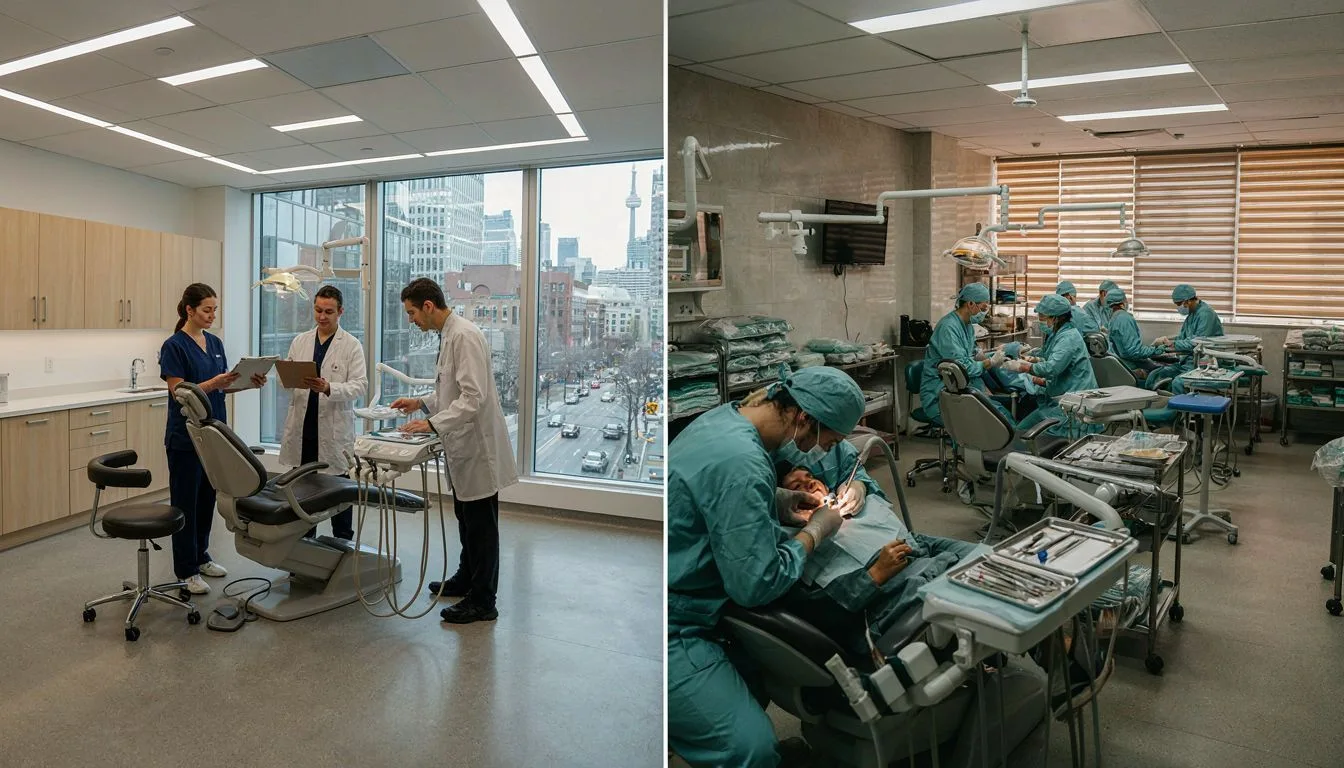
The gap between a crown fee in Turkey and one in Canada is not the result of a single discount or a single markup. It comes from how each market is built. In Canada, a dental practice carries high fixed costs: licensed dentists and registered hygienists earn professional wages that reflect years of regulated training, commercial rent in cities like Toronto or Vancouver is expensive, and clinics absorb liability insurance, sterilization standards, and equipment financing that all feed into every procedure. Those overheads sit in the fee whether the crown takes forty minutes or two visits.
Turkey’s cost base looks different. Operating overhead is lower across the board — rent, staffing, utilities, and equipment maintenance all cost less in lira terms, and many clinics run higher patient volumes that spread fixed costs across more chairs. Currency movement also plays a role: when the lira weakens against the dollar or euro, services priced for international patients become cheaper in foreign currency without the clinic cutting its local margins.
Tax and regulatory layers add another spread. Canada’s provincial fee guides, licensing requirements, and sales tax structures push final prices up, while Turkey’s private dental sector faces a lighter compliance load and less price guidance. Supply chains diverge too — Canadian labs often charge more for the same zirconia or porcelain work, and some Turkish clinics outsource to domestic labs at a fraction of that rate.
Finally, competition shapes the ceiling. Turkey has a dense private dental market competing for both local and medical-tourism patients, which keeps headline prices sharp. Canada has fewer providers per capita and less incentive to discount, so fees stay anchored near the top of the guide.
How Material Choice Affects Crown Pricing in Each Market
Material choice is where the two markets start to behave differently, because the same crown type can carry a very different price tag depending on where it is made and how it is sourced. In Turkey, a zirconia crown — the most requested option for back teeth — typically sits at the top of the local range but still lands far below Canadian pricing, while metal-ceramic and full metal crowns stay cheaper still. In Canada, the spread between a base metal crown and a high-grade zirconia or e.max crown can stretch several hundred dollars, since premium materials carry higher lab fees, import costs, and specialist technician time.
What matters more is how the gap behaves as you move up the material ladder. For basic metal and metal-ceramic crowns, the Turkey-versus-Canada difference is wide but relatively stable. For premium ceramics, the gap often widens in absolute dollars because Canadian labs price advanced materials and CAD/CAM work at a steeper premium, while Turkish labs often have in-house milling and closer access to regional material suppliers. That means the savings do not shrink for better materials — they frequently grow.
Material choice also shapes longevity, and therefore replacement cost. A cheaper crown that fails early can erase the initial saving, so it is worth weighing material quality alongside the headline price rather than treating the lowest quote as the best one.
What Is Included in a Crown Quote in Turkey Versus Canada
A crown quote in Turkey usually bundles more of the clinical episode into one figure. The published price typically covers the crown itself, the laboratory fabrication, local anesthesia, and the fitting appointment. Many Turkish clinics also fold in a temporary crown and one follow-up check before you fly home. What often sits outside the quote is imaging — panoramic X-rays or a CBCT scan — and any treatment needed before the crown, such as a root canal or extraction. Consultation is frequently free or absorbed into the package.
In Canada, quotes are more itemized and more likely to separate every service. The crown fee itself may exclude the initial exam, diagnostic radiographs, a core build-up, and the temporary crown, each billed separately. Diagnostic imaging is almost never included and can add several hundred dollars before work begins. Follow-up visits after cementation are usually covered within a short window, but longer-term adjustments may be charged again.
Warranty terms differ too. Turkish clinics often advertise multi-year guarantees on the crown, though enforcing them from abroad is impractical. Canadian dentists typically offer a one-year warranty tied to continued care in the same practice. Reading both quotes means checking what is missing, not just the headline number.
How Travel and Accommodation Costs Shift the Total for Turkey
Once you look past the crown fee itself, Turkey’s price advantage narrows, and the honest way to judge it is on the all-in trip cost rather than a per-tooth figure. Flights are the biggest single variable, swinging widely by season, departure city, and how far in advance you book. Accommodation follows the same logic: a few nights near the clinic in Istanbul or Antalya costs far less than a week in a resort area, and clinics in dental tourism hubs often sit close to mid-range hotels.
Local transport is modest but real—airport transfers, taxis, and daily rides between hotel and clinic add up over a stay. Trip length matters most. A single crown can often be completed in one visit of roughly five to seven days, while multiple crowns or staged work may require two trips or a longer stay, doubling the flight and hotel line.
Some clinics bundle airport transfers or a few nights’ accommodation into treatment packages, which can pull the total down and simplify planning; others quote the crown alone. Comparing against staying in Canada, the break-even shifts with the number of crowns: the more work you have done, the more easily travel costs are absorbed, whereas a single crown may leave a thinner margin once flights and lodging are counted.
How to Compare Overall Value When Choosing Between Turkey and Canada
Comparing overall value comes down to one question: what does each option actually cost you in money, time, and risk once everything is counted? A useful way to frame this is a total-cost-of-ownership comparison, where the crown fee is only the first line item. Start by listing the crown fee itself, then add travel and accommodation for Turkey or the equivalent logistics costs at home, days off work, the cost of any follow-up visits, and a realistic allowance for a possible revision or replacement. In Canada, those follow-up visits are usually a short drive away; in Turkey, a revision may mean another flight, which can quietly erase part of the savings.
Next, weigh the non-price factors. Ask how easily you can reach the clinic if something feels wrong weeks later, whether the warranty is written and enforceable from abroad, how communication works across time zones, and how quickly you can get an appointment. These matter most for complex cases: multiple crowns, bite changes, or a history of dental problems. For a single straightforward crown on a healthy tooth, the savings from Turkey are often clear even after flights and hotels. For a full-mouth reconstruction or a case needing several adjustment visits, the gap can shrink or disappear once repeat travel is priced in.
To compare fairly, request written quotes from clinics in both countries using the same inputs: crown material, number of units, whether diagnostic imaging and laboratory work are included, and what the warranty covers. Ask each clinic to state in writing what happens if the crown needs adjustment or replacement, and who pays for what. With identical specifications side by side, the cheaper headline price stops being the deciding factor and the real value becomes visible.
FAQs
How much do dental crowns cost in Turkey compared to Canada?
Dental crowns in Turkey typically cost between $150 and $400 per tooth depending on the material, while the same treatment in Canada generally ranges from $800 to $2,000 or more. This means patients can often save 60 to 80 percent by choosing Turkey, even after factoring in flights and accommodation. The price gap mainly reflects lower labor and overhead costs in Turkey rather than a difference in the crown materials themselves.
Does the price difference between dental crowns in Turkey and Canada affect quality or materials?
The price difference mainly reflects lower labor costs, clinic overheads, and exchange rates in Turkey rather than inferior materials, and many Turkish clinics use the same internationally certified brands (such as Ivoclar, VITA, or 3M) found in Canada. Quality varies widely between providers, so the deciding factor is the individual clinic's standards, certifications, and dentist's skill rather than the country or price alone. Patients should verify material brands, laboratory credentials, and warranty terms before treatment.
What additional expenses should I budget for when getting dental crowns in Turkey versus Canada?
In Turkey, budget for flights, accommodation, airport transfers, and possibly a translator or companion's travel costs, since these are rarely bundled into the crown price. You may also pay separately for X-rays, temporary crowns, or follow-up visits if they are not included in the quoted fee. In Canada, the crown fee itself usually covers most in-office work, but you should still budget for initial consultation, X-rays, potential root canal treatment if needed, and any lab or sedation fees not covered by provincial insurance. In both countries, unexpected extractions, bone grafting, or replacement of a failed crown can add significant out-of-pocket costs.