Nose surgery in Turkey and Istanbul is often researched by people seeking changes to nasal shape, breathing, or both. However, choosing a destination is only one part of the decision. Rhinoplasty is individualized, and suitable techniques, expected results, recovery time, and risks depend on your anatomy, health, and goals. This guide explains the key points to consider before making plans, including candidacy, surgical approaches, the patient journey, and how to assess providers. It helps you ask better questions and compare options realistically rather than focus only on location or advertised cost.
Why Choose Nose Surgery Turkey for Rhinoplasty?

Istanbul attracts many international rhinoplasty patients because it combines major transport links, established private healthcare services, and experience in treating visitors from abroad. For some people, this can make consultations and treatment easier to coordinate than travelling to a smaller destination. English-speaking patient coordinators, airport access, and accommodation options may also simplify practical planning.
These conveniences should not be mistaken for proof of medical quality. A destination’s popularity does not establish the skills of a particular surgeon or the standards of an individual clinic. Patients should independently verify the surgeon’s qualifications, specialist registration, rhinoplasty experience, hospital or facility accreditation, and the arrangements for anaesthesia and emergency care.
Communication deserves equal attention. Before booking, confirm who will conduct the medical consultation, whether the surgeon reviews your health history directly, and how questions can be answered before and after surgery. Ask how continuity of care is managed if you return home soon after treatment, including access to medical records and support for concerns that arise abroad.
Continuity of care is therefore a central factor when assessing nose surgery in Turkey. Compare the quality of clinical planning and follow-up—not just convenience, tourism appeal, or a package price—and make sure the proposed arrangement suits your medical needs and travel circumstances.
Who Is a Suitable Candidate for Rhinoplasty in Istanbul?
Suitable rhinoplasty candidates in Istanbul are usually adults who want to address a specific concern about nasal appearance, breathing, or both. Common reasons include an uneven profile, a crooked nose, nasal asymmetry, an old injury, or persistent obstruction. The decision should be based on a personal goal rather than pressure from family, social media, or unrealistic beauty standards.
A surgeon will review your general health, previous operations, allergies, medications, and any breathing problems before deciding whether surgery is appropriate. Nasal skin thickness, cartilage strength, facial proportions, and the condition of the internal nasal passages also influence the assessment. Younger patients may need to wait until facial growth is substantially complete, while older adults may require closer consideration of skin elasticity, healing capacity, and existing medical conditions.
The most important suitability factor is realistic expectations. Rhinoplasty can improve balance and function, but it cannot guarantee a mathematically perfect nose or resolve every breathing issue. Smokers, people with uncontrolled health conditions, or those unable to follow recovery instructions may need medical preparation or postponement.
Online photos cannot confirm candidacy. An in-person examination is needed to assess the septum, turbinates, airway, skin, and facial structure, and to discuss whether the desired change is medically achievable. Ask the surgeon how your goals relate to your anatomy, what limitations may apply, and how risks and informed consent will be handled.
Which Rhinoplasty Techniques Are Available?

Rhinoplasty can be performed through different surgical approaches, and the choice depends on the patient’s nasal anatomy, breathing needs, aesthetic goals, and whether previous surgery has altered the structure. Understanding the terminology can make a consultation easier, but it should not be used to select a procedure independently.
Open rhinoplasty involves a small incision across the columella, allowing the surgeon to lift the skin and directly view the underlying framework. This access can be useful for complex reshaping, significant structural changes, or revision rhinoplasty. Closed rhinoplasty uses incisions inside the nostrils, leaving no external columellar scar and often suiting selected cases requiring more limited adjustments.
Some patients need structural rhinoplasty to support the nasal bridge, tip, or airway, while others primarily seek cosmetic refinement. Septoplasty may be considered when a deviated septum contributes to impaired breathing. Grafting with cartilage from the septum, ear, or another appropriate source may also be clinically indicated to reinforce or reshape the nose.
Revision rhinoplasty can be more technically demanding because scar tissue, weakened cartilage, or altered anatomy may be present after earlier surgery. During examination, the surgeon assesses the internal and external nose, discusses the desired changes, and determines which approach and supporting techniques are appropriate for that individual.
What Happens Before, During, and After the Procedure?

The patient journey begins with a consultation, usually supported by a physical examination, medical history review, and discussion of breathing concerns, facial balance, and desired changes. The surgeon may assess the nasal structure from several angles and use photographs or imaging to support the plan. Patients should disclose previous operations, allergies, medications, smoking, and any health conditions that could affect healing.
Before surgery, the team should explain the proposed approach, expected limitations, possible risks, anaesthesia arrangements, and aftercare requirements. Written consent is completed only after the patient has had an opportunity to ask questions and understands that the final appearance cannot be guaranteed. Instructions may include medication adjustments, fasting, avoiding nicotine, and arranging transport and accommodation.
On the procedure day, the patient is prepared for anaesthesia and the surgical team carries out the agreed plan. The exact steps and duration vary according to anatomy and surgical objectives, so there is no universal protocol. Afterward, monitoring continues until the patient is sufficiently alert and stable to leave the clinic or hospital with an accompanying adult.
Early recovery commonly involves nasal congestion, bruising, swelling, pressure, and temporary difficulty breathing through the nose. A splint or internal supports may be used, depending on the surgeon’s preference. Postoperative follow-up is essential for checking healing, removing dressings or supports when appropriate, and identifying concerns promptly. Strenuous exercise, contact sports, heavy lifting, and pressure on the nose are usually restricted for a period specified by the surgeon.
International patients should allow enough time in Istanbul for the initial review and any planned follow-up before flying home. Healing continues for months, and swelling may change unevenly during this period. Before travel, confirm who will answer questions after departure, how urgent concerns will be handled, and whether remote reviews or additional in-person appointments are available.
How Should You Compare Clinics, Surgeons, and Treatment Packages?
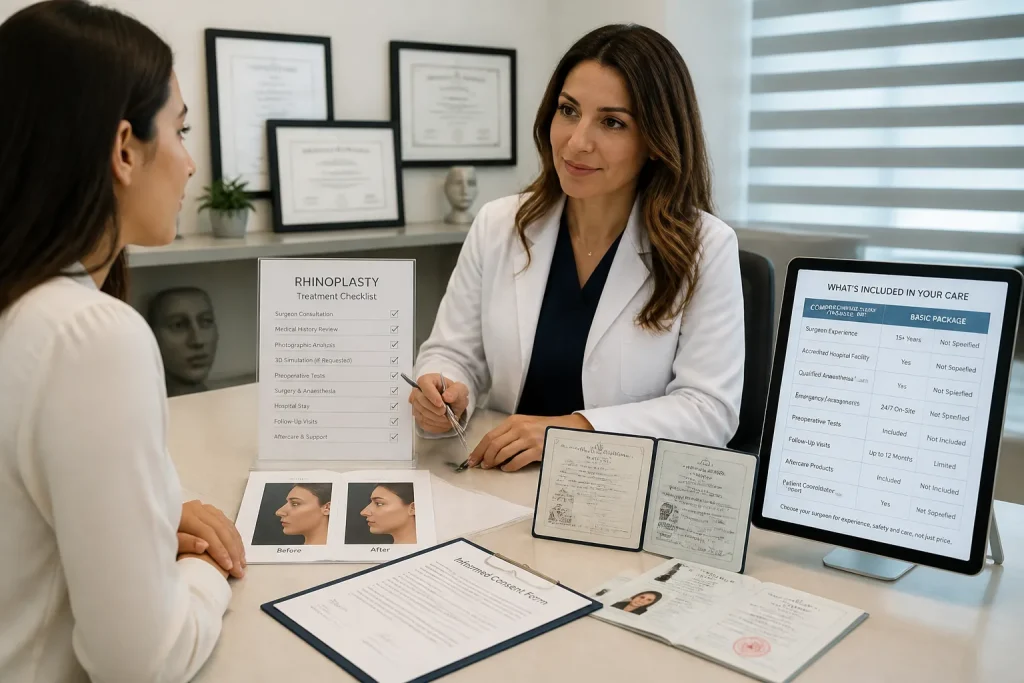
Comparing rhinoplasty providers requires more than checking a clinic’s advertised price. The safest choice is based on verifiable qualifications, appropriate facilities, clear communication, and realistic arrangements for care before and after surgery. When reviewing clinics, surgeons, and treatment packages, consider not only the headline offer but also the quality, safety, and transparency of the complete treatment pathway.
- Surgeon credentials: Confirm the surgeon’s specialist training, registration, rhinoplasty experience, and familiarity with cases similar to yours. Review before-and-after photographs critically, without assuming they predict your result.
- Facility and anaesthesia: Verify that surgery takes place in an accredited hospital or licensed surgical facility, with qualified anaesthesia staff and appropriate emergency arrangements.
- Consultation and consent: A proper consultation should cover your goals, examination findings, possible risks, limitations, and alternatives before you make a decision.
- Package details: Ask exactly what the quoted treatment includes, such as hospital fees, tests, medication, transfers, accommodation, and any additional charges. Check how unexpected care or revision surgery is handled.
- Continuity of care: Establish who will answer questions after you return home, how follow-up is organised, and which documents your local doctor may need.
These points are especially important when comparing providers remotely or arranging treatment abroad. A low price may not represent better value if essential services, follow-up support, or provisions for complications are excluded. Take time to compare written information from each provider, clarify any differences, and ensure that the proposed plan matches your medical needs and personal expectations.
Be cautious if a provider pressures you to book quickly, avoids specific answers, or presents a package as risk-free. Written documentation, transparent communication, and an opportunity to speak directly with the surgeon provide a stronger basis for comparing clinics in Turkey or Istanbul than promotional claims alone.
FAQs
How much does rhinoplasty in Turkey cost?
Rhinoplasty in Turkey typically costs between $2,500 and $5,000, depending on the surgeon’s experience, the procedure’s complexity, the clinic, and whether it is a primary or revision operation. Packages may include consultation, anesthesia, hospital fees, medication, accommodation, and transfers, but inclusions vary. Request a detailed quote and confirm what is covered before booking.
How long does recovery take after nose surgery?
Most people can return to light daily activities within one to two weeks after nose surgery, although swelling and bruising may take several weeks to improve. The nose may continue settling and changing shape for up to a year, especially after rhinoplasty. Your surgeon will provide personalized recovery guidance based on the procedure and your healing progress.
Can I combine rhinoplasty with other procedures in Istanbul?
Yes, rhinoplasty can often be combined with procedures such as chin augmentation, eyelid surgery, or facial liposuction in Istanbul, depending on your health and treatment goals. A qualified plastic surgeon will assess your medical history, surgical risk, anesthesia time, and recovery needs before recommending a safe combination. Combining procedures may reduce the number of operations, but it can also involve a longer recovery and should be carefully planned.